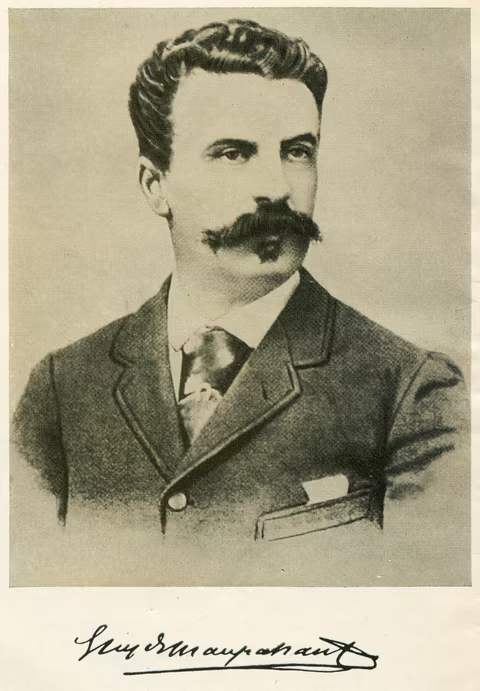
Quick Facts
Henri René Albert Guy de Maupassant
Pen Name: Guy de Maupassant
Born: Aug 5, 1850
Died: Jul 6, 1893
Nationality: French
Genres: Realism, Naturalism
Notable Works: The Necklace, Bel-Ami, Boule de Suif, The Horla, A Piece of String
👶 Early Life and Education
Henri René Albert Guy de Maupassant was born on August 5, 1850, near Dieppe in Normandy, France. His parents, Laure Le Poittevin and Gustave de Maupassant, came from prosperous bourgeois families. When Maupassant was eleven, his mother—an independent-minded woman—obtained a legal separation from his father and kept custody of Guy and his younger brother Hervé. The Norman countryside of his childhood would later provide the vivid settings for many of his most celebrated stories.
Maupassant studied law in Paris before the outbreak of the Franco-Prussian War in 1870, during which he served as a soldier. He drew heavily on that experience, and the war provides the setting for many of his stories, which often depict the tragedy and suffering of innocent civilians caught in war's path.
📖 Literary Career and Flaubert's Mentorship
Maupassant's literary education came through his apprenticeship to Gustave Flaubert, who had been a childhood friend of his mother. Every Sunday, Flaubert invited the young writer to his home, lectured him on prose style, and corrected his literary exercises. Flaubert insisted on the necessity of finding le mot juste—the precise word—and demanded meticulous observation of the world. Through Flaubert, Maupassant met the leading writers of the age, including Émile Zola, Ivan Turgenev, and Henry James.
Maupassant's breakthrough came in 1880 with Boule de Suif, published in the anthology Les Soirées de Médan. The story is a withering criticism of French society in the late 19th century. Maupassant takes representatives from the different classes and stations of French society and places them all in the same carriage, which is driven behind enemy lines during the Franco-Prussian War. In time, the true character of each participant is revealed as Maupassant passes scathing judgment upon his fellow countrymen. Flaubert declared it a masterpiece, and virtually overnight, Maupassant became one of the most popular writers in France.
Over the next decade, he produced an astonishing body of work: roughly 300 short stories, six novels, three travel books, and a volume of verse. He also found inspiration in the not-so-admirable behavior of the bourgeoisie, and made them targets of his biting pessimism and skewering pen. His prolific and deeply admired work influenced a great number of writers, including W. Somerset Maugham, O. Henry, Anton Chekhov, Kate Chopin, and Leo Tolstoy.
🌿 Writing Style
Maupassant is regarded as one of the greatest short story writers in any language. His prose is characterized by economy of style, clarity, and efficient, seemingly effortless dénouements—often featuring ironic twist endings that influenced generations of writers. Writing in the naturalist tradition, he depicted the lives of peasants, soldiers, prostitutes, and the bourgeoisie with equal precision and unsentimental honesty. His stories are compact and tightly plotted, rarely wasting a word.
✒️ Notable Works
His most famous work for English readers is The Necklace, a masterpiece of ironic storytelling. Other essential stories include The Piece of String, Mademoiselle Fifi, Two Friends, My Uncle Jules, The Horla, and A Dead Woman's Secret. If you have the stomach for it, you might try his truly terrifying piece of Gothic fiction, The Hand.
Maupassant also wrote six novels. Bel-Ami (1885), a savage portrait of a ruthless social climber in Parisian journalism, is his best-known novel. Pierre and Jean (1888), his shortest novel, is often acclaimed as his greatest. His other novels include A Woman's Life (1883), Mont Oriol (1887), Strong as Death (1889), and Notre Cœur (1890).
❤️ Personal Life
Maupassant never married, but he had many love affairs. With Joséphine Litzelmann, he fathered three children. He was known for his love of boating on the Seine and along the Normandy coast, and for his vigorous physical lifestyle in his younger years.
✨ Death and Legacy
In his early twenties, Maupassant contracted syphilis, and he adamantly refused treatment. The disease progressed into neurosyphilis, casting a deepening shadow over his mature years. He suffered from hallucinations, paranoia, and a growing obsession with death—experiences that found their way into psychological horror stories like The Horla and The Diary of a Madman. On January 2, 1892, he attempted to take his own life by cutting his throat. He was committed to the private asylum of Dr. Esprit Blanche at Passy in Paris, where he died on July 6, 1893, at the age of forty-two.
Today, Maupassant is considered one of the fathers of the modern short story and one of its finest practitioners. His influence extends across world literature, and his stories remain widely read and taught in classrooms around the globe.
Frequently Asked Questions about Guy de Maupassant
Where can I find study guides for Guy de Maupassant's stories?
We offer free interactive study guides for the following Guy de Maupassant stories:
- A Dead Woman's Secret — comprehension questions, vocabulary review, and discussion prompts
- Boule de Suif — comprehension questions, vocabulary review, and discussion prompts
- The Horla — comprehension questions, vocabulary review, and discussion prompts
- The Necklace — comprehension questions, vocabulary review, and discussion prompts
- Two Friends — comprehension questions, vocabulary review, and discussion prompts