Killed at Resaca
by Ambrose Bierce
Killed at Resaca (1877) examines a Union officer whose reckless bravery under fire puzzles his comrades — until a discovered letter reveals the devastating motive behind his suicidal courage. "The best soldier of our staff was Lieutenant Herman Brayle, one of the two aides-de-camp."
The best soldier of our staff was Lieutenant Herman Brayle, one of the two aides-de-camp. I don't remember where the general picked him up; from some Ohio regiment, I think; none of us had previously known him, and it would have been strange if we had, for no two of us came from the same State, nor even from adjoining States. The general seemed to think that a position on his staff was a distinction that should be so judiciously conferred as not to beget any sectional jealousies and imperil the integrity of that part of the country which was still an integer. He would not even choose officers from his own command, but by some jugglery at department headquarters obtained them from other brigades. Under such circumstances, a man's services had to be very distinguished indeed to be heard of by his family and the friends of his youth; and "the speaking trump of fame" was a trifle hoarse from loquacity, anyhow.
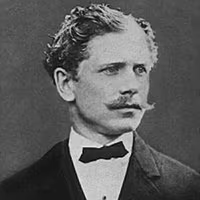
Lieutenant Brayle was more than six feet in height and of splendid proportions, with the light hair and gray-blue eyes which men so gifted usually find associated with a high order of courage. As he was commonly in full uniform, especially in action, when most officers are content to be less flamboyantly attired, he was a very striking and conspicuous figure. As to the rest, he had a gentleman's manners, a scholar's head, and a lion's heart. His age was about thirty.
We all soon came to like Brayle as much as we admired him, and it was with sincere concern that in the engagement at Stone's River--our first action after he joined us--we observed that he had one most objectionable and unsoldierly quality: he was vain of his courage. During all the vicissitudes and mutations of that hideous encounter, whether our troops were fighting in the open cotton fields, in the cedar thickets, or behind the railway embankment, he did not once take cover, except when sternly commanded to do so by the general, who usually had other things to think of than the lives of his staff officers--or those of his men, for that matter.
In every later engagement while Brayle was with us it was the same way. He would sit his horse like an equestrian statue, in a storm of bullets and grape, in the most exposed places--wherever, in fact, duty, requiring him to go, permitted him to remain--when, without trouble and with distinct advantage to his reputation for common sense, he might have been in such security as is possible on a battlefield in the brief intervals of personal inaction.
On foot, from necessity or in deference to his dismounted commander or associates, his conduct was the same. He would stand like a rock in the open when officers and men alike had taken to cover; while men older in service and years, higher in rank and of unquestionable intrepidity, were loyally preserving behind the crest of a hill lives infinitely precious to their country, this fellow would stand, equally idle, on the ridge, facing in the direction of the sharpest fire.
When battles are going on in open ground it frequently occurs that the opposing lines, confronting each other within a stone's throw for hours, hug the earth as closely as if they loved it. The line officers in their proper places flatten themselves no less, and the field officers, their horses all killed or sent to the rear, crouch beneath the infernal canopy of hissing lead and screaming iron without a thought of personal dignity.
In such circumstances the life of a staff officer of a brigade is distinctly "not a happy one," mainly because of its precarious tenure and the unnerving alternations of emotion to which he is exposed. From a position of that comparative security from which a civilian would ascribe his escape to a "miracle," he may be despatched with an order to some commander of a prone regiment in the front line--a person for the moment inconspicuous and not always easy to find without a deal of search among men somewhat preoccupied, and in a din in which question and answer alike must be imparted in the sign language. It is customary in such cases to duck the head and scuttle away on a keen run, an object of lively interest to some thousands of admiring marksmen. In returning --well, it is not customary to return.
Brayle's practice was different. He would consign his horse to the care of an orderly,--he loved his horse,--and walk quietly away on his perilous errand with never a stoop of the back, his splendid figure, accentuated by his uniform, holding the eye with a strange fascination. We watched him with suspended breath, our hearts in our mouths. On one occasion of this kind, indeed, one of our number, an impetuous stammerer, was so possessed by his emotion that he shouted at me:
"I'll b-b-bet you t-two d-d-dollars they d-drop him b-b-before he g-gets to that d-d-ditch!"
I did not accept the brutal wager; I thought they would.
Let me do justice to a brave man's memory; in all these needless exposures of life there was no visible bravado nor subsequent narration. In the few instances when some of us had ventured to remonstrate, Brayle had smiled pleasantly and made some light reply, which, however, had not encouraged a further pursuit of the subject. Once he said:
"Captain, if ever I come to grief by forgetting your advice, I hope my last moments will be cheered by the sound of your beloved voice breathing into my ear the blessed words, 'I told you so.'"
We laughed at the captain--just why we could probably not have explained--and that afternoon when he was shot to rags from an ambuscade Brayle remained by the body for some time, adjusting the limbs with needless care--there in the middle of a road swept by gusts of grape and canister! It is easy to condemn this kind of thing, and not very difficult to refrain from imitation, but it is impossible not to respect, and Brayle was liked none the less for the weakness which had so heroic an expression. We wished he were not a fool, but he went on that way to the end, sometimes hard hit, but always returning to duty about as good as new.
Of course, it came at last; he who ignores the law of probabilities challenges an adversary that is seldom beaten. It was at Resaca, in Georgia, during the movement that resulted in the taking of Atlanta. In front of our brigade the enemy's line of earthworks ran through open fields along a slight crest. At each end of this open ground we were close up to him in the woods, but the clear ground we could not hope to occupy until night, when darkness would enable us to burrow like moles and throw up earth. At this point our line was a quarter-mile away in the edge of a wood. Roughly, we formed a semicircle, the enemy's fortified line being the chord of the arc.
"Lieutenant, go tell Colonel Ward to work up as close as he can get cover, and not to waste much ammunition in unnecessary firing. You may leave your horse."
When the general gave this direction we were in the fringe of the forest, near the right extremity of the arc. Colonel Ward was at the left. The suggestion to leave the horse obviously enough meant that Brayle was to take the longer line, through the woods and among the men. Indeed, the suggestion was needless; to go by the short route meant absolutely certain failure to deliver the message. Before anybody could interpose, Brayle had cantered lightly into the field and the enemy's works were in crackling conflagration.
"Stop that damned fool!" shouted the general.
A private of the escort, with more ambition than brains, spurred forward to obey, and within ten yards left himself and his horse dead on the field of honor.
Brayle was beyond recall, galloping easily along, parallel to the enemy and less than two hundred yards distant. He was a picture to see! His hat had been blown or shot from his head, and his long, blond hair rose and fell with the motion of his horse. He sat erect in the saddle, holding the reins lightly in his left hand, his right hanging carelessly at his side. An occasional glimpse of his handsome profile as he turned his head one way or the other proved that the interest which he took in what was going on was natural and without affectation.
The picture was intensely dramatic, but in no degree theatrical. Successive scores of rifles spat at him viciously as he came within range, and our own line in the edge of the timber broke out in visible and audible defense. No longer regardful of themselves or their orders, our fellows sprang to their feet, and swarming into the open sent broad sheets of bullets against the blazing crest of the offending works, which poured an answering fire into their unprotected groups with deadly effect. The artillery on both sides joined the battle, punctuating the rattle and roar with deep, earth-shaking explosions and tearing the air with storms of screaming grape, which from the enemy's side splintered the trees and spattered them with blood, and from ours defiled the smoke of his arms with banks and clouds of dust from his parapet.
My attention had been for a moment drawn to the general combat, but now, glancing down the unobscured avenue between these two thunderclouds, I saw Brayle, the cause of the carnage. Invisible now from either side, and equally doomed by friend and foe, he stood in the shot-swept space, motionless, his face toward the enemy. At some little distance lay his horse. I instantly saw what had stopped him.
As topographical engineer I had, early in the day, made a hasty examination of the ground, and now remembered that at that point was a deep and sinuous gully, crossing half the field from the enemy's line, its general course at right angles to it. From where we now were it was invisible, and Brayle had evidently not known about it. Clearly, it was impassable. Its salient angles would have afforded him absolute security if he had chosen to be satisfied with the miracle already wrought in his favor and leapt into it. He could not go forward, he would not turn back; he stood awaiting death. It did not keep him long waiting.
By some mysterious coincidence, almost instantaneously as he fell, the firing ceased, a few desultory shots at long intervals serving rather to accentuate than break the silence. It was as if both sides had suddenly repented of their profitless crime. Four stretcher-bearers of ours, following a sergeant with a white flag, soon afterward moved unmolested into the field, and made straight for Brayle's body. Several Confederate officers and men came out to meet them, and with uncovered heads assisted them to take up their sacred burden. As it was borne toward us we heard beyond the hostile works fifes and a muffled drum--a dirge. A generous enemy honored the fallen brave.
Amongst the dead man's effects was a soiled Russia-leather pocketbook. In the distribution of mementoes of our friend, which the general, as administrator, decreed, this fell to me.
A year after the close of the war, on my way to California, I opened and idly inspected it. Out of an overlooked compartment fell a letter without envelope or address. It was in a woman's handwriting, and began with words of endearment, but no name.
It had the following date line: "San Francisco, Cal., July 9, 1862." The signature was "Darling," in marks of quotation. Incidentally, in the body of the text, the writer's full name was given--Marian Mendenhall.
The letter showed evidence of cultivation and good breeding, but it was an ordinary love letter, if a love letter can be ordinary. There was not much in it, but there was something. It was this:
"Mr. Winters, whom I shall always hate for it, has been telling that at some battle in Virginia, where he got his hurt, you were seen crouching behind a tree. I think he wants to injure you in my regard, which he knows the story would do if I believed it. I could bear to hear of my soldier lover's death, but not of his cowardice."
These were the words which on that sunny afternoon, in a distant region, had slain a hundred men. Is woman weak?
One evening I called on Miss Mendenhall to return the letter to her. I intended, also, to tell her what she had done--but not that she did it. I found her in a handsome dwelling on Rincon Hill. She was beautiful, well bred--in a word, charming.
"You knew Lieutenant Herman Brayle," I said, rather abruptly. "You know, doubtless, that he fell in battle. Among his effects was found this letter from you. My errand here is to place it in your hands."
She mechanically took the letter, glanced through it with deepening color, and then, looking at me with a smile, said:
"It is very good of you, though I am sure it was hardly worth while." She started suddenly and changed color. "This stain," she said, "is it-- surely it is not--"
"Madam," I said, "pardon me, but that is the blood of the truest and bravest heart that ever beat."
She hastily flung the letter on the blazing coals. "Uh! I cannot bear the sight of blood!" she said. "How did he die?"
I had involuntarily risen to rescue that scrap of paper, sacred even to me, and now stood partly behind her. As she asked the question she turned her face about and slightly upward. The light of the burning letter was reflected in her eyes and touched her cheek with a tinge of crimson like the stain upon its page. I had never seen anything so beautiful as this detestable creature.
"He was bitten by a snake," I replied.
Frequently Asked Questions about Killed at Resaca
What is the main theme of "Killed at Resaca" by Ambrose Bierce?
The central theme of Killed at Resaca is the complex and often deceptive nature of courage. uses the story of Lieutenant Herman Brayle to question whether true bravery stems from inner conviction or from external pressure. Brayle's seemingly heroic refusal to take cover during battle is ultimately revealed to be driven not by patriotism or principle, but by a woman's taunt about his supposed cowardice.
The story also explores the destructive power of romantic ideals about war. Marian Mendenhall's letter, written from the safety of San Francisco, casually weaponizes the concept of honor, leading to Brayle's death and the deaths of roughly a hundred other soldiers. Bierce, a Civil War veteran himself, uses this irony to expose the gap between civilian fantasies of heroism and the brutal reality of combat.
Who is Lieutenant Herman Brayle in "Killed at Resaca"?
Lieutenant Herman Brayle is the central figure of Killed at Resaca, a tall, handsome Union officer from Ohio who serves as an aide-de-camp on a brigade staff during the Civil War. He is described as having "light hair and gray-blue eyes," a gentleman's manners, a scholar's head, and a lion's heart. His age is about thirty.
What sets Brayle apart is his conspicuous refusal to take cover during battle. While other officers sensibly flatten themselves behind crests and embankments, Brayle stands fully exposed in his dress uniform, walking calmly through enemy fire as if on parade. His comrades admire him but consider his behavior reckless and foolish. The story's devastating twist reveals that this apparent bravery is motivated by a letter from Marian Mendenhall, who implied she would rather hear of his death than his cowardice.
What is the significance of the letter in "Killed at Resaca"?
The letter is the story's pivotal revelation and the key to its devastating ironic twist. Found among Brayle's personal effects after his death, it was written by Marian Mendenhall from San Francisco and dated July 9, 1862. In it, she mentions that a man named Mr. Winters has told her Brayle was seen "crouching behind a tree" during a battle in Virginia.
She writes the crushing line: "I could bear to hear of my soldier lover's death, but not of his cowardice." This single sentence, the narrator realizes, is what drove Brayle's suicidal recklessness on the battlefield. makes the letter's power explicit when the narrator reflects that these were the words that "had slain a hundred men," connecting Mendenhall's casual cruelty to the carnage her demand for performed heroism caused.
How does Brayle die in "Killed at Resaca"?
At the Battle of Resaca in Georgia (1864), the general orders Brayle to deliver a message to Colonel Ward. Instead of taking the safer wooded route, Brayle canters his horse directly into an open field in full view of Confederate earthworks. Enemy rifles erupt in a fusillade, and the Union line breaks from cover to provide supporting fire, triggering a full-scale engagement.
Brayle's horse is shot from under him, and he finds himself at the edge of a deep gully that blocks his path forward. The gully would have offered him complete protection had he leapt into it, but he refuses to take cover. He stands motionless, facing the enemy, and is killed. The firing ceases almost simultaneously with his fall. Confederate soldiers come out under a truce to help carry his body, and a Confederate fife-and-drum corps plays a dirge in his honor.
What is the meaning of the last line "He was bitten by a snake" in "Killed at Resaca"?
The final line is one of the most famous examples of mastery of the surprise ending and double meaning. When Miss Mendenhall asks the narrator how Brayle died, he replies simply, "He was bitten by a snake." On the surface, it is a lie that denies her any knowledge of Brayle's heroic death or the role her letter played in it.
But the line carries a devastating metaphorical meaning. The "snake" is Mendenhall herself, whose venomous words in the letter drove Brayle to prove his courage at the cost of his life. The narrator's answer is both an act of revenge and a bitter moral judgment. By calling her a snake to her face without her realizing it, he denies her the satisfaction of feeling responsible for a hero's death while simultaneously condemning her.
Who is Marian Mendenhall in "Killed at Resaca"?
Marian Mendenhall is the woman whose letter drives the entire plot of Killed at Resaca. She lives in a "handsome dwelling on Rincon Hill" in San Francisco and is described as beautiful, well bred, and charming. Her relationship to Brayle is that of a romantic interest, though the letter's signature is simply "Darling" in quotation marks.
Despite her refined appearance, the narrator views her as "this detestable creature" because of the casual cruelty in her letter. When the narrator returns the bloodstained letter, she flings it into the fireplace, saying she "cannot bear the sight of blood" — a response that reveals her complete disconnection from the violence her words caused. uses her character to critique those who romanticize war from a safe distance and hold soldiers to impossible standards of performed courage.
What literary devices does Ambrose Bierce use in "Killed at Resaca"?
employs several powerful literary devices in Killed at Resaca. The most prominent is dramatic irony: readers eventually learn that Brayle's apparent courage is actually a desperate performance driven by a woman's thoughtless letter. The story also uses situational irony — the bravest-seeming soldier is motivated by the most personal and unheroic of reasons.
Bierce's trademark sardonic wit appears throughout, as in his observation that a staff officer's life "is distinctly 'not a happy one'" and his note that returning from a message delivery "is not customary." The story features vivid battlefield imagery with photographic precision, first-person narration that creates intimacy and authority, and a masterful twist ending with the snake metaphor. The contrast between heavenly imagery on the battlefield (white flag, dirge, sacred burden) and hellish imagery in Mendenhall's parlor (blazing coals, crimson stain) reinforces the story's moral inversion.
What war and battle is "Killed at Resaca" set during?
Killed at Resaca is set during the American Civil War (1861–1865). The story references several real battles, beginning with the Battle of Stones River (December 1862 – January 1863) in Tennessee, where Brayle's reckless behavior is first observed. The climactic action takes place at the Battle of Resaca (May 13–15, 1864) in Georgia, part of the Atlanta Campaign.
The narrator is a topographical engineer on a Union brigade staff, and the story accurately depicts the tactical details of Civil War combat — earthworks, open-field engagements, the dangerous role of staff officers delivering messages under fire. served in the Union Army during the actual Battle of Resaca, making his battlefield descriptions among the most authentic in American war literature. The historical casualties at Resaca were approximately six thousand Union and five thousand Confederate soldiers killed, wounded, or missing.
Is "Killed at Resaca" based on a true story?
While Killed at Resaca is a work of fiction, it draws heavily on personal experience as a Union soldier. Bierce enlisted in the 9th Indiana Infantry in 1861 and served throughout the war, including at Stones River and in the Atlanta Campaign, both of which feature in the story. He held the rank of first lieutenant and served as a topographical engineer — the same role as the narrator.
The story was first published in The San Francisco Examiner on June 5, 1887, and was later collected in Tales of Soldiers and Civilians (1891). While Lieutenant Brayle and Marian Mendenhall are fictional characters, Bierce's detailed knowledge of military tactics, battlefield terrain, and the psychology of soldiers under fire gives the story a documentary quality. His bitter critique of civilian attitudes toward soldiers likely reflects real frustrations he and fellow veterans experienced after the war.
What is the narrator's role in "Killed at Resaca" and why does he lie to Mendenhall?
The narrator is a topographical engineer serving on a Union brigade staff during the Civil War. He is an unnamed officer who witnesses Brayle's reckless behavior firsthand and, after Brayle's death, receives the dead man's pocketbook containing the fateful letter. A year after the war ends, he discovers the letter and visits Marian Mendenhall in San Francisco.
The narrator lies about Brayle's death — saying "He was bitten by a snake" — as a deliberate act of moral judgment. He originally intended to tell Mendenhall what her letter had caused, but her shallow reaction to the bloodstained letter (throwing it in the fire because she "cannot bear the sight of blood") convinces him she is incapable of understanding or remorse. By withholding the truth, he denies her any sense of romantic glory about Brayle's death while delivering a veiled insult she is too self-absorbed to recognize.
Save stories, build your reading list, and access all study tools — completely free.
Save Killed at Resaca to your library — it's free!Need help with Killed at Resaca?
Study tools to help with homework, prepare for quizzes, and deepen your understanding.
Flashcards → | Vocabulary →