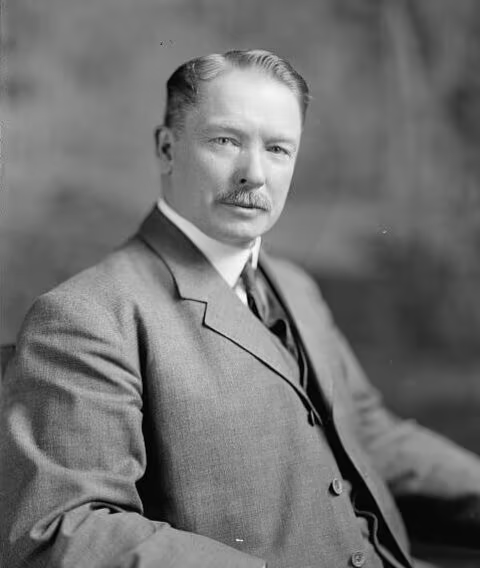
Quick Facts
Richard Edward Connell Jr.
Born: October 17, 1893
Died: November 22, 1949
Nationality: American
Genres: Adventure, Mystery, Horror
Notable Works: The Most Dangerous Game
👶 Early Life and Education
Richard Edward Connell Jr. was born on October 17, 1893, in Poughkeepsie, New York. His father, Richard E. Connell, was a newspaper editor at The Poughkeepsie News-Press who later served as a U.S. Congressman. Young Connell showed an extraordinary talent for writing from an early age — by the age of ten, he was already covering baseball games for his father's newspaper. At sixteen, he became an editor at the publication.
After his father's death in 1912, Connell attended Georgetown University for one year before transferring to Harvard University, where he quickly proved himself as a campus literary force. At Harvard, he served as editor of both The Harvard Crimson, the university's daily newspaper, and The Harvard Lampoon, its famous humor magazine. He graduated in 1915.
⚔️ Military Service
When the United States entered World War I, Connell enlisted in the Army and served with the 27th New York Division in France. His wartime experiences profoundly influenced his writing, shifting his focus from journalism to fiction and giving him a keen sense of irony and dramatic tension that would characterize his best work.
📖 Literary Career
After the war, Connell married Louise Herrick Fox in 1919 and began his career as a freelance short story writer. He proved astonishingly prolific, eventually claiming to have written over 300 short stories. His work appeared regularly in the most prestigious magazines of the era, including The Saturday Evening Post, Collier's Weekly, and Cosmopolitan.
His short stories were collected in several volumes: The Sin of Monsieur Pettipon, and Other Humorous Tales (1922), Apes and Angels (1924), Variety (1925), and Ironies (1930). He also wrote several novels, including The Mad Lover (1927) and Playboy (1936).
🎯 The Most Dangerous Game
Connell's most celebrated work, The Most Dangerous Game (also published as "The Hounds of Zaroff"), first appeared in Collier's Weekly on January 19, 1924. The story won the prestigious O. Henry Memorial Award that year and launched Connell into full-time freelance writing. The tale of a big-game hunter who becomes the hunted on a remote island has never been out of print and remains one of the most anthologized and frequently taught short stories in American schools. It has been adapted into at least eight films, beginning with the 1932 RKO production.
✒️ Writing Style
Connell was a versatile writer who moved easily between humor, adventure, horror, and social satire. His humorous stories — particularly the "Mr. Pottle" series and the tales in The Sin of Monsieur Pettipon — showcase his gift for comic timing and absurd situations. His darker work, including The Most Dangerous Game, demonstrates his mastery of suspense, pacing, and ironic reversal. His prose is clean and direct, with vivid sensory detail and sharp dialogue that made his stories ideal for magazine serialization and later film adaptation.
🎬 Hollywood Career
In the mid-1920s, Connell and his wife moved to Beverly Hills, California, where he began a successful parallel career as a screenwriter. His short story A Reputation (1922) served as the basis for Frank Capra's 1941 film Meet John Doe, starring Gary Cooper and Barbara Stanwyck. The film earned Connell an Academy Award nomination for Best Original Story in 1942. He contributed to numerous screenplays throughout the 1930s and 1940s.
❤️ Personal Life and Legacy
Connell lived in Beverly Hills with his wife Louise for over two decades, continuing to write both fiction and screenplays. He died of a heart attack on November 22, 1949, at the age of 56. While he published hundreds of stories across dozens of genres, his literary reputation rests almost entirely on The Most Dangerous Game, which has become a cornerstone of American short fiction and a staple of school curricula worldwide. The story's exploration of the hunter-hunted dynamic, survival instincts, and moral boundaries continues to resonate with new generations of readers.
⭐ Interesting Facts
- Connell claimed to have written over 300 short stories during his career, though only about 200 have been accounted for.
- He started covering sports for his father's newspaper at the age of ten.
- At Harvard, he held the rare distinction of editing both The Crimson and The Lampoon simultaneously.
- The Most Dangerous Game has inspired numerous films, TV episodes, video games, and other stories exploring the "hunting humans" premise.
- His story A Reputation became the Oscar-nominated film Meet John Doe (1941), directed by Frank Capra.
Frequently Asked Questions about Richard Connell
Where can I find study guides for Richard Connell's stories?
We offer free interactive study guides for the following Richard Connell stories:
- The Most Dangerous Game — comprehension questions, vocabulary review, and discussion prompts