Quick Facts
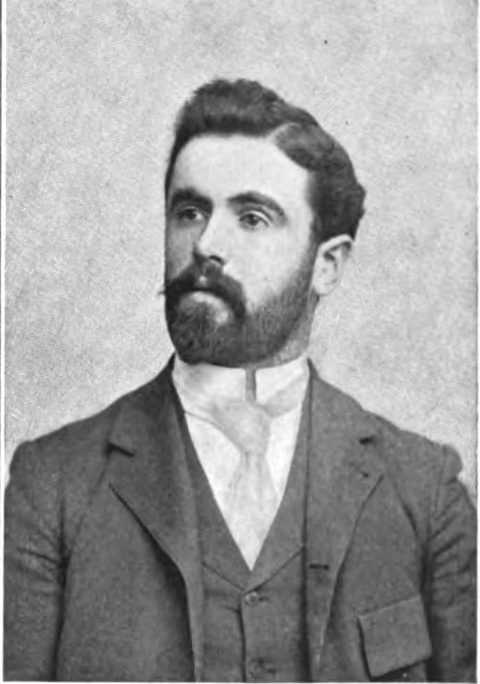
Stephen Crane
Born: November 1, 1871
Died: June 5, 1900
Nationality: American
Genres: Realism, Naturalism
Notable Works: The Red Badge of Courage, The Open Boat, Maggie: A Girl of the Streets, The Blue Hotel, The Black Riders and Other Lines
👶 Early Life and Education
Stephen Crane was born November 1, 1871, in Newark, New Jersey — the fourteenth and last child of Reverend Jonathan Townley Crane, a Methodist minister, and Mary Helen Peck Crane, a journalist and suffragist. His father died when Stephen was eight, and his devout, strong-minded mother raised him alongside his older siblings. He attended preparatory school at Claverack College, then spent less than two years as a college student — first at Lafayette College in Easton, Pennsylvania, then at Syracuse University. He showed far more interest in baseball and writing than in academics, and left college to pursue a literary career in New York City.
📖 Career and Literary Breakthrough
Moving to New York in the early 1890s, Crane freelanced as a journalist for the New York Tribune, living a bohemian life among artists and gaining firsthand familiarity with poverty in the Bowery. This experience shaped his first novel, Maggie: A Girl of the Streets (1893), about an innocent slum girl's descent into prostitution. Quite scandalous for its time, Crane published it at his own expense under the pseudonym "Johnston Smith" — but it attracted the attention of William Dean Howells, who championed the young writer.
Though he never fought in battle himself, Crane created stories about the battlefield so realistic that veterans reading his work thirty years after the Civil War praised it for capturing the true feelings and images of combat. His second novel, The Red Badge of Courage (1895), follows Henry Fleming, a young Union soldier who struggles with cowardice and bravery on the field of battle. The title itself comes from Fleming's longing for a battle wound — a "red badge of courage" — to conceal his shame after fleeing from combat. The novel brought Crane international fame and established him as one of America's foremost writers, all before he turned twenty-five.
🌿 Writing Style
Crane's writing is characterized by vivid intensity, irony, and a unique blend of naturalism and impressionism. Critics have variously labeled him a realist, a naturalist, an impressionist, a symbolist, and an ironist. His prose creates tension between illusion and reality, hope and despair, the individual's perception of events and the events as they actually are. His style was startlingly modern — stripped of Victorian ornamentation, driven by sensory detail and psychological insight.
✒️ Notable Works
In just four years of major output, Crane published five novels, two poetry collections, three short story collections, and dozens of individual stories and journalistic pieces. His short stories rank among the finest in American literature. The Open Boat (1897), based on his own near-fatal shipwreck off the coast of Florida, is widely considered one of the greatest short stories ever written — a masterwork of naturalism exploring man's insignificance against an indifferent universe. The Blue Hotel is a taut psychological drama set in a Nebraska hotel, and The Bride Comes to Yellow Sky is a satirical Western that subverts frontier mythology.
A Dark Brown Dog is a superlative allegorical story about a child and a stray dog with a devastating ending. For students and teachers, we offer a helpful Study Guide. The Veteran serves as a sequel to The Red Badge of Courage, revisiting Henry Fleming as an old man. Other notable stories include An Experiment in Misery, A Mystery of Heroism, and The Upturned Face.
Crane's poetry, collected in The Black Riders and Other Lines (1895) and War Is Kind (1899), was strikingly unconventional — stripped of meter and rhyme, employing stark imagery and heavy irony. He called them "lines" rather than poems, and their minimalist style anticipated the Imagist movement.
🌊 Adventure and War Correspondence
After the success of The Red Badge of Courage, Crane sought out real war. In 1897, he sailed for Cuba to cover the rebellion against Spain as a journalist, but his ship, the Commodore, sank off the Florida coast. Crane was reported dead. In fact, he had survived in a small dinghy with three other men for thirty hours before swimming to shore, losing all his money in the process. This harrowing experience became The Open Boat. He later covered the Greco-Turkish War and the Spanish-American War in Cuba, where he contracted malaria and yellow fever — diseases that would hasten his death.
❤️ Personal Life
Crane entered a common-law marriage with Cora Taylor, whom he met in Jacksonville, Florida, in 1896. Her husband would not grant a divorce, so Crane always called her "Mrs. Crane." The two had no children. Cora traveled with him to cover the Greco-Turkish War — becoming one of the first female war correspondents — and later settled with him in England, where they became fixtures in literary circles, known for lavish parties and an extravagant lifestyle they could ill afford. Rumors of drug addiction, rampant promiscuity, and even satanism — all untrue — had followed Crane from New York and prompted the move abroad. In England, he befriended Joseph Conrad and Henry James, both of whom admired his work deeply.
✨ Death and Legacy
Crane's health deteriorated rapidly in his final years, ravaged by tuberculosis compounded by the yellow fever and malaria he had contracted as a war correspondent. On June 5, 1900, he died at a sanatorium in Badenweiler, in Germany's Black Forest. He was twenty-eight years old. In just four years of major literary output, he had produced a body of work that would influence generations of writers.
Ernest Hemingway wrote in Green Hills of Africa (1935): "The good writers are Henry James, Stephen Crane, and Mark Twain." Willa Cather, Robert Frost, and Ezra Pound all praised Crane as one of the finest creative spirits of his era. His unflinching realism, psychological insight, and stripped-down prose style are widely credited with marking the beginning of modern American Naturalism and anticipating literary modernism.
Visit American Literature's American History, Civil War Stories, and African American Library for other important historical documents and figures which helped shape America.
Frequently Asked Questions about Stephen Crane
Where can I find study guides for Stephen Crane's stories?
We offer free interactive study guides for the following Stephen Crane stories:
- A Dark Brown Dog — comprehension questions, vocabulary review, and discussion prompts
- The Blue Hotel — comprehension questions, vocabulary review, and discussion prompts
- The Open Boat — comprehension questions, vocabulary review, and discussion prompts
- The Veteran — comprehension questions, vocabulary review, and discussion prompts