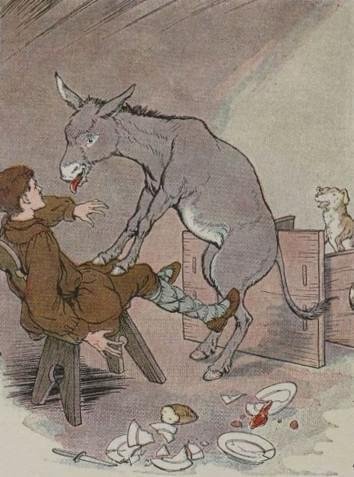
The Ass And The Lap Dog


The Ass and the Lap Dog (Perry Index 91) is one of Aesop's most widely retold fables about the folly of imitation. The fable was versified by Phaedrus in Latin (1st century CE) and later adapted by Jean de La Fontaine as L'Ane et le petit Chien (Fables IV.5, 1668). The version here follows Milo Winter's 1919 retelling for The Aesop for Children collection. The tale belongs to a family of Aesop fables about donkeys who overestimate themselves, alongside The Ass in the Lion's Skin (Perry 188) and The Monkey and the Camel (Perry 83), all warning against imitating qualities that do not belong to you.
The Ass And The Lap Dog by Aesop

There was once a Donkey whose master also owned a little Lap Dog. The Dog was his master's favorite and was always being petted and praised, fed treats from the table, and allowed to curl up on his master's lap. Every day the Dog would run to greet the master, wagging his tail, jumping up playfully, and licking his hands and face.

The Donkey watched all of this with growing resentment. He was well fed, true enough, but he had to work hard every day, and his master barely noticed he existed.

One day the jealous Donkey got a foolish idea: if he just acted like the Dog, he would win his master's love too. So he broke free from his stall and came clattering eagerly into the house.

Finding his master seated at the dinner table, the Donkey kicked up his heels and brayed loudly, prancing around the table in wild circles and knocking it over. Then he planted his heavy front hooves on his master's knees and stuck out his tongue to lick the master's face, just as he had seen the Dog do. But his weight toppled the chair, and the Donkey and his master crashed together into the pile of broken dishes.

The master shouted for help, and servants came running. When they saw their master pinned beneath the clumsy beast, they grabbed sticks and drove the Donkey back to his stall with a sound beating. There he stood alone, bruised and sorry, realizing his foolishness had earned him nothing but pain.

What is charming in one may be rude and clumsy in another.

Do not try to win favor by imitating those whose gifts are different from your own.

There was once an Ass whose Master also owned a Lap Dog. This Dog was a favorite and received many a pat and kind word from his Master, as well as choice bits from his plate. Every day the Dog would run to meet the Master, frisking playfully about and leaping up to lick his hands and face.

All this the Ass saw with much discontent. Though he was well fed, he had much work to do; besides, the Master hardly ever took any notice of him.

Now the jealous Ass got it into his silly head that all he had to do to win his Master's favor was to act like the Dog. So one day he left his stable and clattered eagerly into the house.

Finding his Master seated at the dinner table, he kicked up his heels and, with a loud bray, pranced giddily around the table, upsetting it as he did so. Then he planted his forefeet on his Master's knees and rolled out his tongue to lick the Master's face, as he had seen the Dog do. But his weight upset the chair, and Ass and man rolled over together in the pile of broken dishes from the table.

The Master was much alarmed at the strange behavior of the Ass, and calling for help, soon attracted the attention of the servants. When they saw the danger the Master was in from the clumsy beast, they set upon the Ass and drove him with kicks and blows back to the stable. There they left him to mourn the foolishness that had brought him nothing but a sound beating.

Behavior that is regarded as agreeable in one is very rude and impertinent in another.

Do not try to gain favor by acting in a way that is contrary to your own nature and character.


You may also enjoy the parody poem of this fable, titled The Pampered Lapdog and the Misguided Ass.


Frequently Asked Questions about The Ass And The Lap Dog

What is the moral of "The Ass and the Lap Dog"?

The moral is "Do not try to win favor by imitating those whose gifts are different from your own." The Donkey sees the Lap Dog earn affection through playful frisking and licking and assumes the same behavior will win him love too. But what is charming in a small, light pet is dangerous and destructive in a heavy donkey. Aesop teaches that each creature has its own natural strengths, and trying to copy someone else's talents instead of developing your own leads to failure and humiliation.

What is "The Ass and the Lap Dog" about?

The fable tells the story of a Donkey and a Lap Dog who belong to the same master. The Lap Dog is pampered, fed treats from the table, and allowed to sit on the master's lap. The Donkey, who works hard but receives little attention, grows jealous and decides to imitate the Dog's behavior. He breaks free from his stall, charges into the house, kicks up his heels, brays loudly, knocks over the dinner table, and tries to climb onto his master's lap. The terrified master calls for help, and the servants drive the Donkey back to his stall with a beating. The fable ends with the observation that behavior charming in one creature is rude and clumsy in another.

What is the theme of "The Ass and the Lap Dog"?

The central theme is the danger of envy-driven imitation. The Donkey does not simply want what the Dog has -- he believes he can get it by copying the Dog's behavior. But the fable shows that success is not just about what you do; it is about who you are when you do it. The Dog's playfulness works because it matches his nature. The Donkey's imitation fails because it contradicts his. A secondary theme is the injustice of unequal treatment -- the Donkey works hard while the Dog contributes nothing, yet the Dog receives all the affection. Aesop acknowledges this unfairness but warns that imitating others is not the way to correct it.

Why does the Donkey try to act like the Lap Dog?

The Donkey is driven by jealousy and a misunderstanding of cause and effect. He watches the Lap Dog receive constant affection -- pats, kind words, treats from the table, and a place on the master's lap -- and concludes that the Dog's behavior is what causes the master's love. He reasons that if he frisks, jumps, and licks like the Dog, he will earn the same treatment. What the Donkey fails to understand is that the Dog's actions are appealing because the Dog is small and suited to them. The behavior is not the cause of the affection -- it is the expression of a relationship that already exists.

What is the Perry Index number for "The Ass and the Lap Dog"?

The Ass and the Lap Dog is Perry Index 91, sometimes titled "The Ass Who Would Be Playmate to His Master." The fable appears in the earliest Greek Aesop collections and was later versified by Phaedrus in Latin (1st century CE). Jean de La Fontaine adapted it as L'Ane et le petit Chien (Fables IV.5) in 1668. The version most familiar to English readers comes from Milo Winter's The Aesop for Children (1919), which softened the story for younger audiences while keeping the core lesson intact.

What lesson does "The Ass and the Lap Dog" teach children?

For children, the fable teaches a straightforward lesson: be yourself instead of trying to copy others. The Donkey sees the little Dog getting attention and thinks, "I can do that too!" But he cannot -- he is too big, too heavy, and too clumsy. Instead of winning love, he breaks dishes, scares his master, and earns a beating. The story helps children understand that everyone has different strengths. Just because something works for someone else does not mean it will work for you. The healthier approach is to discover what you do well and let that be the source of your value.

How is "The Ass and the Lap Dog" similar to "The Ass in the Lion's Skin"?

Both fables belong to Aesop's "foolish donkey" cycle and share the theme of an ass pretending to be something it is not. In The Ass in the Lion's Skin (Perry 188), a donkey dresses in a lion's hide to frighten other animals but is exposed by his bray. In The Ass and the Lap Dog (Perry 91), the donkey imitates a pet dog's playful behavior but is exposed by his size and clumsiness. In both cases, the donkey's true nature reveals itself despite his performance. The paired fables reinforce Aesop's warning that disguises and imitations always fail because you cannot hide what you fundamentally are.

What are the best Aesop fables to read next?

If you enjoyed The Ass and the Lap Dog, here are more of Aesop's fables that explore similar themes of identity, envy, and knowing your true nature:

  • The Mule -- A mule boasts about his horse mother until a hard day's work reminds him he is also the son of a donkey.
  • The Wolf and the House Dog -- A starving wolf envies a well-fed dog's life until he sees the price of comfort: a chain around the neck.
  • Jupiter and the Monkey -- A monkey enters her baby in a beauty contest among the gods, teaching that love can blind us to reality.
  • The Ass and His Driver -- A stubborn donkey ignores his driver's warnings and pays the ultimate price for refusing good advice.

Save stories, build your reading list, and access all study tools — completely free.

Save The Ass And The Lap Dog to your library — it's free!

Need help with The Ass And The Lap Dog?

Study tools to help with homework, prepare for quizzes, and deepen your understanding.

Flashcards →