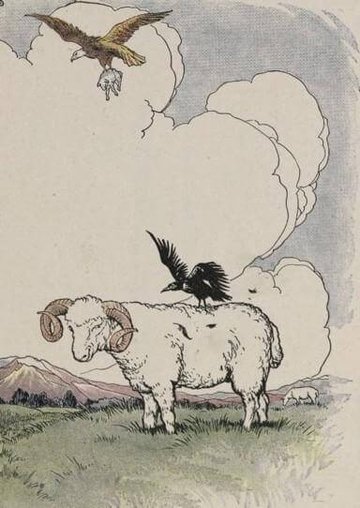
The Eagle And The Jackdaw


The Eagle and the Jackdaw (Perry Index 2) is one of the earliest numbered fables in the Aesopic tradition, recorded in ancient Greek collections and later retold by Phaedrus in Latin verse and Jean de La Fontaine in French as Le Geai paré des plumes du Paon. The fable is sometimes titled "The Eagle, the Jackdaw, and the Shepherd" and belongs to a family of Aesopic tales warning against imitation beyond one's abilities, alongside The Frog and the Ox. It appears in the Townsend (250) and Jacobs collections and has been widely used in Western education as a lesson on self-knowledge. Full text provided by Aesop.
The Eagle And The Jackdaw by Aesop

An Eagle, swooping down on powerful wings, seized a lamb in her talons and carried it off to her nest. A Jackdaw watched the deed, and his foolish head was filled with the idea that he was big and strong enough to do what the Eagle had done. So with a great rustling of feathers and a fierce air, he came down swiftly on the back of a large Ram. But when he tried to rise again, he found that he could not get away, for his claws were tangled in the wool. And so far was he from carrying away the Ram, that the Ram hardly noticed he was there.

The Shepherd saw the fluttering Jackdaw and guessed at once what had happened. Running up, he caught the bird and clipped its wings. That evening he gave the Jackdaw to his children.

"What a funny bird this is!" they said, laughing. "What do you call it, Father?"

"That is a Jackdaw, my children. But if you asked him, he would say he is an Eagle."

Do not let your vanity make you overestimate your powers.

An Eagle, swooping down on powerful wings, seized a lamb in her talons and made off with it to her nest. A Jackdaw saw the deed, and his silly head was filled with the idea that he was big and strong enough to do as the Eagle had done. So with much rustling of feathers and a fierce air, he came down swiftly on the back of a large Ram. But when he tried to rise again he found that he could not get away, for his claws were tangled in the wool. And so far was he from carrying away the Ram, that the Ram hardly noticed he was there.

The Shepherd saw the fluttering Jackdaw and at once guessed what had happened. Running up, he caught the bird and clipped its wings. That evening he gave the Jackdaw to his children.

"What a funny bird this is!" they said laughing, "what do you call it, father?"

"That is a Jackdaw, my children. But if you should ask him, he would say he is an Eagle."

Do not let your vanity make you overestimate your powers.


Frequently Asked Questions about The Eagle And The Jackdaw

What is the moral of The Eagle and the Jackdaw?

The moral of The Eagle and the Jackdaw is "Do not let your vanity make you overestimate your powers." The fable warns that envy and unchecked ambition can lead us to attempt feats far beyond our real abilities. The Jackdaw watches the Eagle seize a lamb and assumes he can do the same, but he lacks the Eagle's strength and skill. His failure is not just embarrassing — it costs him his freedom. The lesson is that self-awareness and honest self-assessment are essential before taking on any great challenge.

What is the theme of The Eagle and the Jackdaw?

The central themes of The Eagle and the Jackdaw are vanity, self-knowledge, and the danger of imitation. The fable explores what happens when envy replaces honest self-assessment: the Jackdaw sees the Eagle's success and copies the action without possessing the ability. A secondary theme is the gap between self-perception and reality — even after his humiliating capture, the Jackdaw still considers himself an Eagle. Aesop uses this to show that vanity often survives the very consequences it creates.

Why does the Jackdaw try to carry off the Ram?

The Jackdaw tries to carry off the Ram because he is envious of the Eagle's successful capture of a lamb. After watching the Eagle swoop down and fly away with prey in its talons, the Jackdaw's "foolish head was filled with the idea" that he could do the same. He does not stop to consider that the Eagle is far larger, stronger, and equipped with powerful talons designed for hunting. His motivation is pure imitation driven by vanity — he wants to appear as powerful as the Eagle without having any of the Eagle's actual abilities.

What happens to the Jackdaw at the end of the story?

When the Jackdaw lands on the Ram's back and tries to fly away with it, his claws become tangled in the thick wool, and he cannot free himself. The Shepherd sees the fluttering bird, catches him, and clips his wings so he can never fly properly again. That evening, the Shepherd gives the Jackdaw to his children as a pet. When the children ask what kind of bird it is, the Shepherd delivers the fable's famous punchline: "That is a Jackdaw, my children. But if you asked him, he would say he is an Eagle."

What does the Shepherd's final line mean in The Eagle and the Jackdaw?

The Shepherd's remark — "That is a Jackdaw, but if you asked him, he would say he is an Eagle" — is the fable's sharpest observation about vanity. It means that the Jackdaw's delusion has survived his failure. Despite being caught, having his wings clipped, and being reduced to a children's pet, he still sees himself as an Eagle. The line highlights the stubborn persistence of self-deception: some people are not cured of their inflated self-image even when reality proves them wrong. It is both humorous and unsettling.

What is the Perry Index number for The Eagle and the Jackdaw?

The Eagle and the Jackdaw is Perry Index number 2, making it one of the earliest numbered fables in the Aesopic canon. It is sometimes listed under the title "The Eagle, the Jackdaw, and the Shepherd." The fable was retold by the Roman poet Phaedrus in his Latin verse collection and later adapted by Jean de La Fontaine. It appears in the Townsend translation (number 250) and the Joseph Jacobs collection, both widely used English-language editions of Aesop's fables.

What is the difference between the Eagle and the Jackdaw in the fable?

The Eagle and the Jackdaw represent genuine ability versus empty imitation. The Eagle acts from natural strength — it has powerful wings, sharp talons, and the predatory instinct to seize a lamb and carry it away. The Jackdaw, by contrast, is a small, common bird with none of these attributes. The Eagle succeeds because its ambition matches its capability, while the Jackdaw fails because his ambition is based entirely on envy, not on any honest assessment of his own powers. Aesop uses this contrast to argue that aspiration must be grounded in self-knowledge.

What are the best Aesop fables to read next?

If you enjoyed The Eagle and the Jackdaw, try these thematically related Aesop fables: The Lark and Her Young Ones, about a mother bird who teaches her chicks that you can only rely on yourself when danger comes; The Lion's Share, a fable about power, greed, and the folly of partnering with those who will take everything; The Man and the Satyr, which warns against people whose words do not match their nature; and The Owl and the Grasshopper, where flattery lures the unwary into a deadly trap.

Save stories, build your reading list, and access all study tools — completely free.

Save The Eagle And The Jackdaw to your library — it's free!

Need help with The Eagle And The Jackdaw?

Study tools to help with homework, prepare for quizzes, and deepen your understanding.

Flashcards →