The Miller His Son And The Ass


Perry Index: 721. Unlike most Aesop fables, the earliest known written version of this tale comes from the 13th-century Arab writer Ibn Said, not from the classical Greek or Latin tradition. It entered the European fable canon through various medieval collections and became widely known through Jean de La Fontaine's influential retelling in Fables (Book III, No. 1, 1668). The story also appears in the 1919 Aesop for Children illustrated by Milo Winter, which popularized the version most English readers know today. A closely related variant, The Man, the Boy, and the Donkey, tells essentially the same story with minor differences in framing. Read more fables in our full Aesop's Fables collection.
The Miller His Son And The Ass by Aesop

One day, a long time ago, an old Miller and his Son were on their way to market with an Ass which they hoped to sell. They drove him very slowly, for they thought they would have a better chance to sell him if they kept him in good condition. As they walked along the highway some travelers laughed loudly at them.

"What foolishness," cried one, "to walk when they might as well ride. The most stupid of the three is not the one you would expect it to be."

The Miller did not like to be laughed at, so he told his son to climb up and ride.

They had gone a little farther along the road, when three merchants passed by.

"Oho, what have we here?" they cried. "Respect old age, young man! Get down, and let the old man ride."

Though the Miller was not tired, he made the boy get down and climbed up himself to ride, just to please the Merchants.

At the next turnstile they overtook some women carrying market baskets loaded with vegetables and other things to sell.

"Look at the old fool," exclaimed one of them. "Perched on the Ass, while that poor boy has to walk."

The Miller felt a bit vexed, but to be agreeable he told the Boy to climb up behind him.

They had no sooner started out again than a loud shout went up from another company of people on the road.

"What a crime," cried one, "to load up a poor dumb beast like that! They look more able to carry the poor creature, than he to carry them."

"They must be on their way to sell the poor thing's hide," said another.

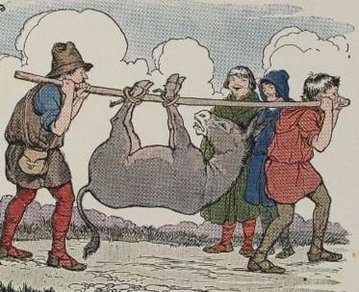
The Miller and his Son quickly scrambled down, and a short time later, the market place was thrown into an uproar as the two came along carrying the Donkey slung from a pole. A great crowd of people ran out to get a closer look at the strange sight.

The Ass did not dislike being carried, but so many people came up to point at him and laugh and shout, that he began to kick and bray, and then, just as they were crossing a bridge, the ropes that held him gave way, and down he tumbled into the river.

The poor Miller now set out sadly for home. By trying to please everybody, he had pleased nobody, and lost his Ass besides.

If you try to please all, you please none.


Frequently Asked Questions about The Miller His Son And The Ass

What is the moral of "The Miller, His Son, and the Ass"?

The moral is stated directly at the end of the fable: "If you try to please all, you please none." The miller and his son change their behavior every time a new group of strangers criticizes them, ultimately losing the donkey they intended to sell. The story warns that abandoning your own judgment to satisfy every outside opinion leads to worse outcomes than simply committing to a reasonable course of action.

What is the theme of "The Miller, His Son, and the Ass"?

The central theme is the futility of people-pleasing. The fable explores how public opinion is inherently contradictory—each group of travelers offers advice that directly contradicts the last—and how deferring to every critic strips a person of autonomy and common sense. Secondary themes include the danger of valuing appearances over substance and the social dynamic in which unsolicited critics bear no consequences for their bad advice.

Why did the miller and his son carry the donkey?

After being criticized for walking beside the donkey, for letting the son ride, for letting the father ride, and for both riding at once, the miller ran out of conventional options. A group of travelers accused them of overloading the poor animal, so in desperation, the miller and his son tied the donkey’s legs to a pole and carried it between them. This absurd escalation illustrates how people-pleasing can push someone from reasonable compromises into completely irrational behavior.

What happened to the donkey at the end of the story?

As the miller and his son carried the donkey across a bridge, the animal began to kick and bray because of the noise from a crowd that had gathered to laugh at the spectacle. The ropes holding the donkey gave way, and it tumbled into the river below. The miller lost the very asset he had been trying to bring to market, making the consequences of his indecisiveness concrete and irreversible.

What is the Perry Index number for this fable?

This fable is listed as Perry Index 721. Unlike most fables attributed to Aesop, the earliest known written version comes from the 13th-century Arab writer Ibn Said rather than from classical Greek or Latin sources. It later entered European literature through Jean de La Fontaine’s Fables (Book III, No. 1, published in 1668) and has been included in Aesop collections ever since.

Is "The Miller, His Son, and the Ass" the same as "The Man, the Boy, and the Donkey"?

Yes, they are essentially the same fable with minor variations in framing and detail. Both share Perry Index 721 and convey the identical moral about the futility of trying to please everyone. The version titled "The Man, the Boy, and the Donkey" sometimes differs in how the donkey is lost—in some retellings it drowns, in others it simply runs away—but the core narrative arc and lesson are the same.

What lesson does this fable teach children?

For young readers, the fable teaches that you cannot make everyone happy, and that trying to do so often makes things worse. It encourages children to think for themselves and make decisions based on their own reasoning rather than constantly changing course because of what others say. The humorous image of two people carrying a donkey on a pole makes the lesson memorable and easy to understand.

What other Aesop fables have a similar moral?

Several Aesop fables explore related themes of misguided effort, futile action, and public opinion. The Man, the Boy, and the Donkey is a direct variant of this same tale. The Belly and the Members examines how parts of a whole undermine themselves by refusing cooperation. The Mountain in Labor warns about grand efforts that produce trivial results. And The Bald Man and the Fly shows how overreacting to a minor annoyance causes self-inflicted harm.

Save stories, build your reading list, and access all study tools — completely free.

Save The Miller His Son And The Ass to your library — it's free!

Need help with The Miller His Son And The Ass?

Study tools to help with homework, prepare for quizzes, and deepen your understanding.

Flashcards →