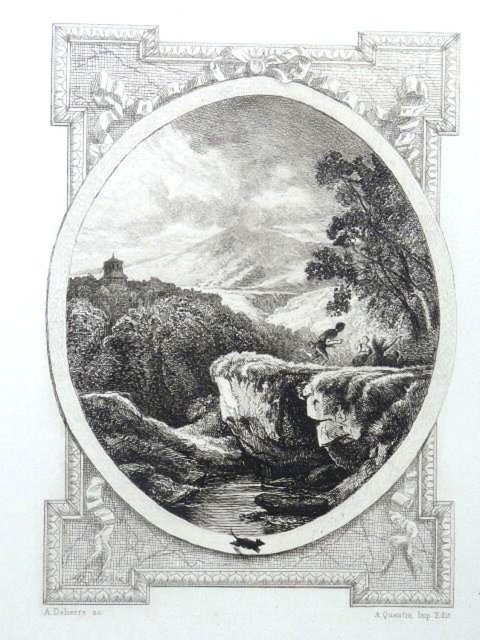
The Mountain in Labor (Perry Index 520) is one of Aesop's most enduring fables, famous for giving rise to the proverb "the mountain labored and brought forth a mouse." The Roman poet Horace immortalized the image in his Ars Poetica (c. 19 BCE) with the Latin line Parturient montes, nascetur ridiculus mus — "Mountains will labor, and a ridiculous mouse will be born" — warning writers against grand openings that lead to trivial payoffs. Plutarch called it an "old proverb," and Phaedrus included it among his Latin verse adaptations of Aesop. Jean de La Fontaine later retold the fable in his celebrated French collection (Book V, Fable 10). The expression "much ado about nothing" captures the same spirit in English.
One day, the people of a certain country noticed that a great mountain nearby had begun to rumble and shake. Smoke and flames shot up from its peak. The earth trembled beneath their feet, and enormous cracks split the ground around the mountain's base.
"Something tremendous is about to happen!" the people cried, and they gathered from miles around to watch.
Crowds pressed together at what they hoped was a safe distance, their eyes fixed upon the shaking mountain. Some thought a new volcano was being born. Others whispered that a giant must be struggling to break free from deep within the earth. A few declared that the mountain was surely about to split open and pour forth rivers of gold and precious gems.
The rumbling grew louder. The ground shook harder. Rocks tumbled down the mountainside in great avalanches that raised clouds of dust. The people held their breath, waiting for the magnificent spectacle that was sure to come.
Then, at last, a small crack appeared near the base of the mountain. The crowd leaned forward. Out of the crack crept... a tiny mouse.
It blinked in the sunlight, twitched its whiskers, and scurried away into the grass.
The crowd stared in silence for a moment, then burst into laughter that echoed across the valley.
Frequently Asked Questions about The Mountain in Labor
What is the moral of "The Mountain in Labor"?
The moral is that grand promises often end in small results. When the mountain shakes and roars, the crowd expects something magnificent — a volcano, a giant, rivers of gold. Instead, a tiny mouse emerges. The fable warns against judging the importance of an event by the noise surrounding it and reminds us that dramatic buildup does not guarantee a dramatic outcome. The related English expression is "much ado about nothing."
What is the origin and history of this fable?
The fable is attributed to Aesop and classified as Perry Index 520 in the standard reference system for Aesopic fables. Plutarch called the mountain-and-mouse image an "old proverb," suggesting it predates even the earliest written versions. The Roman fabulist Phaedrus included a Latin verse adaptation, and the poet Horace quoted it in his Ars Poetica (c. 19 BCE). Jean de La Fontaine retold it in his French fable collection (Book V, Fable 10). The story has appeared in virtually every major edition of Aesop's fables published since antiquity.
What does the Latin phrase "Parturient montes, nascetur ridiculus mus" mean?
The phrase translates to "Mountains will labor, and a ridiculous mouse will be born." It comes from the Roman poet Horace's Ars Poetica (c. 19 BCE), where he warns writers against opening their works with grandiose promises they cannot fulfill. Horace used the image from Aesop's fable as a cautionary example: if your introduction thunders like a mountain in labor, your readers will expect something spectacular — and a mousy payoff will make you look foolish. The phrase became one of the most quoted lines in Latin literature.
How is "The Mountain in Labor" relevant to modern life?
The fable applies wherever spectacle outpaces substance. Product launches hyped with months of teasers that deliver minor upgrades. Political campaigns built on sweeping promises that result in token gestures. Corporate reorganizations announced with great fanfare that change almost nothing. Social media outrage cycles that flare dramatically and fade without consequence. The mountain-to-mouse pattern is a permanent feature of human affairs, and the fable's advice — judge results, not the noise that precedes them — remains as practical today as it was in ancient Greece.
What is the Perry Index number for "The Mountain in Labor"?
This fable is number 520 in the Perry Index, the standard scholarly classification system for Aesop's fables. The index was compiled by Ben Edwin Perry, a classics professor at the University of Illinois, and is used by scholars worldwide to identify and cross-reference the hundreds of fables attributed to Aesop across different translations and traditions.
What literary technique does this fable use?
The fable relies on anticlimax — the deliberate deflation of rising expectations — as its central device. The narrative builds tension systematically: the mountain rumbles, smoke rises, the earth cracks, crowds gather, and the suspense mounts with each detail. Then the payoff is absurdly small: a mouse. This gap between expectation and reality creates both the humor and the moral. The fable also uses satire, mocking those who mistake noise for importance, and irony, since the crowd's excitement is entirely self-generated.
Is "The Mountain in Labor" connected to the phrase "much ado about nothing"?
Yes, the fable expresses the same idea as the English phrase "much ado about nothing," which Shakespeare used as the title of his comedy around 1598. Both convey that a great fuss can produce a trivial result. While Shakespeare's play explores the theme through romantic misunderstandings and social deception rather than mountains and mice, the underlying principle is identical. The fable is also connected to the expressions "a storm in a teacup" and "making a mountain out of a molehill," which invert the image — turning something small into something artificially large.
What other Aesop fables explore similar themes of disappointment and exaggeration?
Several of Aesop's fables deal with the gap between expectation and reality. The Fisherman and the Little Fish warns against throwing away a small but real gain in hopes of something bigger. Two Travelers and a Bear reveals how a crisis exposes the truth behind grand promises of friendship. The Quack Toad satirizes a boastful creature whose claims of expertise are exposed as hollow. And The Boy Bathing shows how real danger strips away all pretense, leaving only the raw truth of a situation.
Save stories, build your reading list, and access all study tools — completely free.
"The Mountain in Labor" is one of the shortest and sharpest fables in the Aesopic tradition. A mountain shakes, roars, and cracks open — …
...
Advertisement
Understanding The Mountain in Labor
A short summary of the story
All That Noise for a Mouse: The Fable Explained
"The Mountain in Labor" is one of the shortest and sharpest fables in the Aesopic tradition. A mountain shakes, roars, and cracks open — and the crowd that gathers to witness the catastrophe watches in stunned silence as a tiny mouse scurries out. The punchline is the moral: grand promises often end in small results.
What gives this fable its lasting power is how universally the pattern repeats. Politicians announce sweeping reforms and deliver minor adjustments. Companies tease revolutionary products and release incremental updates. Writers open with thunderous prologues and fizzle into mediocrity. The mountain-to-mouse ratio is everywhere, and once you see it, you cannot unsee it.
The Roman poet Horace recognized this when he quoted the fable in his Ars Poetica around 19 BCE. His famous Latin line — Parturient montes, nascetur ridiculus mus ("Mountains will labor, and a ridiculous mouse will be born") — was aimed specifically at poets who open their epics with grandiose promises they cannot sustain. Horace's advice was to start modestly and let the work build, rather than frontloading bombast that the rest of the poem cannot support. The fable, in his hands, became a lesson in artistic restraint.
But the application extends far beyond literature. Plutarch called the mountain-and-mouse image an "old proverb" even in antiquity, suggesting the fable had been a fixture of common wisdom long before it was written down. In political life, the fable targets leaders who manufacture crises to justify their importance, then produce nothing of substance. The great rumbling of the mountain is the spectacle of power — the committees, the proclamations, the dramatic press conferences — and the mouse is the actual outcome.
There is also a subtler psychological reading. The crowd in the fable is complicit in its own disappointment. They rush to the mountain, project their fantasies onto the noise — volcanoes, giants, rivers of gold — and set themselves up for a letdown. The fable suggests that we are often co-authors of our own inflated expectations. The mountain never promised anything; the people simply assumed that something loud must also be something important.
This is why the crowd laughs at the end rather than getting angry. The joke is on them, and they know it. The mouse is not a tragedy — it is a comedy of misplaced anticipation. In a world saturated with hype, the mountain's lesson is as fresh as it was two thousand years ago: judge results, not the noise that precedes them.
Advertisement
Find this helpful? Create a free account to bookmark stories and save explanations for quick reference.