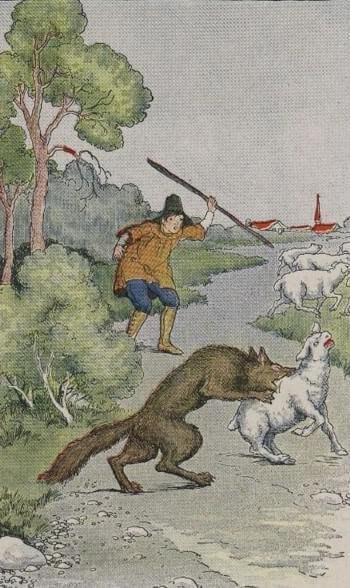
This is Aesop’s original telling of the fable better known today as "The Boy Who Cried Wolf." This longer version, from the Joseph Jacobs translation, includes richer descriptive detail — the dark forest, the setting sun, the shadows creeping over the pasture — that the shorter retelling leaves out. Perry Index 210.
A Shepherd Boy tended his master's Sheep near a dark forest not far from the village. Soon he found life in the pasture very dull. All he could do to amuse himself was to talk to his dog or play on his shepherd's pipe.
One day as he sat watching the Sheep and the quiet forest, and thinking what he would do should he see a Wolf, he thought of a plan to amuse himself.
His Master had told him to call for help should a Wolf attack the flock, and the Villagers would drive it away. So now, though he had not seen anything that even looked like a Wolf, he ran toward the village shouting at the top of his voice—
“Wolf! Wolf!”
As he expected, the Villagers who heard the cry dropped their work and ran in great excitement to the pasture. But when they got there they found the Boy doubled up with laughter at the trick he had played on them.
• • •
A few days later the Shepherd Boy again shouted—
“Wolf! Wolf!”
Again the Villagers ran to help him, only to be laughed at again.
• • •
Then one evening as the sun was setting behind the forest and the shadows were creeping out over the pasture, a Wolf really did spring from the underbrush and fall upon the Sheep.
In terror the Boy ran toward the village shouting—
“Wolf! Wolf!”
But though the Villagers heard the cry, they did not run to help him as they had before.
“He cannot fool us again,” they said.
The Wolf killed a great many of the Boy's sheep and then slipped away into the forest.
Liars are not believed even when they speak the truth.
Also referred to as: Never cry “Wolf”!
Frequently Asked Questions
What is the moral of "The Shepherd Boy and the Wolf"?
The moral is "Liars are not believed even when they speak the truth." The shepherd boy’s repeated false cries of "Wolf!" destroyed the villagers’ trust in him. When a real wolf finally appeared, his genuine cries for help were ignored because the villagers assumed he was lying again. The fable teaches that dishonesty has consequences that extend far beyond the moment of the lie.
What is the difference between "The Shepherd Boy and the Wolf" and "The Boy Who Cried Wolf"?
They are the same fable — Aesop’s Perry Index 210. "The Shepherd Boy and the Wolf" is the traditional title from classic Aesop collections (such as Joseph Jacobs’ 1894 edition), while "The Boy Who Cried Wolf" is the popular modern name. The older version is typically longer and more descriptive, while the modern retelling is streamlined. Both carry the same moral. The modern title also gave rise to the English idiom "to cry wolf," meaning to raise a false alarm.
What is the theme of "The Shepherd Boy and the Wolf"?
The central theme is that dishonesty destroys trust. The fable explores how repeated deception trains people to stop believing you — not out of malice, but out of experience. The villagers don’t refuse to help as punishment; they genuinely believe the boy is lying again. Secondary themes include the dangers of boredom-driven mischief, the vulnerability that comes from isolation, and the irreversibility of lost credibility.
Would you like to read more of Aesop’s Fables?
Here are some of our favorite Aesop fables to read next:
The moral — "Liars are not believed even when they speak the truth" — describes a mechanism, not just a punishment. The boy’s lies don’t anger the villagers into refusing …
...
Advertisement
Understanding The Shepherd Boy And The Wolf
A short summary of the story
The Real Moral
The moral — "Liars are not believed even when they speak the truth" — describes a mechanism, not just a punishment. The boy’s lies don’t anger the villagers into refusing to help; they recalibrate the villagers’ expectations. After being fooled twice, the villagers have learned a new rule: when this boy says "Wolf," there is no wolf. They apply that rule consistently — and it happens to be wrong the one time it matters.
This is what makes the fable so powerful. The consequences are not arbitrary. They follow logically and inevitably from the boy’s actions. He is not punished; he is simply no longer believed.
What This Fable Teaches
This longer version of the fable adds descriptive detail that deepens the story’s meaning. The "dark forest," the "shadows creeping out over the pasture," and the sun "setting behind the forest" create an atmosphere of encroaching danger that mirrors the boy’s situation: the safety he took for granted is disappearing.
Trust is a resource, not a right. The villagers owed the boy nothing after he abused their goodwill. Trust must be maintained through consistent honesty.
Boredom is not an excuse. The boy’s lies began as entertainment. The fable warns that treating other people’s time and concern as a joke has real consequences.
The "boy who cried wolf" pattern is everywhere. From false fire alarms to exaggerated news headlines to the child who pretends to be sick, the pattern of false alarms leading to ignored real ones repeats endlessly in modern life.
Historical Context
This version of the fable comes from the Joseph Jacobs collection (1894), one of the most widely read English-language Aesop editions. Jacobs’ version is notable for its descriptive prose — the dark forest, the quiet pasture, the shepherd’s pipe — which gives the story a narrative atmosphere that briefer retellings lack.
The fable is Perry Index 210, dating to ancient Greece. In the earliest versions, the ending is stark: the wolf kills the sheep and the boy loses his livelihood. Later English retellings by Roger L’Estrange (1692) and Thomas Bewick (1818) sometimes add the detail that the wolf kills the boy as well, raising the stakes from financial loss to mortal danger.
The phrase "never cry wolf" entered English as a proverb meaning "never raise a false alarm." Canadian writer Farley Mowat borrowed it for his 1963 memoir Never Cry Wolf, about his time studying wolves in the Arctic — a book that itself challenged false assumptions about wolves.
Advertisement
Find this helpful? Create a free account to bookmark stories and save explanations for quick reference.