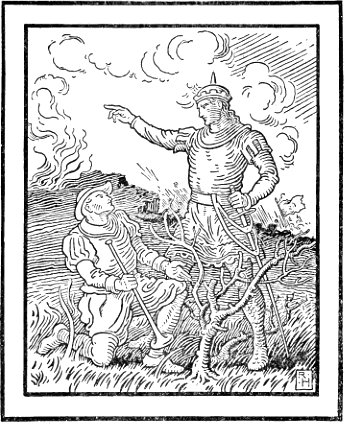
The Trumpeter Taken Prisoner (Perry Index 370) is one of the rare Aesop fables featuring only human characters, making its moral lesson unusually direct. Attributed to Aesop and retold by Phaedrus in Latin verse, the fable appeared in Joseph Jacobs's 1894 collection and George Fyler Townsend's popular 1867 translation. Its central argument — that those who incite conflict bear greater guilt than those who carry it out — has made it a touchstone in discussions of propaganda, complicity, and the ethics of influence from ancient Rome to the modern media age.
A great battle had been fought and lost. Among the prisoners dragged before the victorious army was a Trumpeter.
"Spare me, I beg you!" he cried, falling to his knees before the enemy soldiers. "Do not put me to death. I have not fought against you. I carry no sword, no spear, no weapon of any kind. I have killed no one. All I have is this trumpet."
"That," said his captors, "is precisely why you must die. You yourself may not have fought, but your trumpet stirred all the others to battle. Without your call to arms, the soldiers would never have drawn their swords. The man who incites the fight is guiltier than any who take part in it."
Those who incite conflict share the guilt of those who fight.
Frequently Asked Questions about The Trumpeter Taken Prisoner
What is the moral of "The Trumpeter Taken Prisoner"?
The moral is that those who incite conflict are as guilty — or guiltier — than those who carry it out. The trumpeter never wielded a weapon, but his trumpet rallied soldiers to fight. Aesop warns that influence carries responsibility: enabling harm makes a person complicit in the harm itself.
Why do the captors say the trumpeter is guiltier than the soldiers?
The captors argue that without the trumpeter's call to arms, the soldiers would never have drawn their swords. In their view, the person who motivates and enables the violence bears more responsibility than those who simply respond to the call. The instigator sets the entire chain of destruction in motion.
What is the Perry Index number for this fable?
This fable is Perry Index 370. It is one of the rare Aesop fables featuring only human characters — no animals appear. The fable was retold in Latin verse by Phaedrus and later included in Joseph Jacobs's 1894 collection and George Fyler Townsend's 1867 translation.
How does this fable relate to modern concepts of complicity?
The fable anticipates modern legal and ethical discussions about complicity. Just as the trumpeter claims innocence because he "only" played music, modern enablers of harm often argue they were "just following orders" or "only" providing support. Aesop's point is that the enabler — whether a propagandist, a financier, or a rhetorician — shares in the guilt of those they empower to act.
What other Aesop fables teach about responsibility for harm?
Several Aesop fables explore accountability and the consequences of harmful actions. The Boys And The Frogs warns that what is play to one may be death to another. The Miser teaches that clinging to something you refuse to use is as good as not having it. And The Wolf And The Kid shows that bravado without real courage is meaningless. Each fable, like "The Trumpeter Taken Prisoner," insists that we own the consequences of our choices.
Is "The Trumpeter Taken Prisoner" based on a real event?
There is no evidence the fable is based on a specific historical event. However, the scenario it describes — a non-combatant captured during a battle — was a real and recurring feature of ancient warfare. Trumpeters, drummers, and flag-bearers held important roles in military operations, making the question of their culpability both practical and philosophical.
What makes this fable unusual among Aesop's stories?
Unlike the vast majority of Aesop's fables, "The Trumpeter Taken Prisoner" features no animals at all. Every character is human, and the moral lesson is delivered through a realistic battlefield scenario rather than an animal allegory. This directness gives the fable an unusually modern and legalistic tone, which may explain its enduring appeal in discussions of ethics and law.
In The Lion And The Ass, the ass boasts about its role in a joint hunt, claiming credit for frightening prey — much as the trumpeter might have boasted about rallying soldiers. Both fables explore the gap between self-importance and actual contribution. The key difference is that in "The Trumpeter," the enabler's role is taken seriously by others, while in "The Lion And The Ass," the boaster is simply mocked.
Save stories, build your reading list, and access all study tools — completely free.
After a great battle, a trumpeter is captured by the victorious army. He begs for his life, insisting he is innocent because he carried no weapon and killed no one — he only …
...
Advertisement
Understanding The Trumpeter Taken Prisoner
A short summary of the story
Summary
After a great battle, a trumpeter is captured by the victorious army. He begs for his life, insisting he is innocent because he carried no weapon and killed no one — he only blew the trumpet. His captors reject this defense, arguing that his trumpet was the very thing that drove soldiers into battle. Without his call to arms, they say, no swords would have been drawn. They condemn him as guiltier than any fighter.
Moral
Those who incite conflict share the guilt of those who fight. The fable warns that influence carries responsibility. One need not wield a weapon to cause harm — stirring others to violence through words, signals, or encouragement makes a person complicit in the destruction that follows.
Analysis
"The Trumpeter Taken Prisoner" is one of Aesop's most legally and ethically precise fables. Unlike most entries in the canon, it features no animals at all — just human beings arguing over degrees of culpability. The trumpeter's defense anticipates a reasoning that courts and ethicists still debate: "I only followed orders" or "I didn't pull the trigger." The captors' reply cuts through this logic with devastating clarity: the person who motivates and enables the violence may be more responsible than the person who carries it out, because without the incitement, there would be no action at all.
The fable resonates powerfully in any era where propaganda, rhetoric, or media can drive people toward conflict. A general who never lifts a sword, a politician who calls for war from safety, a media figure who inflames hatred — all are modern trumpeters. Aesop's insight is that the instrument of influence (the trumpet, the pen, the microphone) is itself a weapon when used to incite harm.
Perry Index 370, this fable also connects to the broader Aesopic theme of personal accountability. Compare it to The Lion And The Ass, where boasting about borrowed strength earns contempt, or The Boys And The Frogs, where tormentors fail to consider the real consequences of their "sport." In each case, Aesop insists that we cannot hide behind technicalities — the harm we enable is the harm we own.
Advertisement
Find this helpful? Create a free account to bookmark stories and save explanations for quick reference.