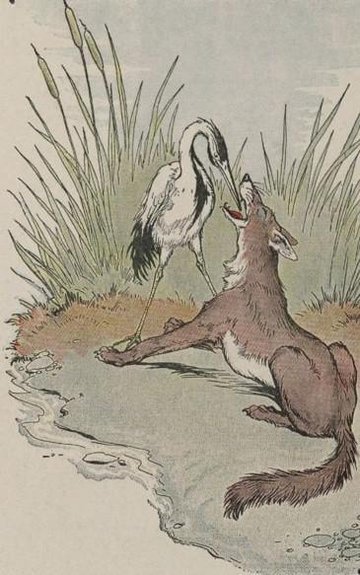
The Wolf And The Crane


The Wolf and the Crane (Perry Index 156) is one of Aesop's fables about the dangers of helping the powerful. Recorded by Phaedrus in Latin around 40 CE and retold by Jean de La Fontaine as Le Loup et la Cigogne (Fables III.9), the story has close parallels in the Buddhist Jataka tales, where a woodpecker removes a bone from a lion's throat. The rabbi Joshua ben Hananiah famously used a variant of this fable during Emperor Hadrian's reign to warn the Jewish people against rebellion—arguing they should be grateful to have their heads out of the lion's mouth.
The Wolf And The Crane by Aesop

A Wolf had been eating too greedily, and a bone had gotten stuck crosswise in his throat. He could get it neither up nor down, and of course he could not eat a thing. Naturally, that was a terrible state of affairs for a greedy Wolf.

So off he hurried to the Crane. He was sure that she, with her long neck and bill, would easily be able to reach the bone and pull it out.

"I will reward you very handsomely," said the Wolf, "if you pull that bone out for me."

The Crane, as you can imagine, was very uneasy about putting her head in a Wolf's throat. But she was greedy by nature, so she did what the Wolf asked her to do.

When the Wolf felt that the bone was gone, he started to walk away.

"But what about my reward!" called the Crane anxiously.

"What!" snarled the Wolf, whirling around. "Haven't you got it? Isn't it enough that I let you take your head out of my mouth without snapping it off?"

Expect no reward for serving the wicked.

A Wolf had been feasting too greedily, and a bone had stuck crosswise in his throat. He could get it neither up nor down, and of course he could not eat a thing. Naturally that was an awful state of affairs for a greedy Wolf.

So away he hurried to the Crane. He was sure that she, with her long neck and bill, would easily be able to reach the bone and pull it out.

"I will reward you very handsomely," said the Wolf, "if you pull that bone out for me."

The Crane, as you can imagine, was very uneasy about putting her head in a Wolf's throat. But she was grasping in nature, so she did what the Wolf asked her to do.

When the Wolf felt that the bone was gone, he started to walk away.

"But what about my reward!" called the Crane anxiously.

"What!" snarled the Wolf, whirling around. "Haven't you got it? Isn't it enough that I let you take your head out of my mouth without snapping it off?"

Expect no reward for serving the wicked.


Frequently Asked Questions about The Wolf And The Crane

What is the moral of The Wolf and the Crane?

The moral of The Wolf and the Crane is "Expect no reward for serving the wicked." The fable warns that helping dangerous or ungrateful people is its own punishment. The Wolf promised the Crane a handsome reward for removing a bone from his throat, but once she delivered, he redefined the deal entirely—claiming that letting her pull her head from his jaws without biting it off was the reward. The lesson is not simply about ingratitude but about the folly of trusting promises from those who have no incentive to keep them.

What is the theme of The Wolf and the Crane?

The central themes of The Wolf and the Crane are ingratitude, greed, and the abuse of power. The Wolf represents those who use others for their own benefit and discard them once they are no longer needed. The Crane represents those who take risks in pursuit of reward without fully understanding the danger. A secondary theme is the nature of tyranny—medieval interpreters read the fable as an allegory about serving despotic rulers who treat a subject’s survival as sufficient payment for loyalty. The story also explores how power imbalances make fair agreements impossible.

Why did the Wolf refuse to reward the Crane?

The Wolf refused to reward the Crane because he never intended to pay in the first place. His promise was a manipulation born of desperation—he needed help he could not provide himself, so he said whatever was necessary to get it. Once the bone was removed and the Wolf no longer needed the Crane, the power dynamic returned to its natural state: predator and prey. The Wolf’s reasoning—that the Crane should feel grateful to have survived putting her head in his mouth—reveals his view that not being eaten is reward enough. He reframes the entire exchange so that he appears generous rather than indebted.

What does the Crane symbolize in the fable?

The Crane symbolizes those who take dangerous risks for the promise of reward from untrustworthy people. She is not entirely innocent in the story—Aesop describes her as greedy by nature, meaning she was motivated by self-interest rather than compassion. Her long neck and bill represent a unique skill that makes her valuable to the Wolf, but only temporarily. Once she has performed her service, her special ability no longer protects her. The Crane serves as a warning about negotiating from a position of weakness and trusting verbal promises from those who hold all the power.

Is The Wolf and the Crane similar to other fables?

Yes, The Wolf and the Crane has several parallels in world literature. In the Buddhist Jataka tales, a woodpecker removes a bone from a lion’s throat after propping its mouth open with a stick—a more cautious approach than the Crane’s. Phaedrus recorded the fable in Latin around 40 CE, and Jean de La Fontaine retold it as Le Loup et la Cigogne in his French collection. The fable also shares themes with The Farmer and the Snake, another Aesop tale about the danger of helping creatures whose nature is to harm.

What is the Perry Index number for The Wolf and the Crane?

The Wolf and the Crane is classified as Perry Index 156 in the standard index of Aesop’s fables compiled by scholar Ben Edwin Perry. The Perry Index is the most widely used classification system for Aesopic fables. In some early versions, including the one by Babrius, a heron takes the place of the crane, while Indian variants substitute a lion for the wolf. The fable’s core plot—a helpful bird and an ungrateful predator—has remained remarkably consistent across cultures and centuries.

What lesson does The Wolf and the Crane teach children?

The Wolf and the Crane teaches children several important lessons. First, be careful who you trust—the Wolf’s promise sounded sincere, but he had no intention of keeping it. Second, some people will never show gratitude, no matter how much you help them. Third, the fable shows that it is wise to consider the character of the person asking for help before putting yourself at risk. For younger readers, the simplest takeaway is that helping someone dangerous can be risky, and a promise from an untrustworthy person is worth nothing.

What are the best Aesop fables to read next?

If you enjoyed The Wolf and the Crane, here are four more Aesop fables worth exploring:

  • The Owl and the Grasshopper — A clever owl outsmarts an annoying grasshopper through flattery, showing how cunning defeats nuisance.
  • The Wolf and the Goat — Another wolf tries to lure a goat from safety with false promises, echoing the same theme of predatory deception.
  • The Astrologer — A stargazer so focused on the sky that he falls into a well, a fable about ignoring obvious dangers.
  • The Stag and His Reflection — A stag admires his beautiful antlers but despises his plain legs—until a chase reveals which one truly saves him.

Save stories, build your reading list, and access all study tools — completely free.

Save The Wolf And The Crane to your library — it's free!

Need help with The Wolf And The Crane?

Study tools to help with homework, prepare for quizzes, and deepen your understanding.

Flashcards →