Oil of Dog
by Ambrose Bierce
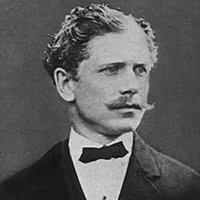
Oil of Dog (1911) is Bierce at his darkest and most wickedly funny — a young man's memoir of growing up between his father's dog-oil factory and his mother's side business disposing of unwelcome infants. "I was born of honest parents in one of the humbler walks of life, my father being a manufacturer of dog-oil."
My name is Boffer Bings. I was born of honest parents in one of the humbler walks of life, my father being a manufacturer of dog-oil and my mother having a small studio in the shadow of the village church, where she disposed of unwelcome babes. In my boyhood I was trained to habits of industry; I not only assisted my father in procuring dogs for his vats, but was frequently employed by my mother to carry away the debris of her work in the studio. In performance of this duty I sometimes had need of all my natural intelligence for all the law officers of the vicinity were opposed to my mother's business. They were not elected on an opposition ticket, and the matter had never been made a political issue; it just happened so. My father's business of making dog-oil was, naturally, less unpopular, though the owners of missing dogs sometimes regarded him with suspicion, which was reflected, to some extent, upon me. My father had, as silent partners, all the physicians of the town, who seldom wrote a prescription which did not contain what they were pleased to designate as Ol. can. It is really the most valuable medicine ever discovered. But most persons are unwilling to make personal sacrifices for the afflicted, and it was evident that many of the fattest dogs in town had been forbidden to play with me--a fact which pained my young sensibilities, and at one time came near driving me to become a pirate.
Looking back upon those days, I cannot but regret, at times, that by indirectly bringing my beloved parents to their death I was the author of misfortunes profoundly affecting my future.
One evening while passing my father's oil factory with the body of a foundling from my mother's studio I saw a constable who seemed to be closely watching my movements. Young as I was, I had learned that a constable's acts, of whatever apparent character, are prompted by the most reprehensible motives, and I avoided him by dodging into the oilery by a side door which happened to stand ajar. I locked it at once and was alone with my dead. My father had retired for the night. The only light in the place came from the furnace, which glowed a deep, rich crimson under one of the vats, casting ruddy reflections on the walls. Within the cauldron the oil still rolled in indolent ebullition, occasionally pushing to the surface a piece of dog. Seating myself to wait for the constable to go away, I held the naked body of the foundling in my lap and tenderly stroked its short, silken hair. Ah, how beautiful it was! Even at that early age I was passionately fond of children, and as I looked upon this cherub I could almost find it in my heart to wish that the small, red wound upon its breast--the work of my dear mother--had not been mortal.
It had been my custom to throw the babes into the river which nature had thoughtfully provided for the purpose, but that night I did not dare to leave the oilery for fear of the constable. "After all," I said to myself, "it cannot greatly matter if I put it into this cauldron. My father will never know the bones from those of a puppy, and the few deaths which may result from administering another kind of oil for the incomparable ol. can. are not important in a population which increases so rapidly." In short, I took the first step in crime and brought myself untold sorrow by casting the babe into the cauldron.
The next day, somewhat to my surprise, my father, rubbing his hands with satisfaction, informed me and my mother that he had obtained the finest quality of oil that was ever seen; that the physicians to whom he had shown samples had so pronounced it. He added that he had no knowledge as to how the result was obtained; the dogs had been treated in all respects as usual, and were of an ordinary breed. I deemed it my duty to explain--which I did, though palsied would have been my tongue if I could have foreseen the consequences. Bewailing their previous ignorance of the advantages of combining their industries, my parents at once took measures to repair the error. My mother removed her studio to a wing of the factory building and my duties in connection with the business ceased; I was no longer required to dispose of the bodies of the small superfluous, and there was no need of alluring dogs to their doom, for my father discarded them altogether, though they still had an honorable place in the name of the oil. So suddenly thrown into idleness, I might naturally have been expected to become vicious and dissolute, but I did not. The holy influence of my dear mother was ever about me to protect me from the temptations which beset youth, and my father was a deacon in a church. Alas, that through my fault these estimable persons should have come to so bad an end!
Finding a double profit in her business, my mother now devoted herself to it with a new assiduity. She removed not only superfluous and unwelcome babes to order, but went out into the highways and byways, gathering in children of a larger growth, and even such adults as she could entice to the oilery. My father, too, enamored of the superior quality of oil produced, purveyed for his vats with diligence and zeal. The conversion of their neighbors into dog-oil became, in short, the one passion of their lives--an absorbing and overwhelming greed took possession of their souls and served them in place of a hope in Heaven--by which, also, they were inspired.
So enterprising had they now become that a public meeting was held and resolutions passed severely censuring them. It was intimated by the chairman that any further raids upon the population would be met in a spirit of hostility. My poor parents left the meeting broken-hearted, desperate and, I believe, not altogether sane. Anyhow, I deemed it prudent not to enter the oilery with them that night, but slept outside in a stable.
At about midnight some mysterious impulse caused me to rise and peer through a window into the furnace-room, where I knew my father now slept. The fires were burning as brightly as if the following day's harvest had been expected to be abundant. One of the large cauldrons was slowly "walloping" with a mysterious appearance of self-restraint, as if it bided its time to put forth its full energy. My father was not in bed; he had risen in his night clothes and was preparing a noose in a strong cord. From the looks which he cast at the door of my mother's bedroom I knew too well the purpose that he had in mind. Speechless and motionless with terror, I could do nothing in prevention or warning. Suddenly the door of my mother's apartment was opened, noiselessly, and the two confronted each other, both apparently surprised. The lady, also, was in her night clothes, and she held in her right hand the tool of her trade, a long, narrow-bladed dagger.
She, too, had been unable to deny herself the last profit which the unfriendly action of the citizens and my absence had left her. For one instant they looked into each other's blazing eyes and then sprang together with indescribable fury. Round and round, the room they struggled, the man cursing, the woman shrieking, both fighting like demons--she to strike him with the dagger, he to strangle her with his great bare hands. I know not how long I had the unhappiness to observe this disagreeable instance of domestic infelicity, but at last, after a more than usually vigorous struggle, the combatants suddenly moved apart.
My father's breast and my mother's weapon showed evidences of contact. For another instant they glared at each other in the most unamiable way; then my poor, wounded father, feeling the hand of death upon him, leaped forward, unmindful of resistance, grasped my dear mother in his arms, dragged her to the side of the boiling cauldron, collected all his failing energies, and sprang in with her! In a moment, both had disappeared and were adding their oil to that of the committee of citizens who had called the day before with an invitation to the public meeting.
Convinced that these unhappy events closed to me every avenue to an honorable career in that town, I removed to the famous city of Otumwee, where these memoirs are written with a heart full of remorse for a heedless act entailing so dismal a commercial disaster.
Frequently Asked Questions about Oil of Dog
What is "Oil of Dog" by Ambrose Bierce about?
Oil of Dog is a darkly satirical short story narrated by Boffer Bings, who recounts his childhood in a family of macabre entrepreneurs. His father manufactures medicinal oil from dogs, while his mother runs a secret business disposing of unwanted infants. When Boffer accidentally drops a dead infant into his father's oil vat, the resulting product is far superior to ordinary dog oil. The parents eagerly combine their industries, eventually escalating from using foundlings to actively hunting adults. The community finally objects, and the desperate parents turn on each other in a violent confrontation that ends with both falling into a boiling cauldron. uses grotesque exaggeration to satirize unchecked greed.
What themes does Ambrose Bierce explore in "Oil of Dog"?
explores several interconnected themes in Oil of Dog. The most prominent is greed and moral corruption — both parents abandon all ethical limits in pursuit of commercial success. The story also critiques the American Dream, suggesting that the relentless pursuit of profit can destroy family bonds and basic humanity. Escalation of evil is another key theme: what begins as two questionable but separate businesses rapidly spirals into serial murder. Finally, examines complicity and moral blindness, as neither the narrator nor the community mounts an effective moral response until it is far too late.
What literary devices does Bierce use in "Oil of Dog"?
deploys a rich array of literary devices in Oil of Dog. Verbal irony pervades the opening lines, where Boffer describes his parents as "honest" despite their horrific occupations. Euphemism masks the violence — the mother "disposes of unwelcome babes" and the father "procures" dogs. Understatement reaches its peak in the final line, where Boffer mourns not the loss of life but "so dismal a commercial disaster." The story also uses escalation as a structural device, methodically increasing the horror from dogs to foundlings to live adults. Dark humor binds all of these elements together, making atrocity simultaneously funny and disturbing.
Who is the narrator of "Oil of Dog" and is he reliable?
The narrator is Boffer Bings, who tells the story as a memoir from the city of Otumwee. He is a classic unreliable narrator whose moral compass is completely skewed. He describes his infanticidal mother and dog-boiling father with filial affection, calling them "estimable persons" and "beloved parents." He feels genuine tenderness for the dead infants he carries, yet sees nothing wrong with disposing of them. His final statement frames the family tragedy not as a moral catastrophe but as a "commercial disaster," revealing his total inability to distinguish between business loss and mass murder. uses Boffer's obliviousness to force readers into making the moral judgments the narrator cannot.
How does "Oil of Dog" satirize the American Dream?
Oil of Dog functions as a savage satire of unchecked capitalism and the American Dream. The Bings family embodies the entrepreneurial spirit taken to its logical extreme: they identify a market demand (medicinal oil), discover an innovation (human-enhanced product), and scale their operation aggressively. They even achieve vertical integration by combining their separate businesses under one roof. suggests that when profit becomes the sole measure of success, morality becomes an irrelevant obstacle. The community's response — a public meeting with politely worded resolutions rather than arrests — satirizes civic complacency in the face of corporate wrongdoing, a critique that remains strikingly relevant.
What happens at the end of "Oil of Dog"?
After the community censures the Bings family for their murderous business practices, the parents return home "broken-hearted, desperate and, I believe, not altogether sane." That night, Boffer watches through a window as his father prepares a noose to strangle his mother, while his mother simultaneously emerges with a long, narrow-bladed dagger — each planning to murder the other to claim the remaining "profit." They fight violently until the wounded father seizes his wife and leaps with her into the boiling cauldron, killing them both. Boffer concludes by lamenting the event not as a moral tragedy but as a "dismal commercial disaster" that closed his career prospects in that town.
What is the significance of the euphemistic language in "Oil of Dog"?
The euphemistic language in Oil of Dog is one of most effective satirical tools. The mother's infanticide is called a "small studio" where she "disposed of unwelcome babes." Dead infants are "debris" and "the small superfluous." Dog slaughter becomes "procuring." The medicinal oil is dignified with the Latin designation Ol. can. These sanitized terms create an absurd gap between language and reality, mimicking the way polite society uses euphemism to avoid confronting uncomfortable truths. The technique forces readers to supply the horror that the narrator's language deliberately obscures, making the reader an active participant in recognizing the story's moral depravity.
How does Ambrose Bierce use irony in "Oil of Dog"?
employs multiple forms of irony throughout Oil of Dog. Verbal irony appears in the opening sentence, where Boffer calls his parents "honest" while describing criminal enterprises. Situational irony drives the plot: the accidental innovation that produces superior oil leads not to success but to the family's destruction. The community's response is deeply ironic — instead of prosecution, they pass polite resolutions censuring the murderers. The ending delivers the sharpest irony: each parent tries to murder the other for "the last profit," and their bodies become part of the very product that includes the "committee of citizens" who protested against them. The final line treats mass murder as merely a "commercial disaster."
What is the tone of "Oil of Dog" and how does Bierce achieve it?
The tone of Oil of Dog is one of cheerful, matter-of-fact horror — a hallmark of darkest satire. He achieves this through several techniques: the narrator speaks in an elevated, ornate register that contrasts sharply with the grotesque subject matter. Boffer describes boiling infants with the same mild interest one might use for a cooking recipe. Genuinely disturbing details are delivered in casual subordinate clauses, as when Boffer notes "the small, red wound upon its breast — the work of my dear mother." This relentless tonal mismatch between language and content is what makes the story simultaneously darkly funny and deeply unsettling, earning his nickname "Bitter Bierce."
How does the escalation of horror work in "Oil of Dog"?
structures Oil of Dog as a deliberate escalation of moral transgression. The story begins with enterprises that are merely unsavory: boiling dogs for oil and disposing of unwanted infants. The accidental combination of these businesses produces a superior product, which leads to the first escalation — deliberately using human remains instead of dogs. When the supply of foundlings runs out, Mrs. Bings escalates further by hunting live children and adults. The final escalation comes when the parents attempt to murder each other. Each step follows a horrible internal logic: if the product is better, why not make more? shows how small moral compromises compound into monstrous crimes.
Save stories, build your reading list, and access all study tools — completely free.
Save Oil of Dog to your library — it's free!Need help with Oil of Dog?
Study tools to help with homework, prepare for quizzes, and deepen your understanding.
Flashcards → | Vocabulary →