Fat And Thin
by Anton Chekhov
Time and again, Chekhov used his stories to attack and pillory the strict vertical nature of Russian society during his time. Here he is revisiting that theme in Fat and Thin, where he uses the friendship of two old classmates to draw out the lesson, using a marked change in the conversation between old friends when one of them discloses his position in life to the other.
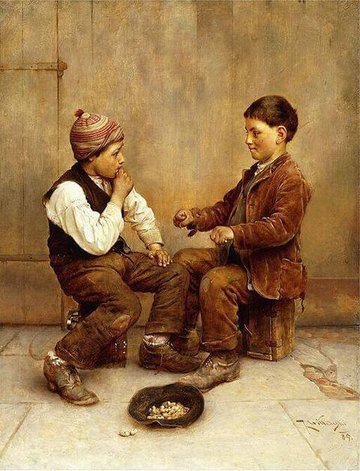
Two friends -- one a fat man and the other a thin man -- met at the Nikolaevsky station. The fat man had just dined in the station and his greasy lips shone like ripe cherries. He smelt of sherry and fleur d'orange. The thin man had just slipped out of the train and was laden with portmanteaus, bundles, and bandboxes. He smelt of ham and coffee grounds. A thin woman with a long chin, his wife, and a tall schoolboy with one eye screwed up came into view behind his back.
"Porfiry," cried the fat man on seeing the thin man. "Is it you? My dear fellow! How many summers, how many winters!"
"Holy saints!" cried the thin man in amazement. "Misha! The friend of my childhood! Where have you dropped from?"
The friends kissed each other three times, and gazed at each other with eyes full of tears. Both were agreeably astounded.
"My dear boy!" began the thin man after the kissing. "This is unexpected! This is a surprise! Come have a good look at me! Just as handsome as I used to be! Just as great a darling and a dandy! Good gracious me! Well, and how are you? Made your fortune? Married? I am married as you see. . . . This is my wife Luise, her maiden name was Vantsenbach . . . of the Lutheran persuasion. . . . And this is my son Nafanail, a schoolboy in the third class. This is the friend of my childhood, Nafanya. We were boys at school together!"
Nafanail thought a little and took off his cap.
"We were boys at school together," the thin man went on. "Do you remember how they used to tease you? You were nicknamed Herostratus because you burned a hole in a schoolbook with a cigarette, and I was nicknamed Ephialtes because I was fond of telling tales. Ho--ho! . . . we were children! . . . Don't be shy, Nafanya. Go nearer to him. And this is my wife, her maiden name was Vantsenbach, of the Lutheran persuasion. . . ."
Nafanail thought a little and took refuge behind his father's back.
"Well, how are you doing my friend?" the fat man asked, looking enthusiastically at his friend. "Are you in the service? What grade have you reached?"
"I am, dear boy! I have been a collegiate assessor for the last two years and I have the Stanislav. The salary is poor, but that's no great matter! The wife gives music lessons, and I go in for carving wooden cigarette cases in a private way. Capital cigarette cases! I sell them for a rouble each. If any one takes ten or more I make a reduction of course. We get along somehow. I served as a clerk, you know, and now I have been transferred here as a head clerk in the same department. I am going to serve here. And what about you? I bet you are a civil councillor by now? Eh?"
"No dear boy, go higher than that," said the fat man. "I have risen to privy councillor already . . . I have two stars."
The thin man turned pale and rigid all at once, but soon his face twisted in all directions in the broadest smile; it seemed as though sparks were flashing from his face and eyes. He squirmed, he doubled together, crumpled up. . . . His portmanteaus, bundles and cardboard boxes seemed to shrink and crumple up too. . . . His wife's long chin grew longer still; Nafanail drew himself up to attention and fastened all the buttons of his uniform.
"Your Excellency, I . . . delighted! The friend, one may say, of childhood and to have turned into such a great man! He--he!"
"Come, come!" the fat man frowned. "What's this tone for? You and I were friends as boys, and there is no need of this official obsequiousness!"
"Merciful heavens, your Excellency! What are you saying. . . ?" sniggered the thin man, wriggling more than ever. "Your Excellency's gracious attention is like refreshing manna. . . . This, your Excellency, is my son Nafanail, . . . my wife Luise, a Lutheran in a certain sense."
The fat man was about to make some protest, but the face of the thin man wore an expression of such reverence, sugariness, and mawkish respectfulness that the privy councillor was sickened. He turned away from the thin man, giving him his hand at parting.
The thin man pressed three fingers, bowed his whole body and sniggered like a Chinaman: "He--he--he!" His wife smiled. Nafanail scraped with his foot and dropped his cap. All three were agreeably overwhelmed.
This story is featured in our collection of Short-Short Stories to read when you have five minutes to spare.
Frequently Asked Questions about Fat And Thin
What is the story Fat and Thin by Anton Chekhov about?
"Fat and Thin" by tells the story of two old school friends, Misha (the fat man) and Porfiry (the thin man), who reunite by chance at a railway station. They greet each other warmly, reminiscing about their school days and sharing updates about their lives. However, the moment Porfiry learns that Misha has risen to the rank of privy councillor, his entire demeanor changes from friendly familiarity to fawning, obsequious deference. The fat man is disgusted by this transformation and turns away, ending the reunion on a sour note.
What is the main theme of Fat and Thin?
The central theme of "Fat and Thin" is how social rank and status destroy genuine human relationships. Chekhov shows that Porfiry, the thin man, cannot maintain an equal friendship once he learns his old classmate outranks him in the civil service. The story also explores servility as a deeply ingrained reflex in hierarchical societies, where people instinctively subordinate themselves to authority. Chekhov satirizes the way Russia's rigid class system turns authentic connection into hollow, performative respect.
Who are the main characters in Fat and Thin by Chekhov?
The two main characters are Misha, the fat man, and Porfiry, the thin man. Misha is a privy councillor with two stars, representing the highest echelons of the Russian civil service. Porfiry is a lower-ranking collegiate assessor who supplements his meager salary by carving wooden cigarette cases. Porfiry's wife Luise (a music teacher of Lutheran background) and his schoolboy son Nafanail also appear, and their behavior mirrors Porfiry's shift from casual friendliness to rigid formality.
What literary devices does Chekhov use in Fat and Thin?
Chekhov employs several key literary devices in "Fat and Thin." The story is built on irony: two equal childhood friends become unequal through rank, and the reunion that should bring joy instead becomes painful. Chekhov uses vivid physical imagery to reflect inner states—the thin man's face "twisted in all directions" and his luggage seems to "shrink and crumple up" as he diminishes himself before authority. The contrast between the two men's opening smells (sherry and fleur d'orange vs. ham and coffee grounds) immediately establishes their different stations. The story is also a masterwork of satire, mocking the servile mindset of the Russian bureaucratic class.
Why does the thin man's behavior change in Fat and Thin?
Porfiry's behavior changes the instant he learns that Misha has risen to the rank of privy councillor, a very high position in the Russian Table of Ranks. As a mere collegiate assessor, Porfiry feels compelled to show deference, switching from calling his friend "Misha" to addressing him as "Your Excellency." Chekhov shows this servility as almost involuntary—a conditioned reflex of someone raised in a rigidly hierarchical society. The thin man cannot separate the person he knew as a boy from the powerful official standing before him, and his ingrained sense of rank overrides the bonds of friendship.
When was Fat and Thin by Chekhov written and published?
"Fat and Thin" was first published on October 1, 1883, in the Russian humor magazine Oskolki (Fragments). Chekhov was just 23 years old at the time. He later revised the story for his 1886 collection Motley Stories (Pyostryye rasskazy), removing the element of official subordination so that the thin man's servility appears entirely reflexive rather than motivated by practical need. This revision sharpened the satire considerably.
What is the significance of the setting in Fat and Thin?
The story takes place at the Nikolaevsky railway station, a major Moscow terminus. The railway station is significant because it is a neutral, public space where people of all social classes mix freely. This setting creates the conditions for the chance encounter between two men whose lives have diverged drastically since childhood. The transient nature of a train station also underscores the brevity of the reunion—the friends meet only to be immediately separated by the invisible barrier of rank. The bustling station becomes a microcosm of Russian society, where class distinctions reassert themselves even in the most personal moments.
What is the moral or message of Fat and Thin?
The moral of "Fat and Thin" is that internalized servility is self-imposed and corrosive. Misha, the fat man, never asks for or wants deference—he is "sickened" by it and tells Porfiry there is "no need of this official obsequiousness." The servility comes entirely from the thin man, who cannot help debasing himself before a higher rank. Chekhov's message is that the "slave" within each person must be overcome by that person alone. No external force compels Porfiry to grovel; he does so out of deeply conditioned habit, destroying what could have been a joyful reunion.
How does Chekhov use irony in Fat and Thin?
Irony pervades every level of "Fat and Thin." The situational irony is that a reunion between childhood friends—which should be warm and joyful—becomes cold and uncomfortable because of social rank. There is dramatic irony in the fact that the fat man actively resists the hierarchy ("You and I were friends as boys"), yet the thin man insists on enforcing it against both their interests. Chekhov also employs verbal irony through the thin man's exaggerated flattery, calling Misha's attention "refreshing manna" while visibly making both of them miserable. The final line—"All three were agreeably overwhelmed"—drips with irony, as the encounter has been anything but agreeable for the fat man.
How does Fat and Thin reflect Russian society in the 1880s?
"Fat and Thin" directly satirizes Russia's Table of Ranks, the formal hierarchy of civil service positions established by Peter the Great in 1722 and still in force during Chekhov's era. The thin man holds the rank of collegiate assessor (8th class), while the fat man is a privy councillor (3rd class)—a vast gap in the 14-rank system. Chekhov captures how this bureaucratic hierarchy infected all social interactions, making genuine equality impossible even between old friends. The story reflects a broader critique of Tsarist society where a person's worth was measured by their official rank rather than their character or personal history.
Save stories, build your reading list, and access all study tools — completely free.
Save Fat And Thin to your library — it's free!Need help with Fat And Thin?
Study tools to help with homework, prepare for quizzes, and deepen your understanding.
Flashcards →