The End of Something
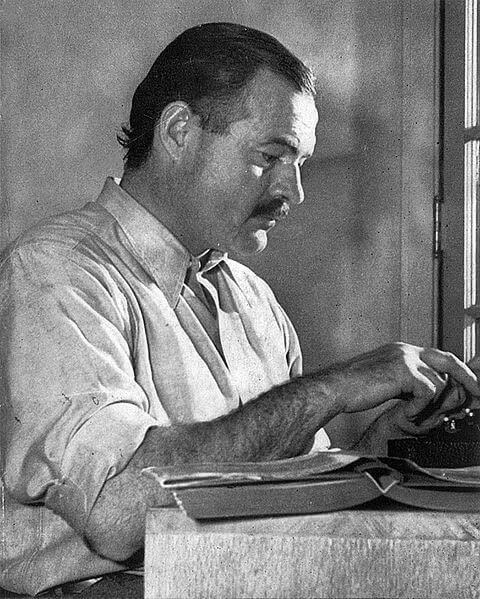
by Ernest Hemingway
The End of Something is Chapter III of Hemingway's short story collection, In Our Time, published in 1925.
We were in a garden in Mons. Young Buckley came in with his patrol from across the river. The first German I saw climbed up over the garden wall. We waited till he got one leg over and then potted him. He had so much equipment on and looked awfully surprised and fell down into the garden. Then three more came over further down the wall. We shot them. They all came just like that.
_________________________________________________________________________________________
In the old days Hortons Bay was a lumbering town. No one who lived in it was out of sound of the big saws in the mill by the lake. Then one year there were no more logs to make lumber. The lumber schooners came into the bay and were loaded with the cut of the mill that stood stacked in the yard. All the piles of lumber were carried away. The big mill building had all its machinery that was removable taken out and hoisted on board one of the schooners by the men who had worked in the mill. The schooner moved out of the bay toward the open lake carrying the two great saws, the traveling carriage that hurled the logs against the revolving, circular saws and all the rollers, wheels, belts and iron piled on a hull-keep load of lumber. Its open hold covered with canvas and lashed tight, the sails of the schooner filled and it moved out into the open lake, carrying with it everything that had made the mill a mill and Hortons Bay, a town.
The one-story bunk houses, the eating-house, the company store, the mill offices, and the big mill itself stood deserted in the acres of sawdust that covered the swampy meadow by the shore of the bay.
Ten years later there was nothing of the mill left except the broken white limestone of its foundations showing through the swampy sec觔nd growth as Nick and Marjorie rowed along the shore. They were trolling along the edge of the channel-bank where the bottom dropped off suddenly from sandy shallows to twelve feet of dark water. They were trolling on their way to the point to set night lines for rainbow trout.
"There's our old ruin, Nick," Marjorie said.
Nick, rowing, looked at the white stone in the green trees.
"There it is," he said.
"Can you remember when it was a mill?" Marjorie asked.
"I can just remember," Nick said.
"It seems more like a castle," Marjorie said.
Nick said nothing. They rowed on out of sight of the mill, following the shore line. Then Nick cut across the bay.
"They aren't striking," he said.
"No," Marjorie said. She was intent on the rod all the time they trolled, even when she talked. She loved to fish. She loved to fish with Nick.
Close beside the boat a big trout broke the surface of the water. Nick pulled hard on one oar so the boat would turn and the bait spinning far behind would pass where the trout was feeding. As the trout's back came up out of the water the minnows jumped wildly. They sprinkled the surface like a handful of shot thrown into the water. Another trout broke water, feed虹ng on the other side of the boat.
"They're feeding," Marjorie said.
"But they won't strike," Nick said.
He rowed the boat around to troll past both the feeding fish, then headed it for the point. Marjorie did not reel in until the boat touched the shore.
They pulled the boat up the beach and Nick lifted out a pail of live perch. The perch swam in the water in the pail. Nick caught three of them with his hands and cut their heads off and skinned them while Marjorie chased with her hands in the bucket, finally caught a perch, cut its head off and skinned it. Nick looked at her fish.
"You don't want to take the ventral fin out," he said. "It'll be all right for bait but it's better with the ventral fin in."
He hooked each of the skinned perch through the tail. There were two hooks attached to a leader on each rod. Then Marjorie rowed the boat out over the channel-bank, holding the line in her teeth, and looking toward Nick, who stood on the shore holding the rod and letting the line run out from the reel.
"That's about right," he called.
"Should I let it drop?" Marjorie called back, holding the line in her hand.
"Sure. Let it go." Marjorie dropped the line overboard and watched the baits go down through the water.
She came in with the boat and ran the second line out the same way. Each time Nick set a heavy slab of driftwood across the butt of the rod to hold it solid and propped it up at an angle with a small slab. He reeled in the slack line so the line ran taut out to where the bait rested on the sandy floor of the channel and set the click on the reel. When a trout, feeding on the bottom, took the bait it would run with it, taking line out of the reel in a rush and making the reel sing with the click on.
Marjorie rowed up the point a little way so she would not disturb the line. She pulled hard on the oars and the boat went way up the beach. Little waves came in with it. Marjorie stepped out of the boat and Nick pulled the boat high up the beach.
"What's the matter, Nick?" Marjorie asked.
"I don't know," Nick said, getting wood for a fire.
They made a fire with driftwood. Marjorie went to the boat and brought a blanket. The evening breeze blew the smoke toward the point, so Marjorie spread the blanket out between the fire and the lake.
Marjorie sat on the blanket with her back to the fire and waited for Nick. He came over and sat down beside her on the blanket. In back of them was the close second-growth timber of the point and in front was the bay with the mouth of Hortons Creek. It was not quite dark. The firelight went as far as the water. They could both see the two steel rods at an angle over the dark water. The fire glinted on the reels.
Marjorie unpacked the basket of supper.
"I don't feel like eating," said Nick.
"Come on and eat, Nick."
"All right."
They ate without talking, and watched the two rods and the fire-light in the water.
"There's going to be a moon tonight," said Nick. He looked across the bay to the hills that were beginning to sharpen against the sky. Beyond the hills he knew the moon was com虹ng up.
"I know it," Marjorie said happily.
"You know everything," Nick said.
"Oh, Nick, please cut it out! Please, please don't be that way!"
"I can't help it," Nick said. "You do. You know everything. That's the trouble. You know you do."
Marjorie did not say anything.
"I've taught you everything. You know you do. What don't you know, anyway?"
"Oh, shut up," Marjorie said. "There comes the moon."
They sat on the blanket without touching each other and watched the moon rise.
"You don't have to talk silly," Marjorie said; "what's really the matter?"
"I don't know."
"Of course you know."
"No I don't."
"Go on and say it."
Nick looked on at the moon, coming up over the hills.
"It isn't fun any more."
He was afraid to look at Marjorie. Then he looked at her. She sat there with her back toward him. He looked at her back. "It isn't fun any more. Not any of it."
She didn't say anything. He went on. "I feel as though everything was gone to hell inside of me. I don't know, Marge. I don't know what to say."
He looked on at her back.
"Isn't love any fun?" Marjorie said.
"No," Nick said. Marjorie stood up. Nick sat there, his head in his hands.
"I'm going to take the boat," Marjorie called to him. "You can walk back around the point."
"All right," Nick said. "I'll push the boat off for you."
"You don't need to," she said. She was afloat in the boat on the water with the moonlight on it. Nick went back and lay down with his face in the blanket by the fire. He could hear Marjorie rowing on the water.
He lay there for a long time. He lay there while he heard Bill come into the clearing, walking around through the woods. He felt Bill coming up to the fire. Bill didn't touch him, either.
"Did she go all right?" Bill said.
"Oh, yes." Nick said, lying, his face on the blanket.
"Have a scene?"
"No, there wasn't any scene."
"How do you feel?"
"Oh, go away, Bill! Go away for a while."
Bill selected a sandwich from the lunch basket and walked over to have a look at the rods.
Frequently Asked Questions about The End of Something
What is "The End of Something" by Ernest Hemingway about?
The End of Something follows Nick Adams and his girlfriend Marjorie on a fishing trip to Hortons Bay, a former lumber town in northern Michigan. As they troll for trout and set night lines, Nick grows increasingly withdrawn and irritable. After they eat supper by a fire on the beach, Nick finally tells Marjorie that their relationship is over — "It isn't fun any more. Not any of it." Marjorie takes the boat and rows away in the moonlight, leaving Nick lying face-down on the blanket. His friend Bill then emerges from the woods, revealing that the breakup was premeditated. The story parallels the death of the lumber town with the death of Nick's romance, using the abandoned mill as a metaphor for a relationship that has been stripped of everything that gave it life.
What are the main themes in "The End of Something"?
The central theme is the end of romantic love and the pain of outgrowing a relationship. Nick's feelings for Marjorie have faded, but he cannot articulate why — his explanation that it "isn't fun any more" is deliberately inadequate. Change and loss are established in the opening paragraph through the dismantling of the lumber mill, which parallels the dismantling of the relationship. Masculine emotional limitation is another key theme: Nick is unable to express his feelings honestly, resorting to vague, almost cruel language that leaves Marjorie without a real explanation. The story also explores the gap between what people feel and what they can say — a quintessential Hemingway concern.
What does the abandoned lumber mill symbolize?
The opening paragraph describes how the lumber mill at Hortons Bay was systematically stripped of its machinery and carried away by schooner, leaving nothing behind but broken limestone foundations in the swamp. This extended metaphor foreshadows the dismantling of Nick and Marjorie's relationship. Just as the town lost everything that made it a town, Nick's love has been emptied of everything that made it meaningful. Marjorie calls the ruins "our old ruin" and says it looks "like a castle," revealing her romantic attachment to the past — she sees beauty in what remains, while Nick sees only what's gone. The contrast between their perceptions of the mill mirrors their diverging feelings about each other.
Why does Nick break up with Marjorie?
Nick never gives a satisfying reason, and that ambiguity is central to the story. He says "It isn't fun any more" and "I feel as though everything was gone to hell inside of me," but these are descriptions of his emotional state, not explanations. Some scholars interpret Nick's restlessness as a rejection of domesticity and commitment — he has taught Marjorie to fish and she now "knows everything," which has eliminated the dynamic that once gave him purpose. Others see the breakup as symptomatic of Nick's larger post-war disillusionment. The presence of Bill, who was waiting in the woods, suggests the breakup was planned in advance, making Nick's halting manner more about the difficulty of executing a decision than about making one.
What is the significance of Bill waiting in the woods?
Bill's appearance at the end reveals that the breakup was premeditated — Nick planned this evening as the moment to end things, and Bill was waiting nearby for it to be over. His casual question "Did she go all right?" and "Have a scene?" suggest he may have encouraged the breakup. Bill's presence complicates Nick's apparent anguish: was Nick genuinely struggling with his emotions, or performing reluctance for his own conscience? When Nick tells Bill to "Go away for a while," it may be genuine distress — or it may be embarrassment at how easily he went through with it. Bill is also the protagonist of the companion story The Three Day Blow, where the two discuss the breakup further.
What literary devices does Hemingway use in "The End of Something"?
The story is built on an extended metaphor: the death of Hortons Bay as a lumber town parallels the death of Nick's relationship with Marjorie. Symbolism pervades the fishing scenes — the trout that are feeding but won't strike mirror Nick, who is present but refuses to commit. The iceberg theory is at its most effective in the breakup dialogue, where Nick's terse, evasive responses ("I don't know") conceal deeper feelings he cannot access. Pathetic fallacy operates subtly: the moonrise that Marjorie greets happily — "There comes the moon" — contrasts with the emotional darkness Nick feels. And juxtaposition between Marjorie's enthusiasm for fishing and Nick's mechanical detachment reveals the emotional asymmetry long before the breakup is spoken.
How does Marjorie react to the breakup?
Marjorie's reaction demonstrates remarkable composure and dignity. She doesn't cry, beg, or make a scene — the very absence of drama that Bill later asks about. She asks the devastating question "Isn't love any fun?" which cuts through Nick's evasions with painful clarity. Then she simply stands up, announces she's taking the boat, and rows away in the moonlight. Her only moment of firmness is refusing Nick's offer to push the boat off: "You don't need to." Marjorie's restraint is both heartbreaking and quietly powerful — she handles the end of the relationship with more honesty and grace than Nick, who lies face-down in the blanket unable to face what he's done.
What does "You know everything" mean when Nick says it to Marjorie?
On the surface, Nick is complaining that Marjorie has become too competent a fishing partner — he has taught her everything he knows and the teacher-student dynamic that structured their relationship is gone. But the phrase carries deeper significance. It suggests Nick is threatened by Marjorie's competence and no longer comfortable with a partner who meets him as an equal. It also reflects his inability to articulate his real feelings: "You know everything" is his way of saying the relationship has become too familiar, too predictable, too domestic. Marjorie's frustrated response — "Oh, Nick, please cut it out!" — shows she recognizes the hostility but not yet its full implication.
When was "The End of Something" published?
The End of Something was published in 's 1925 collection In Our Time. The story is based on Hemingway's own breakup with his first serious girlfriend, Marjorie Bump, in the summer of 1919 at Hortons Bay, Michigan, where his family summered. The real breakup was reportedly engineered with the help of his friend Bill Smith — the basis for the character Bill in the story. It is one of the earliest Nick Adams stories and is often taught alongside its companion piece, The Three Day Blow, which continues the conversation between Nick and Bill after Marjorie's departure.
How does fishing function as a metaphor in the story?
The fishing scenes operate as an extended metaphor for the relationship. The trout are "feeding" but "won't strike," mirroring Nick, who is physically present but emotionally refusing to engage. Marjorie is attentive to the fishing — "intent on the rod all the time" — just as she is attentive to the relationship, hoping Nick will take the bait of commitment. The careful process of setting night lines — baiting hooks, letting out line, waiting — parallels the domestic rituals of their romance, which have become mechanical for Nick even though Marjorie still finds meaning in them. When Nick says "I don't feel like eating" after they've set the lines, the refusal extends beyond food to everything the evening represents.
Save stories, build your reading list, and access all study tools — completely free.
Save The End of Something to your library — it's free!Need help with The End of Something?
Study tools to help with homework, prepare for quizzes, and deepen your understanding.
Flashcards → | Vocabulary →