The Battle of the Ants
by Henry David Thoreau
Please Note: The Battle of the Ants is not a stand-alone essay. It is excerpted from Thoreau's Walden Pond, Chapter 12: Brute Neighbors, presented here as a convenience to students and instructors.
"I have no doubt that it was a principle they fought for, as much as our ancestors, and not to avoid a three-penny tax on their tea; and the results of this battle will be as important and memorable to those whom it concerns as those of the battle of Bunker Hill, at least."
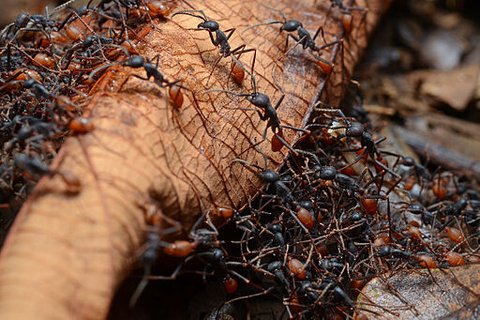
I was witness to events of a less peaceful character. One day when I went out to my wood-pile, or rather my pile of stumps, I observed two large ants, the one red, the other much larger, nearly half an inch long, and black, fiercely contending with one another. Having once got hold they never let go, but struggled and wrestled and rolled on the chips incessantly. Looking farther, I was surprised to find that the chips were covered with such combatants, that it was not a duellum, but a bellum, a war between two races of ants, the red always pitted against the black, and frequently two red ones to one black. The legions of these Myrmidons covered all the hills and vales in my wood-yard, and the ground was already strewn with the dead and dying, both red and black. It was the only battle which I have ever witnessed, the only battle-field I ever trod while the battle was raging; internecine war; the red republicans on the one hand, and the black imperialists on the other. On every side they were engaged in deadly combat, yet without any noise that I could hear, and human soldiers never fought so resolutely. I watched a couple that were fast locked in each other's embraces, in a little sunny valley amid the chips, now at noonday prepared to fight till the sun went down, or life went out. The smaller red champion had fastened himself like a vice to his adversary's front, and through all the tumblings on that field never for an instant ceased to gnaw at one of his feelers near the root, having already caused the other to go by the board; while the stronger black one dashed him from side to side, and, as I saw on looking nearer, had already divested him of several of his members. They fought with more pertinacity than bulldogs. Neither manifested the least disposition to retreat. It was evident that their battle-cry was "Conquer or die." In the meanwhile there came along a single red ant on the hillside of this valley, evidently full of excitement, who either had despatched his foe, or had not yet taken part in the battle; probably the latter, for he had lost none of his limbs; whose mother had charged him to return with his shield or upon it. Or perchance he was some Achilles, who had nourished his wrath apart, and had now come to avenge or rescue his Patroclus. He saw this unequal combat from afar -- for the blacks were nearly twice the size of the red -- he drew near with rapid pace till he stood on his guard within half an inch of the combatants; then, watching his opportunity, he sprang upon the black warrior, and commenced his operations near the root of his right fore leg, leaving the foe to select among his own members; and so there were three united for life, as if a new kind of attraction had been invented which put all other locks and cements to shame. I should not have wondered by this time to find that they had their respective musical bands stationed on some eminent chip, and playing their national airs the while, to excite the slow and cheer the dying combatants. I was myself excited somewhat even as if they had been men. The more you think of it, the less the difference. And certainly there is not the fight recorded in Concord history, at least, if in the history of America, that will bear a moment's comparison with this, whether for the numbers engaged in it, or for the patriotism and heroism displayed. For numbers and for carnage it was an Austerlitz or Dresden. Concord Fight! Two killed on the patriots' side, and Luther Blanchard wounded! Why here every ant was a Buttrick -- "Fire! for God's sake fire!" -- and thousands shared the fate of Davis and Hosmer. There was not one hireling there. I have no doubt that it was a principle they fought for, as much as our ancestors, and not to avoid a three-penny tax on their tea; and the results of this battle will be as important and memorable to those whom it concerns as those of the battle of Bunker Hill, at least.
I took up the chip on which the three I have particularly described were struggling, carried it into my house, and placed it under a tumbler on my window-sill, in order to see the issue. Holding a microscope to the first-mentioned red ant, I saw that, though he was assiduously gnawing at the near fore leg of his enemy, having severed his remaining feeler, his own breast was all torn away, exposing what vitals he had there to the jaws of the black warrior, whose breastplate was apparently too thick for him to pierce; and the dark carbuncles of the sufferer's eyes shone with ferocity such as war only could excite. They struggled half an hour longer under the tumbler, and when I looked again the black soldier had severed the heads of his foes from their bodies, and the still living heads were hanging on either side of him like ghastly trophies at his saddle-bow, still apparently as firmly fastened as ever, and he was endeavoring with feeble struggles, being without feelers and with only the remnant of a leg, and I know not how many other wounds, to divest himself of them; which at length, after half an hour more, he accomplished. I raised the glass, and he went off over the window-sill in that crippled state. Whether he finally survived that combat, and spent the remainder of his days in some Hotel des Invalides, I do not know; but I thought that his industry would not be worth much thereafter. I never learned which party was victorious, nor the cause of the war; but I felt for the rest of that day as if I had had my feelings excited and harrowed by witnessing the struggle, the ferocity and carnage, of a human battle before my door.
Kirby and Spence tell us that the battles of ants have long been celebrated and the date of them recorded, though they say that Huber is the only modern author who appears to have witnessed them. "AEneas Sylvius," say they, "after giving a very circumstantial account of one contested with great obstinacy by a great and small species on the trunk of a pear tree," adds that "this action was fought in the pontificate of Eugenius the Fourth, in the presence of Nicholas Pistoriensis, an eminent lawyer, who related the whole, history of the battle with the greatest fidelity." A similar engagement between great and small ants is recorded by Olaus Magnus, in which the small ones, being victorious, are said to have buried the bodies of their own soldiers, but left those of their giant enemies a prey to the birds. This event happened previous to the expulsion of the tyrant Christiern the Second from Sweden." The battle which I witnessed took place in the Presidency of Polk, five years before the passage of Webster's Fugitive-Slave Bill.
Again, this is not a stand-alone essay. It is simply an excerpt. You can read the passage in the context in Walden Pond where it is located in Chapter 12: Brute Neighbors.
You may also enjoy Leiningen Versus the Ants by Carl Stephenson.
Frequently Asked Questions about The Battle of the Ants
What is "The Battle of the Ants" by Thoreau about?
The Battle of the Ants is an excerpt from Chapter XII ("Brute Neighbors") of Walden in which describes a ferocious war between red and black ants on his woodpile. What begins as a simple nature observation escalates into an epic narrative as Thoreau compares the tiny combatants to Greek and Trojan warriors, transforming a backyard skirmish into a meditation on the futility of war.
What is the theme of "The Battle of the Ants"?
The central theme is the futility and absurdity of war. By describing an ant battle with the same language used for human warfare—valor, sacrifice, patriotism—Thoreau satirizes the glorification of military conflict. He suggests that human wars are no more meaningful than ant wars when viewed from a sufficient distance, and that the "principles" nations fight over may be as trivial as a dispute over a woodpile. A secondary theme is the blurred line between civilization and nature, as the ants display the same ferocity humans claim to have transcended.
What literary devices does Thoreau use in "The Battle of the Ants"?
Thoreau employs several devices to brilliant effect. Mock-epic style elevates the ant fight to the level of the Iliad, comparing the combatants to Achilles and Patroclus. Personification gives the ants human qualities—courage, determination, battle cries of “Conquer or die.” Allegory makes the ant war stand in for human conflict. Satire deflates the heroism of warfare by showing its patterns repeated among insects. Irony pervades the piece, as the grandeur of Thoreau's language contrasts with the tiny scale of the combatants.
What do the ants symbolize in Thoreau's "The Battle of the Ants"?
The ants symbolize humanity's instinct for conflict and destruction. The red ants, which Thoreau compares to Republicans, and the black ants, which he likens to Imperialists, represent opposing factions in human political and military struggles. Their willingness to fight to the death over territory mirrors the way nations sacrifice lives for causes that appear meaningless when viewed from a broader perspective. The ants also symbolize nature's indifference to individual suffering.
Is "The Battle of the Ants" an allegory for war?
Yes, the passage is widely read as an allegory for human warfare. Thoreau explicitly draws parallels between the ant conflict and famous human battles, comparing the scene to the battles of Concord and Austerlitz. By applying epic conventions to insects, he creates a satirical commentary on how humans glorify violence. The allegory works on multiple levels: it critiques specific wars of Thoreau's era (including the Mexican–American War) and questions whether any war is truly fought for noble principles.
Where does "The Battle of the Ants" appear in Walden?
The passage appears in Chapter XII, "Brute Neighbors," of Walden, published in 1854. The chapter explores Thoreau's observations of the wildlife around his cabin at Walden Pond—ants, loons, partridges, and other creatures. The ant battle section is the most famous part of the chapter and is frequently anthologized as a standalone essay for its vivid storytelling and incisive social commentary.
Why is "The Battle of the Ants" commonly taught in schools?
The passage is a staple of American literature curricula because it demonstrates several important literary concepts in a short, accessible text. Students can analyze allegory, satire, personification, and mock-epic style while engaging with Thoreau's anti-war message. The piece is also effective for teaching close reading—its humor and vivid imagery make it engaging for younger readers, while its layered critique of warfare rewards deeper analysis. It serves as an excellent introduction to both Thoreau and the broader Transcendentalist movement.
What historical battles does Thoreau reference in "The Battle of the Ants"?
Thoreau references several famous battles to elevate the ant war to epic proportions. He compares the scene to the Battle of Concord (1775)—fought in his own hometown—and to Austerlitz (1805), one of Napoleon's greatest victories. He also alludes to the warriors of Homer's Iliad, likening individual ants to Achilles and Patroclus. These references are deliberately ironic: by placing an ant fight alongside humanity's most celebrated battles, Thoreau questions whether any war deserves its heroic mythology.
Save stories, build your reading list, and access all study tools — completely free.
Save The Battle of the Ants to your library — it's free!Need help with The Battle of the Ants?
Study tools to help with homework, prepare for quizzes, and deepen your understanding.
Flashcards → | Vocabulary → | Study Guide →