The Law of Life
by Jack London
The Law of Life (1902) is a powerful meditation on aging, death, and the unyielding cycles of nature. An old man sits alone in the snow as his tribe moves on without him. "Nature was not kindly to the flesh. She had no concern for that concrete thing called the individual."
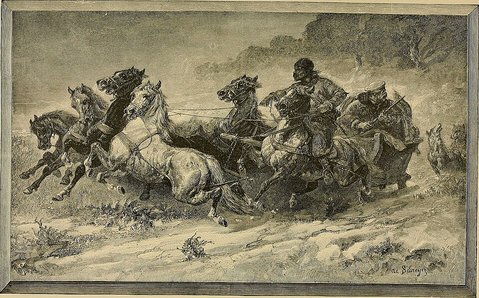
Old Koskoosh listened greedily. Though his sight had long since faded, his hearing was still acute, and the slightest sound penetrated to the glimmering intelligence which yet abode behind the withered forehead, but which no longer gazed forth upon the things of the world. Ah! that was Sit-cum-to-ha, shrilly anathematizing the dogs as she cuffed and beat them into the harnesses. Sit-cum-to-ha was his daughter's daughter, but she was too busy to waste a thought upon her broken grandfather, sitting alone there in the snow, forlorn and helpless. Camp must be broken. The long trail waited while the short day refused to linger. Life called her, and the duties of life, not death. And he was very close to death now.
The thought made the old man panicky for the moment, and he stretched forth a palsied hand which wandered tremblingly over the small heap of dry wood beside him. Reassured that it was indeed there, his hand returned to the shelter of his mangy furs, and he again fell to listening. The sulky crackling of half-frozen hides told him that the chief's moose-skin lodge had been struck, and even then was being rammed and jammed into portable compass. The chief was his son, stalwart and strong, head man of the tribesmen, and a mighty hunter. As the women toiled with the camp luggage, his voice rose, chiding them for their slowness. Old Koskoosh strained his ears. It was the last time he would hear that voice. There went Geehow's lodge! And Tusken's! Seven, eight, nine; only the shaman's could be still standing. There! They were at work upon it now. He could hear the shaman grunt as he piled it on the sled. A child whimpered, and a woman soothed it with soft, crooning gutturals. Little Koo-tee, the old man thought, a fretful child, and not overstrong. It would die soon, perhaps, and they would burn a hole through the frozen tundra and pile rocks above to keep the wolverines away. Well, what did it matter? A few years at best, and as many an empty belly as a full one. And in the end, Death waited, ever-hungry and hungriest of them all.
What was that? Oh, the men lashing the sleds and drawing tight the thongs. He listened, who would listen no more. The whip-lashes snarled and bit among the dogs. Hear them whine! How they hated the work and the trail! They were off! Sled after sled churned slowly away into the silence. They were gone. They had passed out of his life, and he faced the last bitter hour alone. No. The snow crunched beneath a moccasin; a man stood beside him; upon his head a hand rested gently. His son was good to do this thing. He remembered other old men whose sons had not waited after the tribe. But his son had. He wandered away into the past, till the young man's voice brought him back.
"Is it well with you?" he asked.
And the old man answered, "It is well."
"There be wood beside you," the younger man continued, "and the fire burns bright. The morning is gray, and the cold has broken. It will snow presently. Even now is it snowing."
"Ay, even now is it snowing."
"The tribesmen hurry. Their bales are heavy, and their bellies flat with lack of feasting. The trail is long and they travel fast. I go now. It is well?"
"It is well. I am as a last year's leaf, clinging lightly to the stem. The first breath that blows, and I fall. My voice is become like an old woman's. My eyes no longer show me the way of my feet, and my feet are heavy, and I am tired. It is well."
He bowed his head in content till the last noise of the complaining snow had died away, and he knew his son was beyond recall. Then his hand crept out in haste to the wood. It alone stood between him and the eternity that yawned in upon him. At last the measure of his life was a handful of fagots. One by one they would go to feed the fire, and just so, step by step, death would creep upon him. When the last stick had surrendered up its heat, the frost would begin to gather strength. First his feet would yield, then his hands; and the numbness would travel, slowly, from the extremities to the body. His head would fall forward upon his knees, and he would rest. It was easy. All men must die.
He did not complain. It was the way of life, and it was just. He had been born close to the earth, close to the earth had he lived, and the law thereof was not new to him. It was the law of all flesh. Nature was not kindly to the flesh. She had no concern for that concrete thing called the individual. Her interest lay in the species, the race. This was the deepest abstraction old Koskoosh's barbaric mind was capable of, but he grasped it firmly. He saw it exemplified in all life. The rise of the sap, the bursting greenness of the willow bud, the fall of the yellow leaf--in this alone was told the whole history. But one task did Nature set the individual. Did he not perform it, he died. Did he perform it, it was all the same, he died. Nature did not care; there were plenty who were obedient, and it was only the obedience in this matter, not the obedient, which lived and lived always. The tribe of Koskoosh was very old. The old men he had known when a boy, had known old men before them. Therefore it was true that the tribe lived, that it stood for the obedience of all its members, way down into the forgotten past, whose very resting-places were unremembered. They did not count; they were episodes. They had passed away like clouds from a summer sky. He also was an episode, and would pass away. Nature did not care. To life she set one task, gave one law. To perpetuate was the task of life, its law was death. A maiden was a good creature to look upon, full-breasted and strong, with spring to her step and light in her eyes. But her task was yet before her. The light in her eyes brightened, her step quickened, she was now bold with the young men, now timid, and she gave them of her own unrest. And ever she grew fairer and yet fairer to look upon, till some hunter, able no longer to withhold himself, took her to his lodge to cook and toil for him and to become the mother of his children. And with the coming of her offspring her looks left her. Her limbs dragged and shuffled, her eyes dimmed and bleared, and only the little children found joy against the withered cheek of the old squaw by the fire. Her task was done. But a little while, on the first pinch of famine or the first long trail, and she would be left, even as he had been left, in the snow, with a little pile of wood. Such was the law.
He placed a stick carefully upon the fire and resumed his meditations. It was the same everywhere, with all things. The mosquitoes vanished with the first frost. The little tree-squirrel crawled away to die. When age settled upon the rabbit it became slow and heavy, and could no longer outfoot its enemies. Even the big bald-face grew clumsy and blind and quarrelsome, in the end to be dragged down by a handful of yelping huskies. He remembered how he had abandoned his own father on an upper reach of the Klondike one winter, the winter before the missionary came with his talk-books and his box of medicines. Many a time had Koskoosh smacked his lips over the recollection of that box, though now his mouth refused to moisten. The "painkiller" had been especially good. But the missionary was a bother after all, for he brought no meat into the camp, and he ate heartily, and the hunters grumbled. But he chilled his lungs on the divide by the Mayo, and the dogs afterwards nosed the stones away and fought over his bones.
Koskoosh placed another stick on the fire and harked back deeper into the past. There was the time of the Great Famine, when the old men crouched empty-bellied to the fire, and let fall from their lips dim traditions of the ancient day when the Yukon ran wide open for three winters, and then lay frozen for three summers. He had lost his mother in that famine. In the summer the salmon run had failed, and the tribe looked forward to the winter and the coming of the caribou. Then the winter came, but with it there were no caribou. Never had the like been known, not even in the lives of the old men. But the caribou did not come, and it was the seventh year, and the rabbits had not replenished, and the dogs were naught but bundles of bones. And through the long darkness the children wailed and died, and the women, and the old men; and not one in ten of the tribe lived to meet the sun when it came back in the spring. That was a famine!
But he had seen times of plenty, too, when the meat spoiled on their hands, and the dogs were fat and worthless with overeating--times when they let the game go unkilled, and the women were fertile, and the lodges were cluttered with sprawling men-children and women-children. Then it was the men became high-stomached, and revived ancient quarrels, and crossed the divides to the south to kill the Pellys, and to the west that they might sit by the dead fires of the Tananas. He remembered, when a boy, during a time of plenty, when he saw a moose pulled down by the wolves. Zing-ha lay with him in the snow and watched--Zing-ha, who later became the craftiest of hunters, and who, in the end, fell through an air-hole on the Yukon. They found him, a month afterward, just as he had crawled halfway out and frozen stiff to the ice.
But the moose. Zing-ha and he had gone out that day to play at hunting after the manner of their fathers. On the bed of the creek they struck the fresh track of a moose, and with it the tracks of many wolves. "An old one," Zing-ha, who was quicker at reading the sign, said--"an old one who cannot keep up with the herd. The wolves have cut him out from his brothers, and they will never leave him." And it was so. It was their way. By day and by night, never resting, snarling on his heels, snapping at his nose, they would stay by him to the end. How Zing-ha and he felt the blood-lust quicken! The finish would be a sight to see!
Eager-footed, they took the trail, and even he, Koskoosh, slow of sight and an unversed tracker, could have followed it blind, it was so wide. Hot were they on the heels of the chase, reading the grim tragedy, fresh-written, at every step. Now they came to where the moose had made a stand. Thrice the length of a grown man's body, in every direction, had the snow been stamped about and uptossed. In the midst were the deep impressions of the splay-hoofed game, and all about, everywhere, were the lighter footmarks of the wolves. Some, while their brothers harried the kill, had lain to one side and rested. The full-stretched impress of their bodies in the snow was as perfect as though made the moment before. One wolf had been caught in a wild lunge of the maddened victim and trampled to death. A few bones, well picked, bore witness.
Again, they ceased the uplift of their snowshoes at a second stand. Here the great animal had fought desperately. Twice had he been dragged down, as the snow attested, and twice had he shaken his assailants clear and gained footing once more. He had done his task long since, but none the less was life dear to him. Zing-ha said it was a strange thing, a moose once down to get free again; but this one certainly had. The shaman would see signs and wonders in this when they told him.
And yet again, they come to where the moose had made to mount the bank and gain the timber. But his foes had laid on from behind, till he reared and fell back upon them, crushing two deep into the snow. It was plain the kill was at hand, for their brothers had left them untouched. Two more stands were hurried past, brief in time-length and very close together. The trail was red now, and the clean stride of the great beast had grown short and slovenly. Then they heard the first sounds of the battle--not the full-throated chorus of the chase, but the short, snappy bark which spoke of close quarters and teeth to flesh. Crawling up the wind, Zing-ha bellied it through the snow, and with him crept he, Koskoosh, who was to be chief of the tribesmen in the years to come. Together they shoved aside the under branches of a young spruce and peered forth. It was the end they saw.
The picture, like all of youth's impressions, was still strong with him, and his dim eyes watched the end played out as vividly as in that far-off time. Koskoosh marvelled at this, for in the days which followed, when he was a leader of men and a head of councillors, he had done great deeds and made his name a curse in the mouths of the Pellys, to say naught of the strange white man he had killed, knife to knife, in open fight.
For long he pondered on the days of his youth, till the fire died down and the frost bit deeper. He replenished it with two sticks this time, and gauged his grip on life by what remained. If Sit-cum-to-ha had only remembered her grandfather, and gathered a larger armful, his hours would have been longer. It would have been easy. But she was ever a careless child, and honored not her ancestors from the time the Beaver, son of the son of Zing-ha, first cast eyes upon her. Well, what mattered it? Had he not done likewise in his own quick youth? For a while he listened to the silence. Perhaps the heart of his son might soften, and he would come back with the dogs to take his old father on with the tribe to where the caribou ran thick and the fat hung heavy upon them.
He strained his ears, his restless brain for the moment stilled. Not a stir, nothing. He alone took breath in the midst of the great silence. It was very lonely. Hark! What was that? A chill passed over his body. The familiar, long-drawn howl broke the void, and it was close at hand. Then on his darkened eyes was projected the vision of the moose--the old bull moose--the torn flanks and bloody sides, the riddled mane, and the great branching horns, down low and tossing to the last. He saw the flashing forms of gray, the gleaming eyes, the lolling tongues, the slavered fangs. And he saw the inexorable circle close in till it became a dark point in the midst of the stamped snow.
A cold muzzle thrust against his cheek, and at its touch his soul leaped back to the present. His hand shot into the fire and dragged out a burning faggot. Overcome for the nonce by his hereditary fear of man, the brute retreated, raising a prolonged call to his brothers; and greedily they answered, till a ring of crouching, jaw-slobbered gray was stretched round about. The old man listened to the drawing in of this circle. He waved his brand wildly, and sniffs turned to snarls; but the panting brutes refused to scatter. Now one wormed his chest forward, dragging his haunches after, now a second, now a third; but never a one drew back. Why should he cling to life? he asked, and dropped the blazing stick into the snow. It sizzled and went out. The circle grunted uneasily, but held its own. Again he saw the last stand of the old bull moose, and Koskoosh dropped his head wearily upon his knees. What did it matter after all? Was it not the law of life?
Frequently Asked Questions about The Law of Life
What is "The Law of Life" by Jack London about?
The Law of Life follows the final hours of Old Koskoosh, a blind, aging former chief of an Inuit tribe who is left behind in the snow as his people move on to follow the caribou. His son, now the head man, leaves him with a small pile of firewood and a burning fire — the only barrier between Koskoosh and death. As he sits alone, Koskoosh reflects on the cycles of life he has witnessed: famines, times of plenty, the deaths of old men and old animals. His central meditation is on a childhood memory of watching wolves chase down an old bull moose — a scene that parallels his own fate. The story ends as wolves close in around Koskoosh, and he drops his last burning stick into the snow, accepting that his death is simply "the law of life."
What is the theme of "The Law of Life"?
The central theme of The Law of Life is the inevitability of death and nature's indifference to the individual. Koskoosh articulates this as a philosophical principle: "Nature was not kindly to the flesh. She had no concern for that concrete thing called the individual. Her interest lay in the species, the race." A related theme is the cycle of life and death — Koskoosh sees this law operating in everything from the fall of a yellow leaf to the death of an old moose. The story also explores acceptance versus resistance: Koskoosh ultimately chooses to accept his fate rather than fight it, dropping his burning brand and letting the wolves close in. Finally, the role of the individual within the community is examined — the tribe must move on to survive, even at the cost of leaving its elder behind.
What does the fire symbolize in "The Law of Life"?
The fire in The Law of Life symbolizes life itself. The small pile of firewood beside Koskoosh literally measures the time he has left — "At last the measure of his life was a handful of fagots. One by one they would go to feed the fire, and just so, step by step, death would creep upon him." As each stick burns away, Koskoosh's remaining lifespan shrinks. The fire also represents humanity's fragile ability to hold nature at bay: it keeps the wolves at a distance, but only temporarily. When Koskoosh drops his last burning stick into the snow and it "sizzled and went out," this act symbolizes his conscious surrender to the natural law he has been contemplating. The extinguishing of the fire mirrors the extinguishing of his life.
What is the significance of the old bull moose in "The Law of Life"?
The old bull moose that Koskoosh remembers watching as a boy serves as a direct parallel to Koskoosh's own death. Just as the moose was cut out from its herd by wolves because it was old and could no longer keep up, Koskoosh has been left behind by his tribe because he is old and blind. The moose fought desperately — it made multiple stands, threw off its attackers, and crushed wolves beneath it — yet was ultimately brought down by the encircling pack. As the wolves close in on Koskoosh at the story's end, the vision of the moose returns to him: "the torn flanks and bloody sides, the riddled mane, and the great branching horns, down low and tossing to the last." The moose embodies the universality of the law of life — it applies equally to humans and animals, the powerful and the weak.
What literary devices does Jack London use in "The Law of Life"?
uses several key literary devices in this story. Parallelism is the most structurally important: the story of the old moose being hunted by wolves directly parallels Koskoosh's own death, making the theme of nature's universal law concrete and visceral. Symbolism pervades the story — the dwindling firewood represents remaining life, the wolves represent death itself, and Koskoosh's comparison of himself to "a last year's leaf, clinging lightly to the stem" uses natural imagery to express human mortality. Personification appears when London writes of Death as "ever-hungry and hungriest of them all" and Nature as a conscious force with specific interests. The stream-of-consciousness narration, filtering the entire story through Koskoosh's memories and reflections, creates an intimate portrait of a mind confronting its own end.
When was "The Law of Life" published?
The Law of Life was first published in 1901 in McClure's Magazine and was later included in 's 1902 collection Children of the Frost. It is one of London's earliest and most philosophically ambitious short stories, written during the period when he was drawing heavily on his experiences prospecting for gold in the Yukon during the Klondike Gold Rush of 1897-1898. The story's fatalistic tone and focus on Darwinian natural laws are characteristic of the literary naturalism movement that London helped define in American literature.
What happens at the end of "The Law of Life"?
At the story's end, Koskoosh hears the howl of a wolf close at hand, and the vision of the old bull moose — torn, bloodied, but fighting to the last — flashes before his blind eyes. A cold muzzle presses against his cheek, and he instinctively grabs a burning stick from the fire to ward off the wolf. The wolf retreats and howls to summon its pack, and soon a ring of wolves encircles him. Koskoosh waves the brand wildly, but the wolves refuse to scatter. Then he asks himself, "Why should he cling to life?" and drops the burning stick into the snow, where it sizzles and goes out. The wolves hold their circle. Koskoosh sees once more the image of the old moose in its last stand, then drops his head wearily upon his knees and thinks, "What did it matter after all? Was it not the law of life?" The ending is left deliberately ambiguous — we do not witness the actual death, only the acceptance of it.
Is "The Law of Life" an example of naturalism?
Yes, The Law of Life is one of the clearest examples of literary naturalism in American fiction. Naturalism, influenced by Charles Darwin's theory of evolution and Emile Zola's literary theories, depicts characters whose fates are determined by natural forces beyond their control. The story embodies every hallmark of the movement: the idea that nature is indifferent to individual suffering, that survival depends on species rather than individuals, and that death is an impersonal biological process rather than a moral or spiritual event. Koskoosh's own philosophy — "To perpetuate was the task of life, its law was death" — is essentially a restatement of Darwinian natural selection. London's objective, unsentimental narration reinforces this perspective, presenting Koskoosh's death not as tragedy but as natural law.
Save stories, build your reading list, and access all study tools — completely free.
Save The Law of Life to your library — it's free!Need help with The Law of Life?
Study tools to help with homework, prepare for quizzes, and deepen your understanding.
Flashcards → | Study Guide →