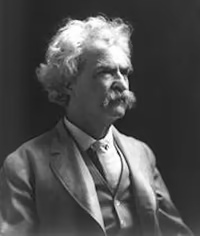
Quick Facts
Samuel Langhorne Clemens
Pen Name: Mark Twain
Born: November 30, 1835
Died: April 21, 1910
Nationality: American
Genres: Humor, Realism, Satire, Regional Fiction
Notable Works: Adventures of Huckleberry Finn, The Adventures of Tom Sawyer, A Connecticut Yankee in King Arthur's Court, The Prince and the Pauper, Life on the Mississippi
Born November 30, 1835 in Florida, Missouri, Mark Twain "came in with the comet" and as he predicted "went out with the comet," passing April 21, 1910, the day after Halley's Comet made its closest approach to the sun. His real name was Samuel Langhorne Clemens, and he took his pen name from his days as a riverboat pilot on the Mississippi River, where the cry "mark twain" signaled the depth of two fathoms — about twelve feet — the minimum required for the safe passage of riverboats.
👶 Early Life and Education
Twain grew up in Hannibal, Missouri, a small town on the Mississippi River that would later serve as the setting for two of his most famous works, The Adventures of Huckleberry Finn and The Adventures of Tom Sawyer. His father died when he was eleven, and Twain left school to become an apprentice printer at a local newspaper. He worked as a typesetter, a printer, and eventually a riverboat pilot on the Mississippi — an experience that gave him both his pen name and an intimate knowledge of American life along the great river. When the Civil War disrupted river traffic in 1861, he briefly joined a Confederate militia before heading west to Nevada Territory with his brother Orion. He tried his hand at silver mining and, when that failed, turned to journalism.
📖 Career and Literary Breakthrough
It was during his time as a newspaper reporter in San Francisco that Twain wrote the short story that launched his career: The Celebrated Jumping Frog of Calaveras County (1865) — a story that captivated me when read out loud by one of my teachers in elementary school. The tale's humor and Twain's gift for vernacular storytelling made him an overnight sensation. His early travel book The Innocents Abroad (1869), based on his excursion to Europe and the Holy Land, became the best-selling book of the year and established him as a major literary voice.
Twain was a tremendously productive writer. His novels include the masterpiece Adventures of Huckleberry Finn (1884), The Adventures of Tom Sawyer (1876), The Prince and the Pauper (1881), A Connecticut Yankee in King Arthur's Court (1889), The Tragedy of Pudd'nhead Wilson (1894), and the memoir Life on the Mississippi (1883). His short stories — including The Man That Corrupted Hadleyburg, The War Prayer, Cannibalism in the Cars, and A True Story, Repeated Word for Word As I Heard It — showcase his range from broad comedy to biting social criticism. Children may also enjoy reading Mark Twain: A Child's Biography.
🎨 Writing Style
Twain was a talented writer, speaker, and humorist whose personality shone through every line of his work. He pioneered the use of American vernacular speech in literary fiction, giving characters like Huck Finn and Jim voices that sounded authentically American rather than imitation-British. His style was direct, conversational, and wickedly funny, blending humor with sharp social commentary. In his essay How to Tell a Story, Twain laid out his philosophy that the comic story "may be spun out to great length, and may wander around as much as it pleases, and arrive nowhere in particular" — the art was in the telling, not the tale.
As the young country grew in size but not in a cultural manner to the liking of the European gentry, it became fashionable to criticize "the ugly American." Twain famously traveled abroad and disarmed his audiences with his wit and humor, with pronouncements like: "In Paris they simply stared when I spoke to them in French; I never did succeed in making those idiots understand their language." As his writing grew in popularity, he became a public figure and iconic American whose work represents some of the best in the genre of Realism.
❤️ Personal Life
In 1870, Twain married Olivia Langdon, the daughter of a wealthy coal industrialist from Elmira, New York. Olivia was a devoted partner who served as his first editor, reviewing his manuscripts and tempering his more provocative passages. Together they had four children: Langdon (who died of diphtheria at nineteen months in 1872), Susy (1872-1896), Clara (1874-1962), and Jean (1880-1909). The family lived in a grand Victorian home in Hartford, Connecticut, where Twain wrote many of his greatest works during the 1870s and 1880s.
While Twain's career as a writer enriched him, his turn as a gentleman investor did much to impoverish him. He lost a great deal of his writing profits and much of his wife's inheritance on different investments, the costliest being his backing of the Paige typesetting machine — a promising device that failed in the market due to frequent breakdowns. Facing bankruptcy in 1894, Twain recovered financially with the help of Henry Huttleson Rogers, a Standard Oil executive who guided him through bankruptcy and even had Twain transfer his copyrights to Olivia to protect his royalties from creditors. Twain then embarked on a grueling worldwide lecture tour, and by 1898 he had paid every creditor in full — a feat that only enhanced his public reputation.
✨ Legacy and Death
Twain's later years were shadowed by personal tragedy. His daughter Susy died of meningitis in 1896 while her parents were abroad. Olivia, whose health had been fragile for years, died in Florence, Italy, in 1904. His youngest daughter Jean died of an epileptic seizure on Christmas Eve 1909. These losses darkened Twain's later writing, producing works of fierce pessimism like The Mysterious Stranger (published posthumously in 1916) and The War Prayer, which he withheld from publication during his lifetime, fearing public reaction to its bitter antiwar message.
Twain died of a heart attack on April 21, 1910, in Redding, Connecticut, one day after Halley's Comet made its closest approach to Earth. He had predicted it himself: "I came in with Halley's Comet in 1835. It is coming again next year, and I expect to go out with it. It will be the greatest disappointment of my life if I don't go out with Halley's Comet."
As Ernest Hemingway famously declared: "All modern American literature comes from one book by Mark Twain called Huckleberry Finn." William Faulkner called Twain "the father of American literature." Today, Twain remains the most quoted, most anthologized, and most beloved American author — a writer whose humor, humanity, and unflinching honesty continue to speak to readers around the world.
💬 Famous Quotes
Mark Twain is among the most quotable writers in the English language. A small sampling of his wit:
"The secret of getting ahead is getting started."
"Whenever you find yourself on the side of the majority, it is time to reform (or pause and reflect)."
"I have never let my schooling interfere with my education."
"Get your facts first, and then you can distort them as much as you please."
"Fiction is obliged to stick to possibilities. Truth isn't."
"A lie can travel halfway around the world while the truth is putting on its shoes."
"If you pick up a starving dog and make him prosperous, he will not bite you. This is the principal difference between a dog and a man."
"Suppose you were an idiot and suppose you were a member of Congress. But I repeat myself."
"It is better to keep your mouth closed and let people think you are a fool than to open it and remove all doubt."
"Always do right. This will gratify some people and astonish the rest."
Frequently Asked Questions about Mark Twain
Where can I find study guides for Mark Twain's stories?
We offer free interactive study guides for the following Mark Twain stories:
- How I Edited an Agricultural Paper — comprehension questions, vocabulary review, and discussion prompts
- How to Tell a Story — comprehension questions, vocabulary review, and discussion prompts
- Mark Twain: A Child's Biography — comprehension questions, vocabulary review, and discussion prompts
- The Celebrated Jumping Frog of Calaveras County — comprehension questions, vocabulary review, and discussion prompts
- The War Prayer — comprehension questions, vocabulary review, and discussion prompts