A Ghost Story
by Mark Twain
A Ghost Story, alternate title A Ghost's Tale (1870), is Twain's unique twist of the ghost story genre, mocking superstition, and proving he's a master employing satirical wit across his broad range of works. Featured in our Halloween Stories
I took a large room, far up Broadway, in a huge old building whose upper stories had been wholly unoccupied for years until I came. The place had long been given up to dust and cobwebs, to solitude and silence. I seemed groping among the tombs and invading the privacy of the dead, that first night I climbed up to my quarters. For the first time in my life a superstitious dread came over me; and as I turned a dark angle of the stairway and an invisible cobweb swung its slazy woof in my face and clung there, I shuddered as one who had encountered a phantom.
I was glad enough when I reached my room and locked out the mold and the darkness. A cheery fire was burning in the grate, and I sat down before it with a comforting sense of relief. For two hours I sat there, thinking of bygone times; recalling old scenes, and summoning half- forgotten faces out of the mists of the past; listening, in fancy, to voices that long ago grew silent for all time, and to once familiar songs that nobody sings now. And as my reverie softened down to a sadder and sadder pathos, the shrieking of the winds outside softened to a wail, the angry beating of the rain against the panes diminished to a tranquil patter, and one by one the noises in the street subsided, until the hurrying footsteps of the last belated straggler died away in the distance and left no sound behind.
The fire had burned low. A sense of loneliness crept over me. I arose and undressed, moving on tiptoe about the room, doing stealthily what I had to do, as if I were environed by sleeping enemies whose slumbers it would be fatal to break. I covered up in bed, and lay listening to the rain and wind and the faint creaking of distant shutters, till they lulled me to sleep.
I slept profoundly, but how long I do not know. All at once I found myself awake, and filled with a shuddering expectancy. All was still. All but my own heart--I could hear it beat. Presently the bedclothes began to slip away slowly toward the foot of the bed, as if some one were pulling them! I could not stir; I could not speak. Still the blankets slipped deliberately away, till my breast was uncovered. Then with a great effort I seized them and drew them over my head. I waited, listened, waited. Once more that steady pull began, and once more I lay torpid a century of dragging seconds till my breast was naked again. At last I roused my energies and snatched the covers back to their place and held them with a strong grip. I waited. By and by I felt a faint tug, and took a fresh grip. The tug strengthened to a steady strain--it grew stronger and stronger. My hold parted, and for the third time the blankets slid away. I groaned. An answering groan came from the foot of the bed! Beaded drops of sweat stood upon my forehead. I was more dead than alive. Presently I heard a heavy footstep in my room--the step of an elephant, it seemed to me--it was not like anything human. But it was moving from me--there was relief in that. I heard it approach the door-- pass out without moving bolt or lock--and wander away among the dismal corridors, straining the floors and joists till they creaked again as it passed--and then silence reigned once more.
When my excitement had calmed, I said to myself, "This is a dream--simply a hideous dream." And so I lay thinking it over until I convinced myself that it was a dream, and then a comforting laugh relaxed my lips and I was happy again. I got up and struck a light; and when I found that the locks and bolts were just as I had left them, another soothing laugh welled in my heart and rippled from my lips. I took my pipe and lit it, and was just sitting down before the fire, when-down went the pipe out of my nerveless fingers, the blood forsook my cheeks, and my placid breathing was cut short with a gasp! In the ashes on the hearth, side by side with my own bare footprint, was another, so vast that in comparison mine was but an infant's! Then I had had a visitor, and the elephant tread was explained.
I put out the light and returned to bed, palsied with fear. I lay a long time, peering into the darkness, and listening.--Then I heard a grating noise overhead, like the dragging of a heavy body across the floor; then the throwing down of the body, and the shaking of my windows in response to the concussion. In distant parts of the building I heard the muffled slamming of doors. I heard, at intervals, stealthy footsteps creeping in and out among the corridors, and up and down the stairs. Sometimes these noises approached my door, hesitated, and went away again. I heard the clanking of chains faintly, in remote passages, and listened while the clanking grew nearer--while it wearily climbed the stairways, marking each move by the loose surplus of chain that fell with an accented rattle upon each succeeding step as the goblin that bore it advanced. I heard muttered sentences; half-uttered screams that seemed smothered violently; and the swish of invisible garments, the rush of invisible wings. Then I became conscious that my chamber was invaded--that I was not alone. I heard sighs and breathings about my bed, and mysterious whisperings. Three little spheres of soft phosphorescent light appeared on the ceiling directly over my head, clung and glowed there a moment, and then dropped --two of them upon my face and one upon the pillow. They, spattered, liquidly, and felt warm. Intuition told me they had--turned to gouts of blood as they fell--I needed no light to satisfy myself of that. Then I saw pallid faces, dimly luminous, and white uplifted hands, floating bodiless in the air--floating a moment and then disappearing. The whispering ceased, and the voices and the sounds, anal a solemn stillness followed. I waited and listened. I felt that I must have light or die. I was weak with fear. I slowly raised myself toward a sitting posture, and my face came in contact with a clammy hand! All strength went from me apparently, and I fell back like a stricken invalid. Then I heard the rustle of a garment it seemed to pass to the door and go out.
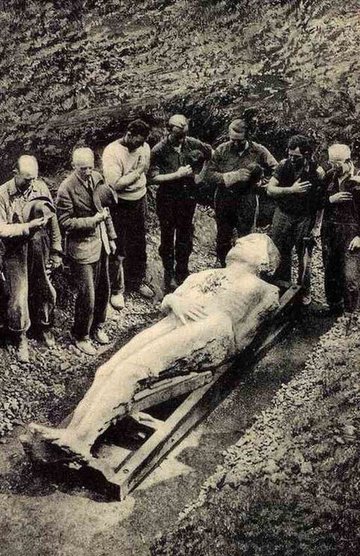
When everything was still once more, I crept out of bed, sick and feeble, and lit the gas with a hand that trembled as if it were aged with a hundred years. The light brought some little cheer to my spirits. I sat down and fell into a dreamy contemplation of that great footprint in the ashes. By and by its outlines began to waver and grow dim. I glanced up and the broad gas-flame was slowly wilting away. In the same moment I heard that elephantine tread again. I noted its approach, nearer and nearer, along the musty halls, and dimmer and dimmer the light waned. The tread reached my very door and paused--the light had dwindled to a sickly blue, and all things about me lay in a spectral twilight. The door did not open, and yet I felt a faint gust of air fan my cheek, and presently was conscious of a huge, cloudy presence before me. I watched it with fascinated eyes. A pale glow stole over the Thing; gradually its cloudy folds took shape--an arm appeared, then legs, then a body, and last a great sad face looked out of the vapor. Stripped of its filmy housings, naked, muscular and comely, the majestic Cardiff Giant loomed above me!
All my misery vanished--for a child might know that no harm could come with that benignant countenance. My cheerful spirits returned at once, and in sympathy with them the gas flamed up brightly again. Never a lonely outcast was so glad to welcome company as I was to greet the friendly giant. I said:
"Why, is it nobody but you? Do you know, I have been scared to death for the last two or three hours? I am most honestly glad to see you. I wish I had a chair--Here, here, don't try to sit down in that thing--"
But it was too late. He was in it before I could stop him and down he went--I never saw a chair shivered so in my life.
"Stop, stop, you'll ruin ev--"
Too late again. There was another crash, and another chair was resolved into its original elements.
"Confound it, haven't you got any judgment at' all? Do you want to ruin all the furniture on the place? Here, here, you petrified fool--"
But it was no use. Before I could arrest him he had sat down on the bed, and it was a melancholy ruin.
"Now what sort of a way is that to do? First you come lumbering about the place bringing a legion of vagabond goblins along with you to worry me to death, and then when I overlook an indelicacy of costume which would not be tolerated anywhere by cultivated people except in a respectable theater, and not even there if the nudity were of your sex, you repay me by wrecking all the furniture you can find to sit down on. And why will you? You damage yourself as much as you do me. You have broken off the end of your spinal column, and littered up the floor with chips of your hams till the place looks like a marble yard. You ought to be ashamed of yourself--you are big enough to know better."
"Well, I will not break any more furniture. But what am I to do? I have not had a chance to sit down for a century." And the tears came into his eyes.
"Poor devil," I said, "I should not have been so harsh with you. And you are an orphan, too, no doubt. But sit down on the floor here--nothing else can stand your weight--and besides, we cannot be sociable with you away up there above me; I want you down where I can perch on this high counting-house stool and gossip with you face to face." So he sat down on the floor, and lit a pipe which I gave him, threw one of my red blankets over his shoulders, inverted my sitz-bath on his head, helmet fashion, and made himself picturesque and comfortable. Then he crossed his ankles, while I renewed the fire, and exposed the flat, honeycombed bottoms of his prodigious feet to the grateful warmth.
"What is the matter with the bottom of your feet and the back of your legs, that they are gouged up so?"
"Infernal chilblains--I caught them clear up to the back of my head, roosting out there under Newell's farm. But I love the place; I love it as one loves his old home. There is no peace for me like the peace I feel when I am there."
We talked along for half an hour, and then I noticed that he looked tired, and spoke of it.
"Tired?" he said. "Well, I should think so. And now I will tell you all about it, since you have treated me so well. I am the spirit of the Petrified Man that lies across the street there in the museum. I am the ghost of the Cardiff Giant. I can have no rest, no peace, till they have given that poor body burial again. Now what was the most natural thing for me to do, to make men satisfy this wish? Terrify them into it! haunt the place where the body lay! So I haunted the museum night after night. I even got other spirits to help me. But it did no good, for nobody ever came to the museum at midnight. Then it occurred to me to come over the way and haunt this place a little. I felt that if I ever got a hearing I must succeed, for I had the most efficient company that perdition could furnish. Night after night we have shivered around through these mildewed halls, dragging chains, groaning, whispering, tramping up and down stairs, till, to tell you the truth, I am almost worn out. But when I saw a light in your room to-night I roused my energies again and went at it with a deal of the old freshness. But I am tired out--entirely fagged out. Give me, I beseech you, give me some hope!" I lit off my perch in a burst of excitement, and exclaimed:
"This transcends everything! everything that ever did occur! Why you poor blundering old fossil, you have had all your trouble for nothing-- you have been haunting a plaster cast of yourself--the real Cardiff Giant is in Albany!--[A fact. The original fraud was ingeniously and fraudfully duplicated, and exhibited in New York as the "only genuine" Cardiff Giant (to the unspeakable disgust of the owners of the real colossus) at the very same time that the latter was drawing crowds at a museum is Albany,]--Confound it, don't you know your own remains?"
I never saw such an eloquent look of shame, of pitiable humiliation, overspread a countenance before.
The Petrified Man rose slowly to his feet, and said:
"Honestly, is that true?"
"As true as I am sitting here."
He took the pipe from his mouth and laid it on the mantel, then stood irresolute a moment (unconsciously, from old habit, thrusting his hands where his pantaloons pockets should have been, and meditatively dropping his chin on his breast); and finally said:
"Well-I never felt so absurd before. The Petrified Man has sold everybody else, and now the mean fraud has ended by selling its own ghost! My son, if there is any charity left in your heart for a poor friendless phantom like me, don't let this get out. Think how you would feel if you had made such an ass of yourself."
I heard his stately tramp die away, step by step down the stairs and out into the deserted street, and felt sorry that he was gone, poor fellow-- and sorrier still that he had carried off my red blanket and my bath-tub.
Ready to get really scared? Enjoy our collection of Halloween Stories
Frequently Asked Questions about A Ghost Story
What is "A Ghost Story" by Mark Twain about?
A Ghost Story begins as a classic haunted-house tale: a narrator takes a room in a vast, abandoned upper floor of a Broadway building and is terrorized by every Gothic convention imaginable — pulled blankets, elephantine footsteps, clanking chains, ghostly whispering, and drops of blood falling from the ceiling. But when the ghost finally materializes, it turns out to be the Cardiff Giant — the famous 10-foot petrified man from the notorious 1869 archaeological hoax. The ghost explains he has been haunting the building to persuade someone to bury his body, which he believes is displayed in the museum across the street. The narrator delivers the devastating punchline: the body across the street is P.T. Barnum's copy of the Cardiff Giant — the ghost has been haunting a plaster cast of himself. Humiliated, the giant leaves, taking the narrator's blanket and bathtub with him.
What is the Cardiff Giant and how does it connect to "A Ghost Story"?
The Cardiff Giant was one of the most famous hoaxes in American history. In 1869, a 10-foot gypsum statue was secretly buried on a farm in Cardiff, New York, then "discovered" by well-diggers and presented as a petrified prehistoric man. Thousands paid to see it before scientists exposed the fraud. The hoax became even more absurd when P.T. Barnum, unable to buy the original, commissioned his own replica and exhibited it as the "only genuine" Cardiff Giant — while the original (itself a fake) was displayed elsewhere. built his story around this layered absurdity: the ghost of a fake giant is haunting the wrong building because it doesn't realize it's been looking at a fake of a fake. The story is a satire about how fraud perpetuates itself until even the frauds are fooled.
What is the theme of "A Ghost Story" by Mark Twain?
The central theme is the absurdity of credulity and the self-perpetuating nature of hoaxes. The Cardiff Giant was a fake that fooled millions; Barnum's copy was a fake of a fake that fooled millions more; and now even the ghost of the original fake has been duped by the copy. Twain stacks irony upon irony to show how people — and apparently ghosts — will believe what they want to believe without verifying the facts. A secondary theme is the parody of Gothic conventions. The first half of the story is a pitch-perfect imitation of a Victorian ghost story, complete with clanking chains, blood dripping from the ceiling, and spectral faces. By abruptly deflating all this atmospheric terror with the absurd revelation, Twain mocks the genre itself and the reader's willingness to be frightened by familiar formulas.
What literary devices does Mark Twain use in "A Ghost Story"?
The story is built on a foundation of genre parody — the first half meticulously recreates every convention of the Victorian ghost story before demolishing them with comedy. Irony operates on multiple levels: the ghost is itself a fraud (the Cardiff Giant was a hoax), it's haunting the wrong body (Barnum's copy), and the whole supernatural apparatus has been wasted on nothing. Tonal shift is Twain's most dramatic device — the story pivots from genuine atmospheric dread to slapstick comedy the moment the ghost is revealed, with the narrator scolding the giant for breaking furniture. Bathos deflates the Gothic mood when the majestic spirit turns out to be a bewildered, furniture-smashing oaf who has caught chilblains from roosting under a farmer's field. The final image — the ghost stealing a blanket and a bathtub — is pure Twain absurdism.
When was "A Ghost Story" by Mark Twain published?
A Ghost Story was published in 1870, just one year after the Cardiff Giant hoax captivated the nation. The timing was deliberate — the hoax was still fresh in the public memory, and Twain's audience would have immediately recognized the reference. The story was later collected in Sketches New and Old (1875). It belongs to the early phase of 's career, when he was making his name as a humorist through short sketches that combined topical satire with literary parody. The story demonstrates that even at this early stage, Twain could write genuinely effective atmospheric prose — and then gleefully undercut it for laughs.
Is "A Ghost Story" by Mark Twain scary?
The first half genuinely is. Twain was a skilled enough writer that his recreation of Gothic horror conventions — the pulled blankets, the enormous footprint in the ashes, the blood dripping from the ceiling, the clanking chains growing nearer — creates real atmospheric dread. Educators who teach the story note that the early build-up shows how well Twain could have written a truly chilling tale had he chosen to. But the terror is entirely setup for the comic payoff. The moment the narrator recognizes the Cardiff Giant — "All my misery vanished — for a child might know that no harm could come with that benignant countenance" — the story pivots to slapstick and satire. The contrast is the point: Twain wants you to feel the fear first so the deflation is funnier.
What is the twist ending of "A Ghost Story"?
The twist operates on two levels. First, the terrifying ghost turns out to be the Cardiff Giant — a well-known archaeological fraud — which immediately deflates the supernatural atmosphere. But the real twist comes when the narrator reveals that the body the ghost has been haunting isn't even the "real" Cardiff Giant: it's P.T. Barnum's plaster copy, displayed across the street. The original fake is in Albany. So the ghost has spent his time and energy haunting a replica of his own fraudulent remains. The giant is mortified: "The Petrified Man has sold everybody else, and now the mean fraud has ended by selling its own ghost!" He begs the narrator not to tell anyone and shuffles away in shame — accidentally stealing the narrator's blanket and bathtub on the way out.
How does "A Ghost Story" parody the Gothic genre?
Twain systematically deploys every trope of Victorian Gothic fiction in the first half — then demolishes them all at once. The lonely room in a decaying building, the creeping atmosphere of dread, the pulled bedclothes, the enormous mysterious footprint, the chains clanking through corridors, the phosphorescent blood drops, the pale spectral faces — each is rendered with such skill that the parody doubles as effective horror. But Twain's point is that these conventions are just furniture, and the moment you remove the mystery, they collapse into absurdity. The ghost turns out to be a sheepish, clumsy giant who breaks chairs and catches chilblains. The clanking chains were the work of "the most efficient company that perdition could furnish," deployed to an empty museum where nobody came at midnight. The story argues that Gothic terror depends entirely on the audience's willingness to be frightened — and that reality is always more ridiculous than fiction.
How does "A Ghost Story" compare to other Mark Twain ghost stories?
Twain returned to ghost and supernatural themes several times throughout his career, but always with a comic or satirical edge. The Facts Concerning the Recent Carnival of Crime in Connecticut features a personified conscience that physically appears to torment the narrator. Captain Stormfield's Visit to Heaven satirizes conventional afterlife imagery. What makes A Ghost Story distinctive is its structural audacity — it commits fully to genuine horror for its entire first half before pulling the rug out. Most of Twain's supernatural pieces signal their comic intent early, but this one lulls the reader into real dread before delivering one of the most satisfying genre-busting twists in American humor.
Save stories, build your reading list, and access all study tools — completely free.
Save A Ghost Story to your library — it's free!Need help with A Ghost Story?
Study tools to help with homework, prepare for quizzes, and deepen your understanding.
Flashcards →