The Story Of The Bad Little Boy
by Mark Twain
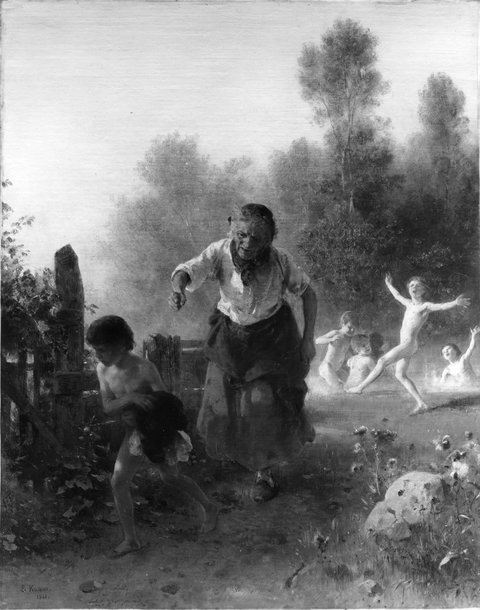
The Story of the Bad Little Boy is Twain's gleeful inversion of Sunday-school morality tales, in which a wicked boy prospers at every turn and suffers none of the punishments that storybook justice demands. "Once he climbed up in Farmer Acorn's apple tree to steal apples, and the limb didn't break."
[Written about 1865]
Once there was a bad little boy whose name was Jim--though, if you will notice, you will find that bad little boys are nearly always called James in your Sunday-school books. It was strange, but still it was true, that this one was called Jim.
He didn't have any sick mother, either--a sick mother who was pious and had the consumption, and would be glad to lie down in the grave and be at rest but for the strong love she bore her boy, and the anxiety she felt that the world might be harsh and cold toward him when she was gone. Most bad boys in the Sunday books are named James, and have sick mothers, who teach them to say, "Now, I lay me down," etc., and sing them to sleep with sweet, plaintive voices, and then kiss them good night, and kneel down by the bedside and weep. But it was different with this fellow. He was named Jim, and there wasn't anything the matter with his mother --no consumption, nor anything of that kind. She was rather stout than otherwise, and she was not pious; moreover, she was not anxious on Jim's account. She said if he were to break his neck it wouldn't be much loss. She always spanked Jim to sleep, and she never kissed him good night; on the contrary, she boxed his ears when she was ready to leave him.
Once this little bad boy stole the key of the pantry, and slipped in there and helped himself to some jam, and filled up the vessel with tar, so that his mother would never know the difference; but all at once a terrible feeling didn't come over him, and something didn't seem to whisper to him, "Is it right to disobey my mother? Isn't it sinful to do this? Where do bad little boys go who gobble up their good kind mother's jam?" and then he didn't kneel down all alone and promise never to be wicked any more, and rise up with a light, happy heart, and go and tell his mother all about it, and beg her forgiveness, and be blessed by her with tears of pride and thankfulness in her eyes. No; that is the way with all other bad boys in the books; but it happened otherwise with this Jim, strangely enough. He ate that jam, and said it was bully, in his sinful, vulgar way; and he put in the tar, and said that was bully also, and laughed, and observed "that the old woman would get up and snort" when she found it out; and when she did find it out, he denied knowing anything about it, and she whipped him severely, and he did the crying himself. Everything about this boy was curious--everything turned out differently with him from the way it does to the bad Jameses in the books.
Once he climbed up in Farmer Acorn's apple tree to steal apples, and the limb didn't break, and he didn't fall and break his arm, and get torn by the farmer's great dog, and then languish on a sickbed for weeks, and repent and become good. Oh, no; he stole as many apples as he wanted and came down all right; and he was all ready for the dog, too, and knocked him endways with a brick when he came to tear him. It was very strange --nothing like it ever happened in those mild little books with marbled backs, and with pictures in them of men with swallow-tailed coats and bell-crowned hats, and pantaloons that are short in the legs, and women with the waists of their dresses under their arms, and no hoops on. Nothing like it in any of the Sunday-school books.
Once he stole the teacher's penknife, and, when he was afraid it would be found out and he would get whipped, he slipped it into George Wilson's cap poor Widow Wilson's son, the moral boy, the good little boy of the village, who always obeyed his mother, and never told an untruth, and was fond of his lessons, and infatuated with Sunday-school. And when the knife dropped from the cap, and poor George hung his head and blushed, as if in conscious guilt, and the grieved teacher charged the theft upon him, and was just in the very act of bringing the switch down upon his trembling shoulders, a white-haired, improbable justice of the peace did not suddenly appear in their midst, and strike an attitude and say, "Spare this noble boy--there stands the cowering culprit! I was passing the school door at recess, and, unseen myself, I saw the theft committed!" And then Jim didn't get whaled, and the venerable justice didn't read the tearful school a homily, and take George by the hand and say such boy deserved to be exalted, and then tell him come and make his home with him, and sweep out the office, and make fires, and run errands, and chop wood, and study law, and help his wife do household labors, and have all the balance of the time to play and get forty cents a month, and be happy. No it would have happened that way in the books, but didn't happen that way to Jim. No meddling old clam of a justice dropped in to make trouble, and so the model boy George got thrashed, and Jim was glad of it because, you know, Jim hated moral boys. Jim said he was "down on them milksops." Such was the coarse language of this bad, neglected boy.
But the strangest thing that ever happened to Jim was the time he went boating on Sunday, and didn't get drowned, and that other time that he got caught out in the storm when he was fishing on Sunday and didn't get struck by lightning. Why, you might look, and look, all through the Sunday-school books from now till next Christmas, and you would never come across anything like this. Oh, no; you would find that all the bad boys who go boating on Sunday invariably get drowned; and all the bad boys who get caught out in storms when they are fishing on Sunday infallibly get struck by lightning. Boats with bad boys in them always upset on Sunday, and it always storms when bad boys go fishing on the Sabbath. How this Jim ever escaped is a mystery to me.
This Jim bore a charmed life--that must have been the way of it. Nothing could hurt him. He even gave the elephant in the menagerie a plug of tobacco, and the elephant didn't knock the top of his head off with his trunk. He browsed around the cupboard after essence-of peppermint, and didn't make a mistake and drink aqua fortis. He stole his father's gun and went hunting on the Sabbath, and didn't shoot three or four of his fingers off. He struck his little sister on the temple with his fist when he was angry, and she didn't linger in pain through long summer days, and die with sweet words of forgiveness upon her lips that redoubled the anguish of his breaking heart. No; she got over it. He ran off and went to sea at last, and didn't come back and find himself sad and alone in the world, his loved ones sleeping in the quiet churchyard, and the vine-embowered home of his boyhood tumbled down and gone to decay. Ah, no; he came home as drunk as a piper, and got into the station-house the first thing.
And he grew up and married, and raised a large family, and brained them all with an ax one night, and got wealthy by all manner of cheating and rascality; and now he is the infernalest wickedest scoundrel in his native village, and is universally respected, and belongs to the legislature.
So you see there never was a bad James in the Sunday-school books that had such a streak of luck as this sinful Jim with the charmed life.
Frequently Asked Questions about The Story Of The Bad Little Boy
What is "The Story of the Bad Little Boy" by Mark Twain about?
The Story of the Bad Little Boy follows Jim, a boy who does everything wrong — steals jam, climbs trees for apples, frames innocent classmates, goes boating on Sunday — yet suffers none of the consequences that befall "bad boys" in Sunday-school literature. The apple-tree limb never breaks beneath him, lightning never strikes him, and no white-haired justice of the peace appears to expose his crimes. Instead, Jim grows up, marries, "brained them all with an ax one night," gets wealthy through "cheating and rascality," and ends up universally respected and serving in the legislature. The story is a gleeful demolition of the moral fables that dominated children's literature in the 1860s.
What is the theme of "The Story of the Bad Little Boy"?
The central theme is the disconnect between morality tales and real life. Sunday-school books promised that bad behavior was always punished and good behavior always rewarded, but Twain observed that life rarely works that way. Jim's story inverts every expected outcome to expose this hypocrisy. A secondary theme is the failure of didactic literature: Twain argues that moral instruction built on lies — stories where bad boys inevitably drown or get struck by lightning — teaches children nothing useful about how the world actually operates. The darkly comic ending, in which a violent criminal becomes a respected legislator, extends the satire to adult society.
What literary devices does Mark Twain use in "The Story of the Bad Little Boy"?
The story's dominant device is parody: every scene mirrors a specific convention of Sunday-school fiction, then inverts it. Twain uses repetition structurally — each episode follows the same pattern of misbehavior, description of what "should" happen according to the books, and then what actually happens to Jim. Irony saturates every line, culminating in the final paragraph where universal respectability is the reward for a lifetime of wickedness. Direct address to the reader ("you might look, and look, all through the Sunday-school books") creates a conspiratorial tone, as though Twain is letting the audience in on a secret the moralists would prefer to keep hidden.
How is "The Story of the Bad Little Boy" related to "The Story of the Good Little Boy"?
The two stories are companion pieces that attack Sunday-school morality from opposite directions. In The Story of the Good Little Boy, Jacob Blivens does everything right — he is pious, obedient, and kind — yet every good deed ends in disaster, and he eventually dies in an explosion. In The Story of the Bad Little Boy, Jim does everything wrong and prospers. Together, the stories make a complete argument: moral fables are lies regardless of which direction they promise — virtue is not reliably rewarded, and vice is not reliably punished. Both were written around 1865 during Twain's early career as a satirist.
When was "The Story of the Bad Little Boy" by Mark Twain published?
The Story of the Bad Little Boy was first published in 1865 in The Californian, a San Francisco literary magazine, under the title "The Christmas Fireside: The Story of the Bad Little Boy That Bore a Charmed Life." It was one of 's earliest published stories, appearing the same year as The Celebrated Jumping Frog of Calaveras County. The companion piece, The Story of the Good Little Boy, followed in 1870.
What is the ending of "The Story of the Bad Little Boy"?
The ending is Twain's most savage punchline. After a youth of unpunished misbehavior, Jim grows up, marries, raises a large family, "brained them all with an ax one night," gets wealthy through cheating and rascality, and becomes "the infernalest wickedest scoundrel in his native village" — yet is "universally respected, and belongs to the legislature." The rapid escalation from petty childhood crimes to murder and political corruption delivers the story's darkest implication: the real world doesn't just fail to punish wickedness; it actively rewards it. The legislature detail is a characteristic Twain jab at politicians.
What is Twain satirizing in "The Story of the Bad Little Boy"?
Twain's primary target is the didactic children's literature that dominated American publishing in the mid-19th century, particularly the "Sunday-school books" produced by religious publishers. These books followed rigid formulas: bad boys named James had pious, consumptive mothers, and every transgression led to swift, dramatic punishment. Twain names these conventions explicitly — the marbled-back covers, the illustrations of men in swallow-tailed coats — and demolishes each one. His broader target is moral sentimentality itself: the comfortable fiction that the universe enforces justice, which Twain saw as a dangerous delusion that left people unprepared for how the world actually works.
Why is "The Story of the Bad Little Boy" considered important in American literature?
The story is significant for several reasons. It was one of Twain's earliest sustained pieces of satire, establishing the anti-sentimental voice that would define his career. It pioneered the technique of parodying genre conventions — attacking not a single work but an entire tradition of formulaic morality fiction. The story also marks an early appearance of Twain's lifelong skepticism about institutional piety and conventional morality, themes he would develop more fully in works like The Man That Corrupted Hadleyburg and Adventures of Huckleberry Finn. Its influence can be traced through later American anti-heroes and satirists.
Save stories, build your reading list, and access all study tools — completely free.
Save The Story Of The Bad Little Boy to your library — it's free!Need help with The Story Of The Bad Little Boy?
Study tools to help with homework, prepare for quizzes, and deepen your understanding.
Flashcards →