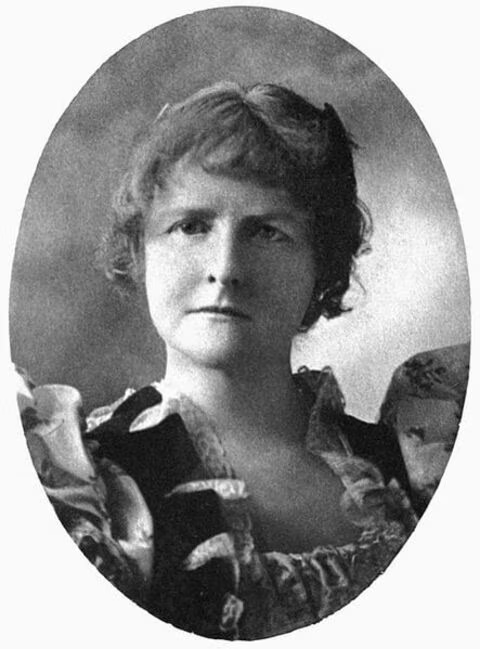
Quick Facts
Mary Eleanor Wilkins Freeman
Pen Name: Mary E. Wilkins Freeman
Born: October 31, 1852
Died: March 13, 1930
Nationality: American
Genres: Realism, Regional Fiction
Notable Works: The Adventures of Ann, Pembroke, The Jamesons
Mary Eleanor Wilkins Freeman was an American novelist (October 1852 - March 1930) and short story writer. The majority of her writing focused on New England life, a subject which she captured masterfully in her subtle and sublime short story A New England Nun.
She was educated at Mount Holyoke Female Seminar (now Mount Holyoke College) and spent much of her life in Massachusetts and Vermont. She produced over two dozen short stories and novels including two superb short story collections, A Humble Romance and Other Stories (1887) and A New England Nun and Other Stories (1891).
For me, personally, discovering the works of Mary Freeman has been an absolute delight. I am rather disappointed that I majored in English at an Ivy League school where I took classes in American Literature and yet I never heard her name mentioned one single time! She is a fantastic writer that should be better known to modern audiences and I encourage anyone reading this page to take the time to explore her canon. She wrote with great range; producing charming children's stories like The Christmas Masquerade; playful poems in Once Upon a Time and Other Child-Verses; ghost stories including the haunting Luella Miller (a story that stayed in my head for weeks after I read it); and feminist themed pieces like A New England Nun. All of those stories have depth! She is a brilliant writer that deserves attention from modern readers.
In April 1926, Freeman was honored by the American Academy of Arts and Letters when she became the first recipient of the William Dean Howells Medal for Distinction in Fiction.
Much of Freeman's broad range of works exemplifies Realism. She is featured in our Feminist Literature Study Guide and Featured Women Writers
Frequently Asked Questions about Mary E. Wilkins Freeman
Who was Mary E. Wilkins Freeman?
Mary Eleanor Wilkins Freeman (October 31, 1852 – March 13, 1930) was a prominent American novelist and short story writer whose work focused on the lives of ordinary people in New England villages. Born in Randolph, Massachusetts, she was educated at Mount Holyoke Female Seminary (now Mount Holyoke College) and spent much of her life in Massachusetts and Vermont. Freeman produced over two dozen volumes of short stories and novels, establishing herself as one of the most important American writers of the late nineteenth and early twentieth centuries. In 1926, she became the first recipient of the William Dean Howells Medal for Distinction in Fiction from the American Academy of Arts and Letters.
What are Mary E. Wilkins Freeman’s most famous works?
Freeman is best known for two landmark short story collections: A Humble Romance and Other Stories (1887) and A New England Nun and Other Stories (1891). Her most widely anthologized stories include A New England Nun, which portrays a woman who chooses solitude over marriage, and The Revolt of Mother, in which a farm wife takes dramatic action to secure a proper home for her family. Her novel Pembroke (1894) was also critically acclaimed. Freeman additionally wrote celebrated ghost stories such as Luella Miller and The Wind in the Rose-Bush.
What themes does Mary E. Wilkins Freeman explore in her writing?
Freeman’s fiction centers on women’s autonomy, economic hardship, and the tension between individual desire and social conformity in rural New England. Her characters are often women trapped by poverty or rigid social expectations who find ways—sometimes quiet, sometimes dramatic—to assert their independence. She also explored themes of isolation, duty versus self-fulfillment, religious strictness, aging, and the slow transformation of village life in post-Civil War America. Across her work, Freeman returned repeatedly to the question of what it costs a woman to claim space and agency in a society that expects her compliance.
Is Mary E. Wilkins Freeman a feminist writer?
Freeman is widely regarded as an early feminist voice in American literature, though she wrote decades before the term was in common use. Her stories consistently center on women who challenge patriarchal authority, reject conventional domestic roles, or quietly reclaim control over their own lives. In A New England Nun, Louisa Ellis chooses solitude and self-determination over a marriage she no longer wants. In The Revolt of Mother, Sarah Penn physically moves her household into a barn to force her husband to acknowledge her needs. Freeman’s characters are not political activists—they are ordinary women whose small acts of resistance carry enormous significance within their constrained worlds.
How does Mary E. Wilkins Freeman fit into the American Realism movement?
Freeman is a key figure in American literary Realism and the regional color movement of the late nineteenth century. Like her contemporaries Sarah Orne Jewett and Kate Chopin, she drew on specific regional settings—in her case, rural New England villages—to explore universal human struggles. Freeman’s strength was her unflinching depiction of poverty, stubbornness, loneliness, and quiet dignity without the sentimentality that plagued much popular fiction of her era. Her precise rendering of New England dialect and village customs gave her stories documentary authenticity, while her penetrating character studies elevated them far beyond local interest.
Did Mary E. Wilkins Freeman write ghost stories?
Yes, Freeman wrote a remarkable body of supernatural fiction that remains widely anthologized today. Her ghost stories are distinctive for blending the psychological realism of her village fiction with genuinely eerie atmospheres. Luella Miller tells of a beautiful woman whose caretakers mysteriously waste away and die—a story that lingers in the mind long after reading. The Wind in the Rose-Bush, The Lost Ghost, and The Shadows on the Wall are among her finest supernatural tales. Her 1903 collection The Wind in the Rose-Bush and Other Stories of the Supernatural remains a landmark of American ghost fiction.
What is “The Revolt of Mother” about?
The Revolt of Mother (1890) tells the story of Sarah Penn, a New England farm wife who has waited forty years for the new house her husband Adoniram promised her. When he instead builds yet another barn, Sarah takes matters into her own hands—she moves the entire household into the new barn while Adoniram is away buying a horse. The story is a powerful portrait of a woman’s quiet determination overcoming decades of dismissal, and it became one of Freeman’s most celebrated and debated works. Freeman herself later expressed discomfort with how literally readers took the story, insisting that no real New England woman would have done such a thing.
How many stories by Mary E. Wilkins Freeman can I read online?
AmericanLiterature.com hosts over 80 short stories by Mary E. Wilkins Freeman, all available to read in full text for free. The collection spans her entire career and includes her most famous literary fiction such as A New England Nun and The Revolt of Mother, her acclaimed supernatural tales like Luella Miller, charming holiday stories such as The Christmas Masquerade, and lesser-known gems waiting to be discovered. Freeman’s works are in the public domain, and this is one of the largest freely available collections of her writing online.
How does Freeman compare to other women writers of her era?
Freeman is frequently grouped with Sarah Orne Jewett, Kate Chopin, and Charlotte Perkins Gilman as part of a generation of women writers who transformed American fiction in the late 1800s. While Jewett shared Freeman’s New England regional focus and gentle style, Freeman’s characters tend to be more economically desperate and psychologically combative. Compared to Chopin’s sensual explorations of desire and selfhood, Freeman’s feminism operates through restraint, silence, and stubborn acts of domestic resistance. Her range was also unusually broad—she moved fluidly between realist village fiction, gothic horror, children’s literature, and poetry in a way few of her peers attempted.
Why is Mary E. Wilkins Freeman not better known today?
Despite winning the first Howells Medal for Fiction and publishing prolifically for over four decades, Freeman’s reputation faded in the mid-twentieth century as regionalist and domestic fiction fell out of critical favor. The literary establishment of that era prioritized modernist experimentation and male-dominated canons, and many women writers of Freeman’s generation were quietly dropped from anthologies and university syllabi. Since the 1970s, feminist literary scholars have led a significant revival of interest in her work, recognizing her as a pioneer in depicting women’s interior lives and social constraints. Today her stories appear regularly in American literature anthologies, and her ghost fiction has found new audiences among readers of classic horror.