The Paradise of Children
by Nathaniel Hawthorne
In this captivating retelling from A Wonder-Book for Girls and Boys (1851), Nathaniel Hawthorne reimagines the ancient Greek myth of Pandora's Box through the innocent eyes of childhood. In a world where all children live in perfect happiness, young Pandora arrives at the cottage of Epimetheus to find a mysterious box with strict instructions: it must never, ever be opened.
But the box exerts a strange power over the curious Pandora. What could possibly be inside? Who left it, and why? As Pandora's fascination grows day by day, the temptation becomes almost unbearable. Hawthorne's playful narration and Walter Crane's beautiful illustrations bring fresh wonder to one of the most famous stories ever told about curiosity and its consequences.
Long, long ago, when this old world was in its tender infancy, there was a child, named Epimetheus, who never had either father or mother; and, that he might not be lonely, another child, fatherless and motherless like himself, was sent from a far country, to live with him, and be his playfellow and helpmate. Her name was Pandora.
The first thing that Pandora saw, when she entered the cottage where Epimetheus dwelt, was a great box. And almost the first question which she put to him, after crossing the threshold, was this,—
"Epimetheus, what have you in that box?"
"My dear little Pandora," answered Epimetheus, "that is a secret, and you must be kind enough not to ask any questions about it. The box was left here to be kept safely, and I do not myself know what it contains."
"But who gave it to you?" asked Pandora. "And where did it come from?"
"That is a secret, too," replied Epimetheus.
"How provoking!" exclaimed Pandora, pouting her lip. "I wish the great ugly box were out of the way!"
"Oh come, don't think of it any more," cried Epimetheus. "Let us run out of doors, and have some nice play with the other children."
It is thousands of years since Epimetheus and Pandora were alive; and the world, nowadays, is a very different sort of thing from what it was in their time. Then, everybody was a child. There needed no fathers and mothers to take care of the children; because there was no danger, nor trouble of any kind, and no clothes to be mended, and there was always plenty to eat and drink. Whenever a child wanted his dinner, he found it growing on a tree; and, if he looked at the tree in the morning, he could see the expanding blossom of that night's supper; or, at eventide, he saw the tender bud of to-morrow's breakfast. It was a very pleasant life indeed. No labor to be done, no tasks to be studied; nothing but sports and dances, and sweet voices of children talking, or carolling like birds, or gushing out in merry laughter, throughout the livelong day.
What was most wonderful of all, the children never quarreled among themselves; neither had they any crying fits; nor, since time first began, had a single one of these little mortals ever gone apart into a corner, and sulked. Oh, what a good time was that to be alive in! The truth is, those ugly little winged monsters, called Troubles, which are now almost as numerous as mosquitoes, had never yet been seen on the earth. It is probable that the very greatest disquietude which a child had ever experienced was Pandora's vexation at not being able to discover the secret of the mysterious box.
This was at first only the faint shadow of a Trouble; but, every day, it grew more and more substantial, until, before a great while, the cottage of Epimetheus and Pandora was less sunshiny than those of the other children.
"Whence can the box have come?" Pandora continually kept saying to herself and to Epimetheus. "And what in the world can be inside of it?"
"Always talking about this box!" said Epimetheus, at last; for he had grown extremely tired of the subject. "I wish, dear Pandora, you would try to talk of something else. Come, let us go and gather some ripe figs, and eat them under the trees, for our supper. And I know a vine that has the sweetest and juiciest grapes you ever tasted."
"Always talking about grapes and figs!" cried Pandora, pettishly.
"Well, then," said Epimetheus, who was a very good-tempered child, like a multitude of children in those days, "let us run out and have a merry time with our playmates."
"I am tired of merry times, and don't care if I never have any more!" answered our pettish little Pandora. "And, besides, I never do have any. This ugly box! I am so taken up with thinking about it all the time. I insist upon your telling me what is inside of it."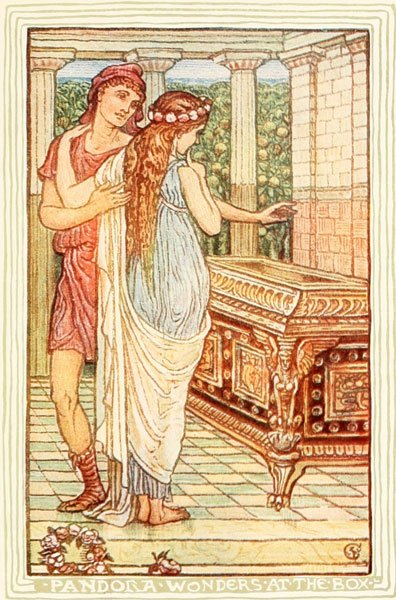
"As I have already said, fifty times over, I do not know!" replied Epimetheus, getting a little vexed. "How, then, can I tell you what is inside?"
"You might open it," said Pandora, looking sideways at Epimetheus, "and then we could see for ourselves."
"Pandora, what are you thinking of?" exclaimed Epimetheus.
And his face expressed so much horror at the idea of looking into a box, which had been confided to him on the condition of his never opening it, that Pandora thought it best not to suggest it any more. Still, however, she could not help thinking and talking about the box.
"At least," said she, "you can tell me how it came here."
"It was just left at the door," replied Epimetheus, "just before you came, by a person who looked very smiling and intelligent, and who could hardly forbear laughing as he put it down. He was dressed in an odd kind of a cloak, and had on a cap that seemed to be made partly of feathers, so that it looked almost as if it had wings."
"What sort of a staff had he?" asked Pandora.
"Oh, the most curious staff you ever saw!" cried Epimetheus. "It was like two serpents twisting around a stick, and was carved so naturally that I, at first, thought the serpents were alive."
"I know him," said Pandora, thoughtfully. "Nobody else has such a staff. It was Quicksilver; and he brought me hither, as well as the box. No doubt he intended it for me; and, most probably, it contains pretty dresses for me to wear, or toys for you and me to play with, or something very nice for us both to eat!"
"Perhaps so," answered Epimetheus, turning away. "But until Quicksilver comes back and tells us so, we have neither of us any right to lift the lid of the box."
"What a dull boy he is!" muttered Pandora, as Epimetheus left the cottage. "I do wish he had a little more enterprise!"
For the first time since her arrival, Epimetheus had gone out without asking Pandora to accompany him. He went to gather figs and grapes by himself, or to seek whatever amusement he could find, in other society than his little playfellow's. He was tired to death of hearing about the box, and heartily wished that Quicksilver, or whatever was the messenger's name, had left it at some other child's door, where Pandora would never have set eyes on it. So perseveringly as she did babble about this one thing! The box, the box, and nothing but the box! It seemed as if the box were bewitched, and as if the cottage were not big enough to hold it, without Pandora's continually stumbling over it, and making Epimetheus stumble over it likewise, and bruising all four of their shins.
Well, it was really hard that poor Epimetheus should have a box in his ears from morning till night; especially as the little people of the earth were so unaccustomed to vexations, in those happy days, that they knew not how to deal with them. Thus, a small vexation made as much disturbance then, as a far bigger one would in our own times.
After Epimetheus was gone, Pandora stood gazing at the box. She had called it ugly, above a hundred times; but, in spite of all that she had said against it, it was positively a very handsome article of furniture, and would have been quite an ornament to any room in which it should be placed. It was made of a beautiful kind of wood, with dark and rich veins spreading over its surface, which was so highly polished that little Pandora could see her face in it. As the child had no other looking-glass, it is odd that she did not value the box, merely on this account.
The edges and corners of the box were carved with most wonderful skill. Around the margin there were figures of graceful men and women, and the prettiest children ever seen, reclining or sporting amid a profusion of flowers and foliage; and these various objects were so exquisitely represented, and were wrought together in such harmony, that flowers, foliage, and human beings seemed to combine into a wreath of mingled beauty. But here and there, peeping forth from behind the carved foliage, Pandora once or twice fancied that she saw a face not so lovely, or something or other that was disagreeable, and which stole the beauty out of all the rest. Nevertheless, on looking more closely, and touching the spot with her finger, she could discover nothing of the kind. Some face, that was really beautiful, had been made to look ugly by her catching a sideway glimpse at it.
The most beautiful face of all was done in what is called high relief, in the centre of the lid. There was nothing else, save the dark, smooth richness of the polished wood, and this one face in the centre, with a garland of flowers about its brow. Pandora had looked at this face a great many times, and imagined that the mouth could smile if it liked, or be grave when it chose, the same as any living mouth. The features, indeed, all wore a very lively and rather mischievous expression, which looked almost as if it needs must burst out of the carved lips, and utter itself in words.
Had the mouth spoken, it would probably have been something like this:—
"Do not be afraid, Pandora! What harm can there be in opening the box? Never mind that poor, simple Epimetheus! You are wiser than he, and have ten times as much spirit. Open the box, and see if you do not find something very pretty!"
The box, I had almost forgotten to say, was fastened; not by a lock, nor by any other such contrivance, but by a very intricate knot of gold cord. There appeared to be no end to this knot, and no beginning. Never was a knot so cunningly twisted, nor with so many ins and outs, which roguishly defied the skillfullest fingers to disentangle them. And yet, by the very difficulty that there was in it, Pandora was the more tempted to examine the knot, and just see how it was made. Two or three times, already, she had stooped over the box, and taken the knot between her thumb and forefinger, but without positively trying to undo it.
"I really believe," said she to herself, "that I begin to see how it was done. Nay, perhaps I could tie it up again, after undoing it. There would be no harm in that, surely. Even Epimetheus would not blame me for that. I need not open the box, and should not, of course, without the foolish boy's consent, even if the knot were untied."
It might have been better for Pandora if she had had a little work to do, or anything to employ her mind upon, so as not to be so constantly thinking of this one subject. But children led so easy a life, before any Troubles came into the world, that they had really a great deal too much leisure. They could not be forever playing at hide-and-seek among the flower-shrubs, or at blind-man's-buff with garlands over their eyes, or at whatever other games had been found out, while Mother Earth was in her babyhood. When life is all sport, toil is the real play. There was absolutely nothing to do. A little sweeping and dusting about the cottage, I suppose, and the gathering of fresh flowers (which were only too abundant everywhere), and arranging them in vases,—and poor little Pandora's day's work was over. And then, for the rest of the day, there was the box!
After all, I am not quite sure that the box was not a blessing to her in its way. It supplied her with such a variety of ideas to think of, and to talk about, whenever she had anybody to listen! When she was in good-humor, she could admire the bright polish of its sides, and the rich border of beautiful faces and foliage that ran all around it. Or, if she chanced to be ill-tempered, she could give it a push, or kick it with her naughty little foot. And many a kick did the box—(but it was a mischievous box, as we shall see, and deserved all it got)—many a kick did it receive. But, certain it is, if it had not been for the box, our active-minded little Pandora would not have known half so well how to spend her time as she now did.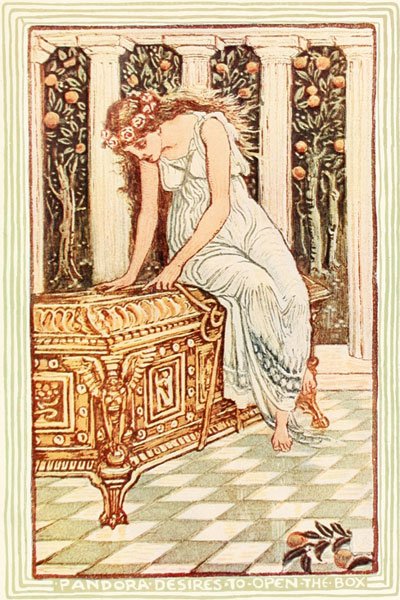
For it was really an endless employment to guess what was inside. What could it be, indeed? Just imagine, my little hearers, how busy your wits would be, if there were a great box in the house, which, as you might have reason to suppose, contained something new and pretty for your Christmas or New Year's gifts. Do you think that you should be less curious than Pandora? If you were left alone with the box, might you not feel a little tempted to lift the lid? But you would not do it. Oh, fie! No, no! Only, if you thought there were toys in it, it would be so very hard to let slip an opportunity of taking just one peep! I know not whether Pandora expected any toys; for none had yet begun to be made, probably, in those days, when the world itself was one great plaything for the children that dwelt upon it. But Pandora was convinced that there was something very beautiful and valuable in the box; and therefore she felt just as anxious to take a peep as any of these little girls, here around me, would have felt. And, possibly, a little more so; but of that I am not quite so certain.
On this particular day, however, which we have so long been talking about, her curiosity grew so much greater than it usually was, that, at last, she approached the box. She was more than half determined to open it, if she could. Ah, naughty Pandora!
First, however, she tried to lift it. It was heavy; quite too heavy for the slender strength of a child, like Pandora. She raised one end of the box a few inches from the floor, and let it fall again, with a pretty loud thump. A moment afterwards, she almost fancied that she heard something stir inside of the box. She applied her ear as closely as possible, and listened. Positively, there did seem to be a kind of stifled murmur, within! Or was it merely the singing in Pandora's ears? Or could it be the beating of her heart? The child could not quite satisfy herself whether she had heard anything or no. But, at all events, her curiosity was stronger than ever.
As she drew back her head, her eyes fell upon the knot of gold cord.
"It must have been a very ingenious person who tied this knot," said Pandora to herself. "But I think I could untie it nevertheless. I am resolved, at least, to find the two ends of the cord."
So she took the golden knot in her fingers, and pried into its intricacies as sharply as she could. Almost without intending it, or quite knowing what she was about, she was soon busily engaged in attempting to undo it. Meanwhile, the bright sunshine came through the open window; as did likewise the merry voices of the children, playing at a distance, and perhaps the voice of Epimetheus among them. Pandora stopped to listen. What a beautiful day it was! Would it not be wiser, if she were to let the troublesome knot alone, and think no more about the box, but run and join her little playfellows, and be happy?
All this time, however, her fingers were half unconsciously busy with the knot; and happening to glance at the flower-wreathed face on the lid of the enchanted box, she seemed to perceive it slyly grinning at her.
"That face looks very mischievous," thought Pandora. "I wonder whether it smiles because I am doing wrong! I have the greatest mind in the world to run away!"
But just then, by the merest accident, she gave the knot a kind of a twist, which produced a wonderful result. The gold cord untwined itself, as if by magic, and left the box without a fastening.
"This is the strangest thing I ever knew!" said Pandora. "What will Epimetheus say? And how can I possibly tie it up again?"
She made one or two attempts to restore the knot, but soon found it quite beyond her skill. It had disentangled itself so suddenly that she could not in the least remember how the strings had been doubled into one another; and when she tried to recollect the shape and appearance of the knot, it seemed to have gone entirely out of her mind. Nothing was to be done, therefore, but to let the box remain as it was until Epimetheus should come in.
"But," said Pandora, "when he finds the knot untied, he will know that I have done it. How shall I make him believe that I have not looked into the box?"
And then the thought came into her naughty little heart, that, since she would be suspected of having looked into the box, she might just as well do so at once. Oh, very naughty and very foolish Pandora! You should have thought only of doing what was right, and of leaving undone what was wrong, and not of what your playfellow Epimetheus would have said or believed. And so perhaps she might, if the enchanted face on the lid of the box had not looked so bewitchingly persuasive at her, and if she had not seemed to hear, more distinctly than before, the murmur of small voices within. She could not tell whether it was fancy or no; but there was quite a little tumult of whispers in her ear,—or else it was her curiosity that whispered,—
"Let us out, dear Pandora,—pray let us out! We will be such nice pretty playfellows for you! Only let us out!"
"What can it be?" thought Pandora. "Is there something alive in the box? Well!—yes!—I am resolved to take just one peep! Only one peep; and then the lid shall be shut down as safely as ever! There cannot possibly be any harm in just one little peep!"
But it is now time for us to see what Epimetheus was doing.
This was the first time, since his little playmate had come to dwell with him, that he had attempted to enjoy any pleasure in which she did not partake. But nothing went right; nor was he nearly so happy as on other days. He could not find a sweet grape or a ripe fig (if Epimetheus had a fault, it was a little too much fondness for figs); or, if ripe at all, they were over-ripe, and so sweet as to be cloying. There was no mirth in his heart, such as usually made his voice gush out, of its own accord, and swell the merriment of his companions. In short, he grew so uneasy and discontented, that the other children could not imagine what was the matter with Epimetheus. Neither did he himself know what ailed him, any better than they did. For you must recollect that, at the time we are speaking of, it was everybody's nature, and constant habit, to be happy. The world had not yet learned to be otherwise. Not a single soul or body, since these children were first sent to enjoy themselves on the beautiful earth, had ever been sick or out of sorts.
At length, discovering that, somehow or other, he put a stop to all the play, Epimetheus judged it best to go back to Pandora, who was in a humor better suited to his own. But, with a hope of giving her pleasure, he gathered some flowers, and made them into a wreath, which he meant to put upon her head. The flowers were very lovely,—roses, and lilies, and orange-blossoms, and a great many more, which left a trail of fragrance behind, as Epimetheus carried them along; and the wreath was put together with as much skill as could reasonably be expected of a boy. The fingers of little girls, it has always appeared to me, are the fittest to twine flower-wreaths; but boys could do it, in those days, rather better than they can now.
And here I must mention that a great black cloud had been gathering in the sky, for some time past, although it had not yet overspread the sun. But, just as Epimetheus reached the cottage door, this cloud began to intercept the sunshine, and thus to make a sudden and sad obscurity.
He entered softly; for he meant, if possible, to steal behind Pandora, and fling the wreath of flowers over her head, before she should be aware of his approach. But, as it happened, there was no need of his treading so very lightly. He might have trod as heavily as he pleased,—as heavily as a grown man,—as heavily, I was going to say, as an elephant,—without much probability of Pandora's hearing his footsteps. She was too intent upon her purpose. At the moment of his entering the cottage, the naughty child had put her hand to the lid, and was on the point of opening the mysterious box. Epimetheus beheld her. If he had cried out, Pandora would probably have withdrawn her hand, and the fatal mystery of the box might never have been known.
But Epimetheus himself, although he said very little about it, had his own share of curiosity to know what was inside. Perceiving that Pandora was resolved to find out the secret, he determined that his playfellow should not be the only wise person in the cottage. And if there were anything pretty or valuable in the box, he meant to take half of it to himself. Thus, after all his sage speeches to Pandora about restraining her curiosity, Epimetheus turned out to be quite as foolish, and nearly as much in fault, as she. So, whenever we blame Pandora for what happened, we must not forget to shake our heads at Epimetheus likewise.
As Pandora raised the lid, the cottage grew very dark and dismal; for the black cloud had now swept quite over the sun, and seemed to have buried it alive. There had, for a little while past, been a low growling and muttering, which all at once broke into a heavy peal of thunder. But Pandora, heeding nothing of all this, lifted the lid nearly upright, and looked inside. It seemed as if a sudden swarm of winged creatures brushed past her, taking flight out of the box, while, at the same instant, she heard the voice of Epimetheus, with a lamentable tone, as if he were in pain.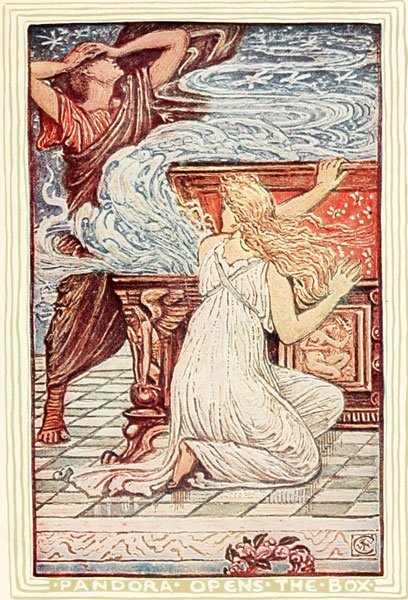
"Oh, I am stung!" cried he. "I am stung! Naughty Pandora! why have you opened this wicked box?"
Pandora let fall the lid, and, starting up, looked about her, to see what had befallen Epimetheus. The thunder-cloud had so darkened the room that she could not very clearly discern what was in it. But she heard a disagreeable buzzing, as if a great many huge flies, or gigantic mosquitoes, or those insects which we call dor-bugs, and pinching-dogs, were darting about. And, as her eyes grew more accustomed to the imperfect light, she saw a crowd of ugly little shapes, with bats' wings, looking abominably spiteful, and armed with terribly long stings in their tails. It was one of these that had stung Epimetheus. Nor was it a great while before Pandora herself began to scream, in no less pain and affright than her playfellow, and making a vast deal more hubbub about it. An odious little monster had settled on her forehead, and would have stung her I know not how deeply, if Epimetheus had not run and brushed it away.
Now, if you wish to know what these ugly things might be, which had made their escape out of the box, I must tell you that they were the whole family of earthly Troubles. There were evil Passions; there were a great many species of Cares; there were more than a hundred and fifty Sorrows; there were Diseases, in a vast number of miserable and painful shapes; there were more kinds of Naughtiness than it would be of any use to talk about. In short, everything that has since afflicted the souls and bodies of mankind had been shut up in the mysterious box, and given to Epimetheus and Pandora to be kept safely, in order that the happy children of the world might never be molested by them. Had they been faithful to their trust, all would have gone well. No grown person would ever have been sad, nor any child have had cause to shed a single tear, from that hour until this moment.
But—and you may see by this how a wrong act of any one mortal is a calamity to the whole world—by Pandora's lifting the lid of that miserable box, and by the fault of Epimetheus, too, in not preventing her, these Troubles have obtained a foothold among us, and do not seem very likely to be driven away in a hurry. For it was impossible, as you will easily guess, that the two children should keep the ugly swarm in their own little cottage. On the contrary, the first thing that they did was to fling open the doors and windows, in hopes of getting rid of them; and, sure enough, away flew the winged Troubles all abroad, and so pestered and tormented the small people, everywhere about, that none of them so much as smiled for many days afterwards. And, what was very singular, all the flowers and dewy blossoms on earth, not one of which had hitherto faded, now began to droop and shed their leaves, after a day or two. The children, moreover, who before seemed immortal in their childhood, now grew older, day by day, and came soon to be youths and maidens, and men and women by and by, and aged people, before they dreamed of such a thing.
Meanwhile, the naughty Pandora, and hardly less naughty Epimetheus, remained in their cottage. Both of them had been grievously stung, and were in a good deal of pain, which seemed the more intolerable to them, because it was the very first pain that had ever been felt since the world began. Of course, they were entirely unaccustomed to it, and could have no idea what it meant. Besides all this, they were in exceedingly bad humor, both with themselves and with one another. In order to indulge it to the utmost, Epimetheus sat down sullenly in a corner with his back towards Pandora; while Pandora flung herself upon the floor and rested her head on the fatal and abominable box. She was crying bitterly, and sobbing as if her heart would break.
Suddenly there was a gentle little tap on the inside of the lid.
"What can that be?" cried Pandora, lifting her head.
But either Epimetheus had not heard the tap, or was too much out of humor to notice it. At any rate, he made no answer.
"You are very unkind," said Pandora, sobbing anew, "not to speak to me!"
Again the tap! It sounded like the tiny knuckles of a fairy's hand, knocking lightly and playfully on the inside of the box.
"Who are you?" asked Pandora, with a little of her former curiosity. "Who are you, inside of this naughty box?"
A sweet little voice spoke from within,—
"Only lift the lid, and you shall see."
"No, no," answered Pandora, again beginning to sob, "I have had enough of lifting the lid! You are inside of the box, naughty creature, and there you shall stay! There are plenty of your ugly brothers and sisters already flying about the world. You need never think that I shall be so foolish as to let you out!"
She looked towards Epimetheus, as she spoke, perhaps expecting that he would commend her for her wisdom. But the sullen boy only muttered that she was wise a little too late.
"Ah," said the sweet little voice again, "you had much better let me out. I am not like those naughty creatures that have stings in their tails. They are no brothers and sisters of mine, as you would see at once, if you were only to get a glimpse of me. Come, come, my pretty Pandora! I am sure you will let me out!"
And, indeed, there was a kind of cheerful witchery in the tone, that made it almost impossible to refuse anything which this little voice asked. Pandora's heart had insensibly grown lighter at every word that came from within the box. Epimetheus, too, though still in the corner, had turned half round, and seemed to be in rather better spirits than before.
"My dear Epimetheus," cried Pandora, "have you heard this little voice?"
"Yes, to be sure I have," answered he, but in no very good humor as yet. "And what of it?"
"Shall I lift the lid again?" asked Pandora.
"Just as you please," said Epimetheus. "You have done so much mischief already, that perhaps you may as well do a little more. One other Trouble, in such a swarm as you have set adrift about the world, can make no very great difference."
"You might speak a little more kindly!" murmured Pandora, wiping her eyes.
"Ah, naughty boy!" cried the little voice within the box, in an arch and laughing tone. "He knows he is longing to see me. Come, my dear Pandora, lift up the lid. I am in a great hurry to comfort you. Only let me have some fresh air, and you shall soon see that matters are not quite so dismal as you think them!"
"Epimetheus," exclaimed Pandora, "come what may, I am resolved to open the box!"
"And as the lid seems very heavy," cried Epimetheus, running across the room, "I will help you!"
So, with one consent, the two children again lifted the lid. Out flew a sunny and smiling little personage, and hovered about the room, throwing a light wherever she went. Have you never made the sunshine dance into dark corners, by reflecting it from a bit of looking-glass? Well, so looked the winged cheerfulness of this fairy-like stranger, amid the gloom of the cottage. She flew to Epimetheus, and laid the least touch of her finger on the inflamed spot where the Trouble had stung him, and immediately the anguish of it was gone. Then she kissed Pandora on the forehead, and her hurt was cured likewise.
After performing these good offices, the bright stranger fluttered sportively over the children's heads, and looked so sweetly at them, that they both began to think it not so very much amiss to have opened the box, since, otherwise, their cheery guest must have been kept a prisoner among those naughty imps with stings in their tails.
"Pray, who are you, beautiful creature?" inquired Pandora.
"I am to be called Hope!" answered the sunshiny figure. "And because I am such a cheery little body, I was packed into the box, to make amends to the human race for that swarm of ugly Troubles, which was destined to be let loose among them. Never fear! we shall do pretty well in spite of them all."
"Your wings are colored like the rainbow!" exclaimed Pandora. "How very beautiful!"
"Yes, they are like the rainbow," said Hope, "because, glad as my nature is, I am partly made of tears as well as smiles."
"And will you stay with us," asked Epimetheus, "forever and ever?"
"As long as you need me," said Hope, with her pleasant smile,—"and that will be as long as you live in the world,—I promise never to desert you. There may come times and seasons, now and then, when you will think that I have utterly vanished. But again, and again, and again, when perhaps you least dream of it, you shall see the glimmer of my wings on the ceiling of your cottage. Yes, my dear children, and I know something very good and beautiful that is to be given you hereafter!"
"Oh, tell us," they exclaimed,—"tell us what it is!"
"Do not ask me," replied Hope, putting her finger on her rosy mouth. "But do not despair, even if it should never happen while you live on this earth. Trust in my promise, for it is true."
"We do trust you!" cried Epimetheus and Pandora, both in one breath.
And so they did; and not only they, but so has everybody trusted Hope, that has since been alive. And to tell you the truth, I cannot help being glad—(though, to be sure, it was an uncommonly naughty thing for her to do)—but I cannot help being glad that our foolish Pandora peeped into the box. No doubt—no doubt—the Troubles are still flying about the world, and have increased in multitude, rather than lessened, and are a very ugly set of imps, and carry most venomous stings in their tails. I have felt them already, and expect to feel them more, as I grow older. But then that lovely and lightsome little figure of Hope! What in the world could we do without her? Hope spiritualizes the earth; Hope makes it always new; and, even in the earth's best and brightest aspect, Hope shows it to be only the shadow of an infinite bliss hereafter.
Frequently Asked Questions about The Paradise of Children
What is "The Paradise of Children" about?
"The Paradise of Children" is Nathaniel Hawthorne's retelling of the Greek myth of Pandora's Box, written for young readers as part of his 1851 collection A Wonder-Book for Girls and Boys. The story follows two children, Epimetheus and Pandora, who live in an idyllic world where children never grow old and all needs are provided for. When Pandora's irresistible curiosity leads her to open a mysterious box left by the god Mercury, she unleashes a swarm of Troubles—including evil Passions, Cares, Sorrows, and Diseases—into the world. However, one final creature remains inside the box: Hope, a radiant fairy-like being who promises to stay with humanity forever, healing the stings of the Troubles and making the world new again.
What is the moral of "The Paradise of Children"?
The central moral of the story is that even when suffering and hardship enter the world, hope endures. Hawthorne shows that disobedience and unchecked curiosity carry real consequences—Pandora's decision to open the box introduces pain, disease, and sorrow to a previously perfect world. Yet the story is ultimately optimistic: Hope, the last thing to emerge from the box, is described as a "sunny and smiling little personage" who cures the stings of every Trouble. The moral suggests that while humans cannot escape suffering, they are never without the comfort and resilience that hope provides. This dual lesson—about the cost of temptation and the permanence of hope—makes the story a gentle but meaningful allegory for children.
How does Hawthorne's version differ from the original Greek myth of Pandora's Box?
Hawthorne significantly softened and reimagined the myth for a young audience. In the original Greek myth, Pandora is created by the gods as a punishment for humanity after Prometheus steals fire, and she is depicted as a flawed adult woman. Hawthorne transforms both Pandora and Epimetheus into innocent children living in a prelapsarian paradise where no one grows old. He removes the punitive origin story entirely and instead frames Pandora's curiosity as a natural childlike impulse rather than a divinely ordained flaw. The box itself (traditionally a jar, or pithos, in Greek sources) is described as a beautifully carved wooden chest delivered by Mercury. Hawthorne also personifies Hope as a radiant, fairy-like figure with rainbow-colored wings, giving the story a warmer, more consoling ending than most classical versions.
What does the box symbolize in "The Paradise of Children"?
The box functions as a powerful symbol of forbidden knowledge and temptation. Its beautiful exterior—polished wood, exquisite carvings of children playing in gardens, and the mischievous face at its center—represents the allure of the unknown. The carved face even seems to whisper encouragement to Pandora, symbolizing how temptation often appears attractive and harmless. On a deeper level, the box represents the boundary between innocence and experience: before it is opened, the world is a paradise without suffering, and after, humanity must contend with the full range of earthly Troubles. The intricate golden knot that unties "as if by magic" suggests that the loss of innocence may be inevitable. Importantly, the box also contains Hope, implying that the capacity for resilience is inseparable from the existence of suffering.
Who are Epimetheus and Pandora in the story?
Epimetheus and Pandora are the two central characters—both depicted as fatherless and motherless children who live together in a small cottage. Epimetheus is cautious, obedient, and reluctant to open the box, having been entrusted with keeping it safe. He represents restraint and respect for authority. Pandora, who was brought to Epimetheus by the god Mercury along with the box, is intensely curious and spirited. Her persistent questioning about the box's contents drives the plot forward. Hawthorne portrays her curiosity sympathetically—as a natural trait rather than a moral failing—even as it leads to the story's catastrophe. Together, the two children embody the tension between caution and curiosity that lies at the heart of the mythological retellings in Hawthorne's A Wonder-Book.
What role does Hope play in the story?
Hope is the final and most important being to emerge from the box, and she serves as the story's redemptive counterpoint to all the Troubles that Pandora released. After both children have been stung and are crying in despair, they hear a gentle tapping and a sweet voice from inside the closed box. When they lift the lid a second time, Hope flies out as a "sunny and smiling little personage" with wings colored like the rainbow. She immediately heals the children's stings with the lightest touch of her finger and promises to remain with them "as long as you live in the world." Hope was deliberately packed into the box by the gods "to make amends for the swarm of ugly Troubles," making her both a gift and a guarantee that humanity will never face suffering without consolation. Hawthorne uses Hope to deliver the story's central message: that even in the darkest moments, hope endures.
What literary devices does Hawthorne use in "The Paradise of Children"?
Hawthorne employs several literary devices to bring this myth to life for young readers. Personification is central—the Troubles are depicted as winged creatures with bats' wings and stinging tails, while Hope is a radiant fairy with rainbow wings. Allegory structures the entire story: the paradise represents innocence, the box represents forbidden knowledge, and the Troubles symbolize the hardships of adult life. Hawthorne also uses foreshadowing extensively, as the carved face on the box seems to silently urge Pandora to open it, and a low growling of thunder builds as she lifts the lid. Pathetic fallacy appears when a black cloud swallows the sun at the exact moment the box is opened. The story's direct address to the reader ("Now, if you wish to know what these ugly things were") creates an intimate, storytelling tone characteristic of Hawthorne's children's writing.
What is "A Wonder-Book for Girls and Boys"?
A Wonder-Book for Girls and Boys is a collection of six Greek myths retold for children by Nathaniel Hawthorne, first published in 1851. "The Paradise of Children" is one of the six stories, alongside "The Gorgon's Head" (Perseus and Medusa), "The Golden Touch" (King Midas), "The Three Golden Apples" (Hercules), "The Miraculous Pitcher" (Baucis and Philemon), and "The Chimaera" (Bellerophon). Hawthorne wrote the collection between April and July 1851, freely adapting the myths to make them accessible and engaging for a young audience. The stories are framed by a narrative in which a college student named Eustace Bright entertains a group of children with these tales. The book was so successful that Hawthorne followed it with Tanglewood Tales in 1853.
What are the Troubles that escape from the box?
When Pandora lifts the lid, a swarm of winged creatures with bats' wings and terribly long stings in their tails rush out into the darkened cottage. Hawthorne catalogs them as "the whole family of earthly Troubles": evil Passions, a great many species of Cares, more than a hundred and fifty Sorrows, Diseases "in a vast number of strange and painful shapes," and more kinds of Naughtiness "than it would be of any kind of use to talk about." In short, everything that has since afflicted the souls and bodies of mankind was contained in the box. Pandora flings open the windows and doors, and the Troubles fly out to torment people everywhere. The children of the earth, who had previously seemed ageless, begin to grow older day by day, passing through youth, adulthood, and old age. This moment marks the end of the paradise and the beginning of mortal human experience.
Is "The Paradise of Children" suitable for children to read?
Yes—Hawthorne wrote this story specifically for young readers, and it remains one of the most accessible introductions to Greek mythology for children. The language is warm and conversational, the characters are children themselves, and the scarier elements (the Troubles) are described in a way that is vivid but not graphic. The story carries meaningful lessons about curiosity, consequences, and the enduring power of hope without being heavy-handed or frightening. It pairs well with other stories from Hawthorne's A Wonder-Book, such as "The Golden Touch" (the story of King Midas) and "The Gorgon's Head" (the story of Perseus and Medusa), which are similarly adapted for a younger audience. Teachers and parents have used these stories for over 170 years as engaging ways to introduce classical mythology and moral reasoning.
Save stories, build your reading list, and access all study tools — completely free.
Save The Paradise of Children to your library — it's free!Need help with The Paradise of Children?
Study tools to help with homework, prepare for quizzes, and deepen your understanding.
Flashcards →