By Courier
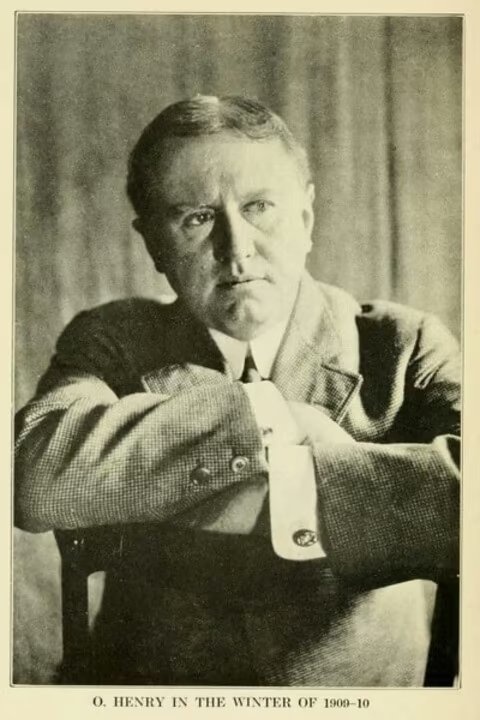
by O. Henry
By Courier is a lovers' quarrel conducted entirely through a streetwise messenger boy, whose colorful translations transform a melodrama of misunderstanding into pure comic delight. "Tell that guy on the other bench that his girl wants him."
It was neither the season nor the hour when the Park had frequenters; and it is likely that the young lady, who was seated on one of the benches at the side of the walk, had merely obeyed a sudden impulse to sit for a while and enjoy a foretaste of coming Spring.
She rested there, pensive and still. A certain melancholy that touched her countenance must have been of recent birth, for it had not yet altered the fine and youthful contours of her cheek, nor subdued the arch though resolute curve of her lips.
A tall young man came striding through the park along the path near which she sat. Behind him tagged a boy carrying a suit-case. At sight of the young lady, the man's face changed to red and back to pale again. He watched her countenance as he drew nearer, with hope and anxiety mingled on his own. He passed within a few yards of her, but he saw no evidence that she was aware of his presence or existence.
Some fifty yards further on he suddenly stopped and sat on a bench at one side. The boy dropped the suit-case and stared at him with wondering, shrewd eyes. The young man took out his handkerchief and wiped his brow. It was a good handkerchief, a good brow, and the young man was good to look at. He said to the boy:
"I want you to take a message to that young lady on that bench. Tell her I am on my way to the station, to leave for San Francisco, where I shall join that Alaska moose-hunting expedition. Tell her that, since she has commanded me neither to speak nor to write to her, I take this means of making one last appeal to her sense of justice, for the sake of what has been. Tell her that to condemn and discard one who has not deserved such treatment, without giving him her reasons or a chance to explain is contrary to her nature as I believe it to be. Tell her that I have thus, to a certain degree, disobeyed her injunctions, in the hope that she may yet be inclined to see justice done. Go, and tell her that."
The young man dropped a half-dollar into the boy's hand. The boy looked at him for a moment with bright, canny eyes out of a dirty, intelligent face, and then set off at a run. He approached the lady on the bench a little doubtfully, but unembarrassed. He touched the brim of the old plaid bicycle cap perched on the back of his head. The lady looked at him coolly, without prejudice or favour.
"Lady," he said, "dat gent on de oder bench sent yer a song and dance by me. If yer don't know de guy, and he's tryin' to do de Johnny act, say de word, and I'll call a cop in t'ree minutes. If yer does know him, and he's on de square, w'y I'll spiel yer de bunch of hot air he sent yer."
The young lady betrayed a faint interest.
"A song and dance!" she said, in a deliberate sweet voice that seemed to clothe her words in a diaphanous garment of impalpable irony. "A new idea--in the troubadour line, I suppose. I--used to know the gentleman who sent you, so I think it will hardly be necessary to call the police. You may execute your song and dance, but do not sing too loudly. It is a little early yet for open-air vaudeville, and we might attract attention."
"Awe," said the boy, with a shrug down the length of him, "yer know what I mean, lady. 'Tain't a turn, it's wind. He told me to tell yer he's got his collars and cuffs in dat grip for a scoot clean out to 'Frisco. Den he's goin' to shoot snow-birds in de Klondike. He says yer told him not to send 'round no more pink notes nor come hangin' over de garden gate, and he takes dis means of puttin' yer wise. He says yer refereed him out like a has-been, and never give him no chance to kick at de decision. He says yer swiped him, and never said why."
The slightly awakened interest in the young lady's eyes did not abate. Perhaps it was caused by either the originality or the audacity of the snow-bird hunter, in thus circumventing her express commands against the ordinary modes of communication. She fixed her eye on a statue standing disconsolate in the dishevelled park, and spoke into the transmitter:
"Tell the gentleman that I need not repeat to him a description of my ideals. He knows what they have been and what they still are. So far as they touch on this case, absolute loyalty and truth are the ones paramount. Tell him that I have studied my own heart as well as one can, and I know its weakness as well as I do its needs. That is why I decline to hear his pleas, whatever they may be. I did not condemn him through hearsay or doubtful evidence, and that is why I made no charge. But, since he persists in hearing what he already well knows, you may convey the matter.
"Tell him that I entered the conservatory that evening from the rear, to cut a rose for my mother. Tell him I saw him and Miss Ashburton beneath the pink oleander. The tableau was pretty, but the pose and juxtaposition were too eloquent and evident to require explanation. I left the conservatory, and, at the same time, the rose and my ideal. You may carry that song and dance to your impresario."
"I'm shy on one word, lady. Jux--jux--put me wise on dat, will yer?"
"Juxtaposition--or you may call it propinquity--or, if you like, being rather too near for one maintaining the position of an ideal."
The gravel spun from beneath the boy's feet. He stood by the other bench. The man's eyes interrogated him, hungrily. The boy's were shining with the impersonal zeal of the translator.
"De lady says dat she's on to de fact dat gals is dead easy when a feller comes spielin' ghost stories and tryin' to make up, and dat's why she won't listen to no soft-soap. She says she caught yer dead to rights, huggin' a bunch o' calico in de hot-house. She side- stepped in to pull some posies and yer was squeezin' de oder gal to beat de band. She says it looked cute, all right all right, but it made her sick. She says yer better git busy, and make a sneak for de train."
The young man gave a low whistle and his eyes flashed with a sudden thought. His hand flew to the inside pocket of his coat, and drew out a handful of letters. Selecting one, he handed it to the boy, following it with a silver dollar from his vest-pocket.
"Give that letter to the lady," he said, "and ask her to read it. Tell her that it should explain the situation. Tell her that, if she had mingled a little trust with her conception of the ideal, much heartache might have been avoided. Tell her that the loyalty she prizes so much has never wavered. Tell her I am waiting for an answer."
The messenger stood before the lady.
"De gent says he's had de ski-bunk put on him widout no cause. He says he's no bum guy; and, lady, yer read dat letter, and I'll bet yer he's a white sport, all right."
The young lady unfolded the letter; somewhat doubtfully, and read it.
DEAR DR. ARNOLD: I want to thank you for your most kind and opportune aid to my daughter last Friday evening, when she was overcome by an attack of her old heart-trouble in the conservatory at Mrs. Waldron's reception. Had you not been near to catch her as she fell and to render proper attention, we might have lost her. I would be glad if you would call and undertake the treatment of her case. Gratefully yours, Robert Ashburton.
The young lady refolded the letter, and handed it to the boy.
"De gent wants an answer," said the messenger. "Wot's de word?"
The lady's eyes suddenly flashed on him, bright, smiling and wet.
"Tell that guy on the other bench," she said, with a happy, tremulous laugh, "that his girl wants him."
Frequently Asked Questions about By Courier
What is "By Courier" by O. Henry about?
"By Courier" is a short story about two estranged lovers who communicate through a street-smart messenger boy in a New York City park. The young man, on his way to San Francisco, sends the boy to plead his case to a young woman who has forbidden him from speaking or writing to her. She accuses him of embracing another woman in a conservatory. Through the boy's colorful slang translations of their formal messages, the man produces a letter revealing he was actually saving the woman from a heart attack. The couple reconciles in 's signature twist ending.
What is the twist ending in "By Courier"?
The twist ending reveals that what the young woman believed was a romantic embrace was actually a medical emergency. She had seen the young man holding Miss Ashburton in the conservatory and assumed he was being unfaithful. However, a letter from Miss Ashburton's father, Robert Ashburton, thanks "Dr. Arnold" for catching his daughter when she collapsed from a heart condition at Mrs. Waldron's reception. The young man was not a lover but a doctor performing his duty. Once the woman reads this letter, she immediately asks the boy to tell the man "that his girl wants him."
Who is the courier in "By Courier" by O. Henry?
The courier is an unnamed street boy whom the young man hires for a half-dollar to carry messages to the young woman. He is described as having "bright, canny eyes out of a dirty, intelligent face" and wearing "an old plaid bicycle cap." What makes him memorable is his vivid New York street dialect—he translates the couple's refined, formal language into colorful slang. For example, he renders "juxtaposition" as being "too near" and turns an eloquent plea about justice into "he says yer swiped him, and never said why." He functions as both messenger and comic relief.
What are the main themes of "By Courier"?
The main themes of "By Courier" include: Miscommunication and jumping to conclusions—the entire conflict stems from the woman misinterpreting an innocent act as infidelity. Trust and forgiveness—the story argues that love requires trust, and the man notes that "if she had mingled a little trust with her conception of the ideal, much heartache might have been avoided." Appearances vs. reality—what looked like a romantic embrace was a medical rescue. Class and language—the contrast between the couple's elevated speech and the boy's street slang highlights New York's social divides while showing that plain language can convey truth just as effectively as formal rhetoric.
What literary devices does O. Henry use in "By Courier"?
employs several literary devices in "By Courier": Situational irony—the woman's strict ideals of "absolute loyalty and truth" cause her to reject a man who was, in fact, being completely loyal. Dramatic irony—readers sense the man may be innocent before the reveal. Juxtaposition—the formal, educated speech of the lovers contrasts sharply with the boy's New York street dialect, creating humor and highlighting class differences. Humor through translation—the boy's slang reinterpretations of elaborate speeches serve as comic relief. Surprise ending—O. Henry's trademark twist resolves the story in a single letter.
What is the role of language and dialect in "By Courier"?
Language and dialect are central to the story's humor and meaning. The young couple speaks in formal, educated English—the woman uses words like "diaphanous," "impalpable irony," and "juxtaposition." The messenger boy, by contrast, speaks in exaggerated New York street slang, turning "San Francisco" into "'Frisco," "Alaska moose-hunting" into "shoot snow-birds in de Klondike," and "the pose and juxtaposition were too eloquent" into "yer was squeezin' de oder gal to beat de band." This contrast creates comedy, but it also shows that the boy's blunt translations cut through the couple's rhetorical posturing to convey the emotional truth of their messages.
What collection is "By Courier" from?
"By Courier" was published in 's 1906 collection The Four Million, one of his most celebrated books. The collection's title is a reference to the entire population of New York City at the time, contrasting with Ward McAllister's famous claim that only "The Four Hundred" (New York's social elite) mattered. Like other stories in the collection—including The Gift of the Magi and The Cop and the Anthem—"By Courier" captures ordinary New Yorkers from different social classes interacting in everyday settings like city parks.
Why does the woman refuse to speak to the man in "By Courier"?
The woman refuses to speak to the man because she believes she caught him being unfaithful. She tells the courier that she entered the conservatory at Mrs. Waldron's reception to cut a rose for her mother and saw the man with Miss Ashburton beneath a pink oleander in what appeared to be a romantic embrace. She describes the "pose and juxtaposition" as "too eloquent and evident to require explanation." Based on her ideals of "absolute loyalty and truth," she condemned him without giving him a chance to explain, believing the visual evidence was so clear that no explanation was necessary.
What is the significance of the letter from Robert Ashburton?
The letter from Robert Ashburton is the story's pivotal plot device—it resolves the entire conflict in a few sentences. Addressed to "Dear Dr. Arnold," it thanks the young man for catching Miss Ashburton when she was "overcome by an attack of her old heart-trouble" at Mrs. Waldron's reception. The letter proves that the young man was not embracing Miss Ashburton romantically but was providing emergency medical aid as a doctor. It demonstrates 's signature technique of withholding a key piece of information until the final moment to create a dramatic reversal that reframes everything the reader has understood.
How does "By Courier" compare to other O. Henry stories?
"By Courier" shares 's hallmark features: a surprise twist ending, warm humor, and sympathetic portrayals of ordinary New Yorkers. Its theme of miscommunication between lovers echoes The Gift of the Magi, where a couple's mutual sacrifices create an ironic mismatch, and The Cactus, where a man loses his beloved over a misunderstood Spanish word. However, "By Courier" is unique in using a third-party translator whose dialect creates comic contrast. While "The Gift of the Magi" ends bittersweet and "The Cactus" ends in loss, "By Courier" delivers one of O. Henry's rare happy endings, with the couple joyfully reunited.
Save stories, build your reading list, and access all study tools — completely free.
Save By Courier to your library — it's free!Need help with By Courier?
Study tools to help with homework, prepare for quizzes, and deepen your understanding.
Flashcards →