The Defeat of the City
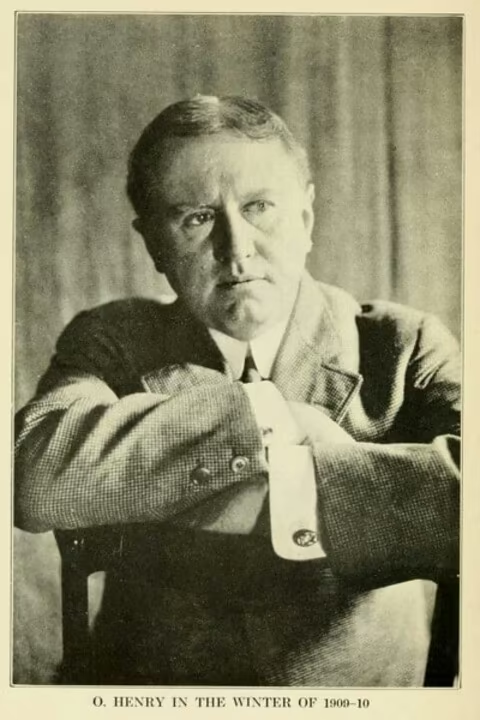
by O. Henry
The Defeat of the City is a charming story of a country boy turned polished Manhattan lawyer who brings his aristocratic bride home to the farm -- where the veneer of city sophistication cracks at the first breath of country air. "I thought I married a gentleman, but I find that I have married something better -- a man."
Robert Walmsley's descent upon the city resulted in a Kilkenny struggle. He came out of the fight victor by a fortune and a reputation. On the other band, he was swallowed up by the city. The city gave him what he demanded and then branded him with its brand. It remodelled, cut, trimmed and stamped him to the pattern it approves. It opened its social gates to him and shut him in on a close- cropped, formal lawn with the select herd of rumi- nants. In dress, habits, manners, provincialism, routine and narrowness he acquired that charming in- solence, that irritating completeness, that sophisti- cated crassness, that overbalanced poise that makes the Manhattan gentleman so delightfully small in his greatness.
One of the up-state rural counties pointed with pride to the successful young metropolitan lawyer as a product of its soil. Six years earlier this county had removed the wheat straw from between its huckle- berry-stained teeth and emitted a derisive and bucolic laugh as old man Walmsley's freckle-faced " Bob abandoned the certain three-per-diem meals of the one-horse farm for the discontinuous quick lunch counters of the three-ringed metropolis. At the end of the six years no murder trial, coaching party, au- tomobile accident or cotillion was complete in which the name of Robert Walmsley did not figure. Tailors waylaid him in the street to get a new wrinkle from the cut of his unwrinkled trousers. Hyphenated fel- lows in the clubs and members of the oldest subpoenaed families were glad to clap him on the back and allow him three letters of his name.
But the Matterhorn of Robert Walmsley's success was not scaled until be married Alicia Van Der Pool. I cite the Matterhorn, for just so high and cool and white and inaccessible was this daughter of the old burghers. The social Alps that ranged about her over whose bleak passes a thousand climbers struggled -- reached only to her knees. She towered in her own atmosphere, serene, chaste, prideful, wading in no fountains, dining no monkeys, breeding no dogs for bench shows. She was a Van Der Pool. Fountains were made to play for her; monkeys were made for other people's ancestors; dogs, she understood, were created to be companions of blind persons and objec- tionable characters who smoked pipes.
This was the Matterhorn that Robert Walmsley accomplished. If he found, with the good poet with the game foot and artificially curled hair, that he who ascends to mountain tops will find the loftiest peaks most wrapped in clouds and snow, he concealed his chilblains beneath a brave and smiling exterior. He was a lucky man and knew it, even though he were imitating the Spartan boy with an ice-cream freezer beneath his doublet frappeeing the region of his heart.
After a brief wedding tour abroad, the couple re- turned to create a decided ripple in the calm cistern (so placid and cool and sunless it is) of the best so- ciety. They entertained at their red brick mausoleum of ancient greatness in an old square that is a ceme- tery of crumbled glory. And Robert Walmsley was proud of his wife; although while one of his hands shook his guests' the other held tightly to his alpen- stock and thermometer.
One day Alicia found a letter written to Robert by his mother. It was an unerudite letter, full of crops and motherly love and farm notes. It chronicled the health of the pig and the recent red calf, and asked concerning Robert's in return. It was a letter direct from the soil, straight from home, full of biographies of bees, tales of turnips, peaans of new-laid eggs, neg- lected parents and the slump in dried apples.
"Why have I not been shown your mother's let- ters?" asked Alicia. There was always something in her voice that made you think of lorgnettes, of ac- counts at Tiffany's, of sledges smoothly gliding on the trail from Dawson to Forty Mile, of the tinkling of pendant prisms on your grandmothers' chandeliers, of snow lying on a convent roof; of a police sergeant refusing bail. "Your mother," continued Alicia, "invites us to make a visit to the farm. I have never seen a farm. We will go there for a week or two, Robert."
"We will," said Robert, with the grand air of an associate Supreme Justice concurring in an opinion. "I did not lay the invitation before you because I thought you would not care to go. I am much pleased at your decision."
"I will write to her myself," answered Alicia, with a faint foreshadowing of enthusiasm. " Felice shall pack my trunks at once. Seven, I think, will be enough. I do not suppose that your mother entertains a great deal. Does she give many house parties?"
Robert arose, and as attorney for rural places filed a demurrer against six of the seven trunks. He en- deavored to define, picture, elucidate, set forth and describe a farm. His own words sounded strange in his ears. He had not realized how thoroughly urbsi- dized he had become.
A week passed and found them landed at the little country station five hours out from the city. A grin- ning, stentorian, sarcastic youth driving a mule to a spring wagon hailed Robert savagely.
"Hallo, Mr. Walmsley. Found your way back at last, have you? Sorry I couldn't bring in the auto- mobile for you, but dad's bull-tonguing the ten-acre clover patch with it to-day. Guess you'll excuse my, not wearing a dress suit over to meet you -- it ain't six o'clock yet, you know."
"I'm glad to see you, Tom," said Robert, grasp- ing his brother's band. "Yes, I've found my way at last. You've a right to say 'at last.' It's been over two years since the last time. But it will be oftener after this, my boy."
Alicia, cool in the summer beat as an Arctic wraith, white as a Norse snow maiden in her flimsy muslin and fluttering lace parasol, came round the corner of the station; and Tom was stripped of his assurance. He became chiefly eyesight clothed in blue jeans, and on the homeward drive to the mule alone did he confide in language the inwardness of his thoughts.
They drove homeward. The low sun dropped a spendthrift flood of gold upon the fortunate fields of wheat. The cities were far away. The road lay curl- ing around wood and dale and bill like a ribbon lost from the robe of careless summer. The wind followed like a whinnying colt in the track of Phoebus's steeds.
By and by the farmhouse peeped gray out of its faithful grove; they saw the long lane with its convoy of walnut trees running from the road to the house; they smelled the wild rose and the breath of cool, damp willows in the creek's bed. And then in unison all the voices of the soil began a chant addressed to the soul of Robert Walmsley. Out of the tilted aisles of the dim wood they came hollowly; they chirped and buzzed from the parched grass; they trilled from the ripples of the creek ford; they floated up in clear Pan's pipe notes from the dimming meadows; the whippoorwills joined in as they pursued midges in the upper air; slow-going cow-bells struck out a homely accompaniment -- and this was what each one said: "You've found your way back at last, have you?"
The old voices of the soil spoke to him. Leaf and bud and blossom conversed with him in the old vocabu- lary of his careless youth - the inanimate things, the familiar stones and rails, the gates and furrows and roofs and turns of the road had an eloquence, too, and a power in the transformation. The country had smiled and he had felt the breath of it, and his heart was drawn as if in a moment back to his old love. The city was far away.
This rural atavism, then, seized Robert Walmsley and possessed him. A queer thing he noticed in con- nection with it was that Alicia, sitting at his side, suddenly seemed to him a stranger. She did not be- long to this recurrent phase. Never before had she seemed so remote, so colorless and high - so intan- gible and unreal. And yet he had never admired her more than when she sat there by him in the rickety spring wagon, chiming no more with his mood and with her environment than the Matterhorn chimes with a peasant's cabbage garden.
That night when the greetings and the supper were over, the entire family, including Buff, the yellow dog, bestrewed itself upon the front porch. Alicia, not haughty but silent, sat in the shadow dressed in an exquisite pale-gray tea gown. Robert's mother dis- coursed to her happily concerning marmalade and lumbago. Tom sat on the top step; Sisters Millie and Pam on the lowest step to catch the lightning bugs. Mother had the willow rocker. Father sat in the big armchair with one of its arms gone. Buff sprawled in the middle of the porch in everybody's way. The twilight pixies and pucks stole forth un- seen and plunged other poignant shafts of memory into the heart of Robert. A rural madness entered his soul. The city was far away.
Father sat without his pipe, writhing in his heavy boots, a sacrifice to rigid courtesy. Robert shouted: "No, you don't!" He fetched the pipe and lit it; he seized the old gentleman's boots and tore them off. The last one slipped suddenly, and Mr. Robert Walmsley, of Washington Square, tumbled off the porch backward with Buff on top of him, bowling fearfully. Tom laughed sarcastically.
Robert tore off his coat and vest and hurled them into a lilac bush.
"Come out here, you landlubber," be cried to Tom, and I'll put grass seed on your back. I think you called me a 'dude' a while ago. Come along and cut your capers."
Tom understood the invitation and accepted it with delight. Three times they wrestled on the grass, "side holds," even as the giants of the mat. And twice was Tom forced to bite grass at the hands of the distinguished lawyer. Dishevelled, panting, each still boasting of his own prowess, they stumbled back to the porch. Millie cast a pert reflection upon the qualities of a city brother. In an instant Robert had secured a horrid katydid in his fingers and bore down upon her. Screaming wildly, she fled up the lane, pursued by the avenging glass of form. A quarter of a mile and they returned, she full of apology to the victorious " dude." The rustic mania possessed him unabatedly.
I can do up a cowpenful of you slow hayseeds," he proclaimed, vaingloriously. "Bring on your bull- dogs, your hired men and your log-rollers."
He turned handsprings on the grass that prodded Tom to envious sarcasm. And then, with a whoop, he clattered to the rear and brought back Uncle like, a battered colored retainer of the family, with his banjo, and strewed sand on the porch and danced "Chicken in the Bread Tray" and did buck-and- wing wonders for half an hour longer. Incredibly, wild and boisterous things he did. He sang, he told stories that set all but one shrieking, he played the yokel, the humorous clodhopper; he was mad, and with the revival of the old life in his blood. He became so extravagant that once his mother sought gently to reprove him. Then Alicia moved as though she were about to speak, but she did not. Through it all she sat immovable, a slim, white spirit in the dusk that no man might question or read.
By and by she asked permission to ascend to her room, saying that she was tired. On her way she passed Robert. He was standing in the door, the figure of vulgar comedy, with ruffled hair, reddened face and unpardonable confusion of attire -- no trace there of the immaculate Robert Walmsley, the courted clubman and ornament of select circles. He was do- ing a conjuring trick with some household utensils, and the family, now won over to him without excep- tion, was beholding him with worshipful admiration.
As Alicia passed in Robert started suddenly. He had forgotten for the moment that she was present.
Without a glance at him she went on upstairs.
After that the fun grew quiet. An hour passed in talk, and then Robert went up himself.
She was standing by the window when he entered their room. She was still clothed as when they were on the porch. Outside and crowding against the window was a giant apple tree, full blossomed.
Robert sighed and went near the window. He was ready to meet his fate. A confessed vulgarian, he foresaw the verdict of justice in the shape of that whiteclad form. He knew the rigid lines that a Van Der Pool would draw. He was a peasant gam- bolling indecorously in the valley, and the pure, cold, white, unthawed summit of the Matterhorn could not but frown on him. He had been unmasked by his own actions. All the polish, the poise, the form that the city had given him had fallen from him like an ill-fitting mantle at the first breath of a country breeze. Dully be awaited the approaching condemna- tion.
"Robert," said the calm, cool voice of his judge, "I thought I married a gentleman."
Yes, it was coming. And yet, in the face of it, Robert Walmsley was eagerly regarding a certain branch of the apple tree upon which be used to climb out of that very window. He believed he could do it now. He wondered bow many blossoms there were on the tree -- ten millions? But here was some one speaking again:
"I thought I married a gentleman," the voice went on, "but -- "
Why had she come and was standing so close by his side?
"But I find that I have married" -- was this Alicia talking? -- "something better -- a man -- Bob, dear, kiss me, won't you?"
The city was far away.
Frequently Asked Questions about The Defeat of the City
What is "The Defeat of the City" by O. Henry about?
"The Defeat of the City" follows Robert Walmsley, a farm boy who moves to New York City and becomes a wealthy, polished Manhattan lawyer. He marries Alicia Van Der Pool, a woman of impeccable high-society breeding. When the couple visits Robert's rural family farm, the sights, sounds, and smells of the countryside reawaken his true nature. He sheds his sophisticated veneer and reverts to the boisterous, playful country boy he once was. The story climaxes with a surprise twist: rather than condemning his behavior, Alicia reveals she has found something better than a gentleman—she has found a real man.
What is the meaning of the title "The Defeat of the City"?
The title refers to the ultimate failure of city life to permanently transform Robert Walmsley. Although New York "remodelled, cut, trimmed and stamped him to the pattern it approves," the city's influence crumbles the moment Robert returns to the farm. His rural roots prove stronger than years of urban conditioning. The "defeat" is the city's inability to erase his authentic self—nature and upbringing triumph over social polish and metropolitan sophistication.
What are the main themes in "The Defeat of the City"?
The story explores several interconnected themes:
Authenticity vs. Social Performance — Robert's city persona is a mask that falls away in the country, revealing his true self.
Rural vs. Urban Life — contrasts the artificiality of Manhattan society with the honest, unpretentious warmth of farm life.
Identity and Transformation — The story asks whether people can truly change or whether their origins remain the core of who they are.
Love and Acceptance — Alicia's surprising reaction shows that genuine love values authenticity over social refinement.
What is the surprise ending of "The Defeat of the City"?
Throughout the story, Robert dreads Alicia's judgment after his wild, undignified behavior on the farm. He expects her—a woman of the highest social standing—to condemn him. When she says, "I thought I married a gentleman," it seems his fears are confirmed. But she finishes: "But I find that I have married something better—a man—Bob, dear, kiss me, won't you?" The twist is that Alicia prefers the real, unpolished Robert to the manufactured city gentleman—a classic reversal of expectations.
Who is Alicia Van Der Pool in "The Defeat of the City"?
Alicia Van Der Pool is Robert Walmsley's wife, described as the pinnacle of old New York aristocracy. compares her to the Matterhorn—"high and cool and white and inaccessible." She has never seen a farm and arrives with seven trunks for the visit. Throughout the evening, she sits silently in a pale-gray tea gown, appearing remote and detached. Her character serves as a foil to Robert's rural family, making her final acceptance of his true nature all the more surprising and powerful.
What literary devices does O. Henry use in "The Defeat of the City"?
employs several notable literary devices:
Extended Metaphor — The Matterhorn metaphor recurs throughout to represent Alicia's cold, lofty social position.
Personification — The countryside itself "speaks" to Robert: voices from the wood, chirps from the grass, and trills from the creek all call him home.
Irony — The city, which seemed to conquer Robert, is itself defeated by a single visit to the farm.
Satirical Tone — O. Henry mocks Manhattan high society with phrases like "charming insolence" and "sophisticated crassness."
What is the significance of the Matterhorn metaphor in the story?
uses the Matterhorn—the famous Swiss mountain peak—as a recurring metaphor for Alicia Van Der Pool. Just as the Matterhorn is "high and cool and white and inaccessible," Alicia towers above society in her own rarefied atmosphere. Robert's marriage to her represents the summit of his social climbing. Later, when Robert fears her judgment, he imagines "the pure, cold, white, unthawed summit of the Matterhorn" frowning on him. The metaphor brilliantly captures how social class creates emotional distance—and makes Alicia's warm, human ending all the more striking.
What collection is "The Defeat of the City" from?
"The Defeat of the City" was published in 's 1908 collection The Voice of the City: Further Stories of the Four Million. This collection focuses on life in New York City and its surrounding areas, continuing themes from his earlier The Four Million (1906). The stories explore how ordinary people navigate the pressures, temptations, and transformations of metropolitan life—a subject O. Henry knew intimately from his own years living in New York.
How does "The Defeat of the City" reflect O. Henry's own life?
drew heavily on personal experience for this story. Born William Sydney Porter in Greensboro, North Carolina, he was a small-town Southerner who reinvented himself in New York City. Like Robert Walmsley, O. Henry understood the tension between rural origins and urban ambition. He spent his most productive writing years in Manhattan, observing how the city shaped and reshaped people. His sympathetic portrayal of Robert's "rural atavism" suggests that O. Henry himself never fully shed his own small-town roots, even at the height of his fame.
What does "rural atavism" mean in "The Defeat of the City"?
writes that "this rural atavism seized Robert Walmsley and possessed him." Atavism means a reversion to an earlier ancestral type or behavior—a throwback to a more primitive state. In this context, "rural atavism" describes Robert's sudden, overwhelming return to his country ways: wrestling his brother, chasing his sister with a katydid, dancing, and telling raucous stories. The word choice implies that Robert's farm-boy nature is not just a preference but something deeply encoded in him, a primal identity that the city's polish could only temporarily suppress.
Save stories, build your reading list, and access all study tools — completely free.
Save The Defeat of the City to your library — it's free!Need help with The Defeat of the City?
Study tools to help with homework, prepare for quizzes, and deepen your understanding.
Flashcards →