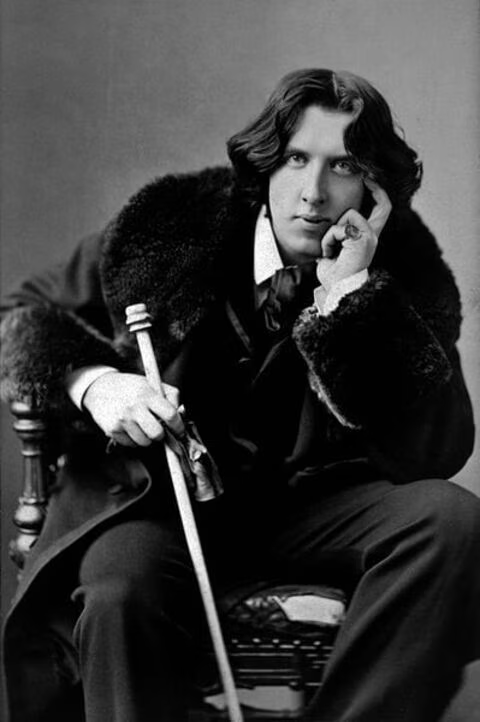
Quick Facts
Oscar Fingal O'Flahertie Wills Wilde
Pen Name: Oscar Wilde
Born: October 16, 1854
Died: November 30, 1900
Nationality: Irish
Genres: Drama, Satire, Victorian, Humor, Fairy Tales, Aestheticism
Notable Works: The Importance of Being Earnest, The Picture of Dorian Gray, The Happy Prince and Other Tales, An Ideal Husband, Lady Windermere's Fan
Oscar Fingal O'Flahertie Wills Wilde (1854–1900) — a difficult name for a complicated man who led an exhilarating life filled with hope and triumph, yet visited by peril and beset with despair. A gifted and prolific writer with a quick wit, Wilde could succeed in any form he chose: novelist, short story writer, essayist, poet, and, ultimately, the preeminent playwright of his day.
"I am not young enough to know everything."
"The difference between journalism and literature is that journalism is unreadable and literature is not read."
👶 Early Life and Education
Oscar Wilde was born on October 16, 1854, in Dublin, Ireland. His father, Sir William Wilde, was Ireland's preeminent ear and eye surgeon, a noted antiquarian and writer. His mother, Lady Jane Wilde, was a revolutionary poet and committed Irish nationalist who wrote under the pen name "Speranza." From both parents, Wilde inherited a love of language and a flair for the dramatic.
Wilde attended Portora Royal School in Enniskillen, where he distinguished himself as a brilliant student and conversationalist. He entered Trinity College Dublin in 1871, studying classics under the eminent scholar J. P. Mahaffy, who cultivated his appreciation of Greek literature and art. In 1874, Wilde won a scholarship to Magdalen College, Oxford, where two professors shaped his intellectual life: John Ruskin, whose lectures on art and social justice inspired him, and Walter Pater, whose philosophy of aestheticism — the belief that art exists for its own beauty, not moral instruction — became a foundation of Wilde's worldview. In 1878, he won the prestigious Newdigate Prize for his long poem Ravenna.
📖 Literary Career
After Oxford, Wilde moved to London and established himself as the apostle of aestheticism, becoming famous as much for his flamboyant personality and brilliant conversation as for his writing. He lectured across America in 1882, charming and scandalizing audiences in equal measure, and returned to London as a literary celebrity. He worked as a journalist and editor, contributed essays and reviews, and in 1888 published The Happy Prince and Other Tales, a collection of allegorical fairy tales that revealed a gift for romantic allegory and moral parable. Stories like The Happy Prince, The Selfish Giant, The Nightingale and the Rose, The Devoted Friend, and The Remarkable Rocket have enchanted readers for over a century and remain among our Favorite Fairy Tales.
The Picture of Dorian Gray, published in 1890, was Wilde's only novel — and it was both a literary triumph and a society scandal. The editor of Lippincott's Monthly Magazine, where it first appeared, thought it indecent and expunged five hundred words without permission. Critics attacked Wilde for the novel's "moral decadence." The trouble was that rather than circle the old maypole of moral virtue and good deeds, The Picture of Dorian Gray incorporated decadence, depravity, duplicity, and shallow beauty. Wilde defended himself and his art, and he revised and expanded the novel into a full-length book in 1891. The novel remains one of the masterpieces of Victorian fiction.
In 1891, Wilde also published Lord Arthur Savile's Crime and Other Stories, which included the comic ghost story The Canterville Ghost and the witty The Sphinx Without a Secret, alongside the darker A House of Pomegranates, featuring stories like The Birthday of the Infanta, The Fisherman and His Soul, The Young King, and The Star-Child.
🎭 The Playwright
Wilde emerged from the Dorian Gray controversy determined to inject his ideas into dramatic plays, which would also serve as vehicles for his social commentary. He began with Salome (1893), a biblical drama written in French, which was prohibited from performance in England but staged in Paris. He then turned to satirical comedies of manners that dissected the hypocrisy of Victorian high society. Lady Windermere's Fan (1892) was an immediate hit, followed by A Woman of No Importance (1893) and An Ideal Husband (1895).
Then came the work for which he is still most revered: The Importance of Being Earnest (1895). Subtitled "A Trivial Comedy for Serious People," it is a masterwork of wit, wordplay, and social satire — widely regarded as the finest comedy in the English language. While the play was dominating the stage, Wilde managed to find court and disaster at the very height of his success.
⚖️ Trial and Imprisonment
Wilde had commenced a relationship with Lord Alfred Douglas, known as "Bosie," the son of the Marquess of Queensberry. The Marquess was determined to separate them and left a card at Wilde's club accusing him of "posing as a Somdomite" [sic]. Wilde, ill-advisedly, sued the Marquess for criminal libel. Difficulty found our friend Wilde when evidence of his private life was unearthed during the Marquess's trial, and he soon found himself the prosecuted rather than the prosecutor. In May 1895, Wilde was found guilty of gross indecency and sentenced to two years of hard labor at Reading Gaol.
While in prison, he wrote a lengthy and anguished letter to Douglas, published posthumously as De Profundis (1905). The letter describes his trials, his suffering, and his spiritual transformation — a turning point from the hedonistic wit of his earlier years toward a more reflective, purposeful understanding of art and life.
🌿 Writing Style and Aestheticism
Wilde was the foremost champion of the Aesthetic Movement, which held that art should be valued for its beauty alone — "art for art's sake" — rather than for moral or social utility. His writing style is instantly recognizable: epigrammatic wit, paradoxical inversions of conventional wisdom, and dazzling dialogue that makes his characters sparkle on the page. He was a master of the aphorism, assembling bons mots and clever reversals into longer works that shimmer with intelligence. His prose carries a rhythmic, almost poetic quality, and his fairy tales blend the whimsical with the deeply moral in ways that appeal to both children and adults.
His critical essays, particularly The Decay of Lying (1889) and The Soul of Man Under Socialism (1891), articulate his philosophy of art and individualism with characteristic brilliance. In The Decay of Lying, Wilde argued that life imitates art far more than art imitates life — a paradox that has proven remarkably prescient.
✒️ Notable Works
Wilde's most enduring works include his novel The Picture of Dorian Gray (1890), his masterpiece play The Importance of Being Earnest (1895), and his beloved fairy tales The Happy Prince and The Selfish Giant. His society comedies — Lady Windermere's Fan, An Ideal Husband, and A Woman of No Importance — remain staples of the theatrical repertoire. After prison, his final major work was The Ballad of Reading Gaol (1898), a powerful poem commemorating the harsh rhythms of prison life and the execution of a fellow inmate.
Wilde was a contemporary of Bernard Shaw, Bram Stoker, and William Butler Yeats — three fellow Irishmen who, like Wilde, transformed English literature. He admired the poetry of John Keats and Percy Bysshe Shelley, both of whom he honored in verse, and corresponded with Robert Browning.
❤️ Personal Life
In 1884, Wilde married Constance Lloyd, the daughter of a prominent Irish barrister. They had two sons: Cyril (1885–1915, killed in World War I) and Vyvyan (1886–1967). Wilde was, by all accounts, a devoted father, and the loss of contact with his children after his imprisonment was, in his own words, "a source of infinite distress, of infinite pain, of grief without end or limit." Constance, to protect the family from scandal, moved to the Continent and changed the family surname to Holland. She died in 1898, never having divorced Wilde, though they never saw each other again after a single prison visit.
✨ Death and Legacy
When released from prison in 1897, Wilde left England for France, never to return. He lived in Paris under the assumed name "Sebastian Melmoth," writing The Ballad of Reading Gaol but otherwise unable to recapture his former creative energy. Like too many other great writers, he died destitute. And young. He was only forty-six years of age when he succumbed to meningitis — a complication of a chronic ear infection — on November 30, 1900, at the Hôtel d'Alsace in Paris.
It is somewhat of a cliché to describe someone's writing as laden with aching beauty, but that is exactly what one finds in his later works — the simple but sublime The Selfish Giant, the devastating letter De Profundis. At the point when he could have been most bitter, Wilde wrote with great and enduring beauty. Today, Wilde is celebrated not only as one of the finest wits in the English language but as a symbol of artistic freedom, individual courage, and the enduring power of beauty over persecution. His trial and imprisonment, once a source of national shame, are now recognized as one of history's great injustices — and his works, undiminished, continue to delight, provoke, and move readers around the world.
💬 Wit and Wisdom
Wilde was legendary for his sharp wit and clever use of language. A selection of his most famous epigrams:
"I can resist everything except temptation."
"Experience is simply the name we give our mistakes."
"The only way to get rid of temptation is to yield to it."
"The only thing to do with good advice is to pass it on. It is never of any use to oneself."
"Be yourself; everyone else is already taken."
"To live is the rarest thing in the world. Most people exist, that is all."
"We are all in the gutter, but some of us are looking at the stars."
"The truth is rarely pure and never simple."
Frequently Asked Questions about Oscar Wilde
Where can I find study guides for Oscar Wilde's stories?
We offer free interactive study guides for the following Oscar Wilde stories:
- The Happy Prince — comprehension questions, vocabulary review, and discussion prompts
- The Nightingale and the Rose — comprehension questions, vocabulary review, and discussion prompts
- The Selfish Giant — comprehension questions, vocabulary review, and discussion prompts