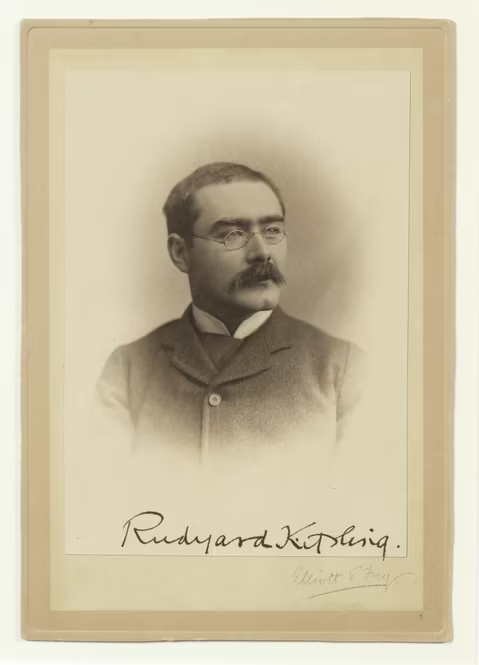
Quick Facts
Joseph Rudyard Kipling
Pen Name: Rudyard Kipling
Born: December 30, 1865, Mumbai
Died: January 18, 1936, Middlesex Hospital
Nationality: British
Genres: Adventure, Poetry, Regional Fiction, Victorian
Notable Works: The Jungle Book, Kim, Just So Stories, Captains Courageous, If—
🇮🇳 Early Life in India
Joseph Rudyard Kipling was born on December 30, 1865, in Bombay (now Mumbai), India, where his father, John Lockwood Kipling, was a professor of architectural sculpture at the Bombay School of Art. Though he spent most of his adult life outside India, Kipling always considered himself "Anglo-Indian," and he referred to his earliest days as a time of "strong light and darkness." In his autobiography, he recalled how his Portuguese ayah and his Hindu bearer Meeta would tell him stories and sing Indian nursery songs — "all unforgotten" — and how he and his sister were sent into the dining room with the caution: "Speak English now to Papa and Mamma." These bilingual, bicultural childhood years planted the seeds that would grow into The Jungle Book.
👶 The House of Desolation
In 1871, following the custom of the British Raj, five-year-old Rudyard and his younger sister were sent to England and boarded with Captain Pryse Agar Holloway and his wife in Southsea — a period Kipling would later call "the House of Desolation." While his sister became a favorite of the household, Rudyard endured years of cruelty. He described the experience in his autobiography as the unlikely beginning of his literary career:
"If you cross-examine a child of seven or eight on his day's doings (specially when he wants to go to sleep) he will contradict himself very satisfactorily. If each contradiction be set down as a lie and retailed at breakfast, life is not easy. I have known a certain amount of bullying, but this was calculated torture — religious as well as scientific. Yet it made me give attention to the lies I soon found it necessary to tell: and this, I presume, is the foundation of literary effort."
When asked later why he never told his family, he wrote: "Children tell little more than animals, for what comes to them they accept as eternally established. Also, badly-treated children have a clear notion of what they are likely to get if they betray the secrets of a prison-house before they are clear of it."
📰 Journalism and Early Career
In 1878 Kipling entered the United Services College at Westward Ho! in Devon. Lacking funds for university, he returned to India in 1882 and joined the Civil and Military Gazette in Lahore as a journalist. By all accounts — including his own — the young reporter was often covered in ink from the printing presses. These seven years as a working journalist in India gave Kipling an extraordinary education in the life of the subcontinent, from soldiers in barracks to native villages, and produced his first short story collections, beginning with Plain Tales from the Hills (1888).
In 1889 Kipling left the paper after a dispute, sold the rights to his story collections, and used the money to travel the world. The journey took him through America, where he met Mark Twain, before arriving in London. His reputation preceded him, and within a year he was the most talked-about young writer in England.
✒️ Notable Works
Kipling's output was prodigious across prose, poetry, and children's literature. His most celebrated works include:
- The Jungle Book (1894) and The Second Jungle Book (1895) — the stories of Mowgli, the boy raised by wolves, which have become enduring classics of world literature.
- Captains Courageous (1897) — a coming-of-age novel set among the fishing fleets of the Grand Banks.
- Kim (1901) — widely considered his masterpiece, a picaresque novel following an orphaned boy through the worlds of espionage and spiritual seeking in colonial India.
- Just So Stories (1902) — beloved children's tales explaining how animals got their distinctive features, including The Elephant's Child and How the Leopard Got His Spots.
- The Man Who Would Be King (1888) — a gripping adventure about two soldiers who set out to become rulers of Kafiristan, later adapted into a celebrated 1975 film.
- Rikki-Tikki-Tavi — the tale of a brave mongoose defending a family from cobras, one of the most widely read animal stories in English.
His most famous poems include If—, voted Britain's favorite poem in multiple polls; Gunga Din; Mandalay; and The White Man's Burden.
🏆 Nobel Prize
In 1907, at the age of 41, Kipling became the first English-language writer to receive the Nobel Prize in Literature, and remains the youngest recipient to this day. The Swedish Academy cited him "in consideration of the power of observation, originality of imagination, virility of ideas and remarkable talent for narration which characterize the creations of this world-famous author." He declined a knighthood and the Poet Laureateship on multiple occasions.
🌿 Writing Style
Kipling is considered one of the great innovators of the short story form. His prose is characterized by its economy, vivid sensory detail, and mastery of dialect and vernacular speech — from the cockney slang of Gunga Din to the Hindi-inflected English of his Indian tales. Henry James described him as "the most complete man of genius" he had ever known. His stories move effortlessly between realism and the supernatural, between adult complexity and childlike wonder.
🏡 Personal Life and Loss
In 1892 Kipling married Caroline "Carrie" Balestier, the sister of his American friend and publisher Wolcott Balestier. They lived in Brattleboro, Vermont, from 1892 to 1896, where Kipling wrote The Jungle Book and Captains Courageous. A bitter family quarrel with Carrie's brother drove them back to England permanently.
Kipling suffered devastating personal losses. His eldest daughter, Josephine, died of pneumonia in 1899 at the age of six. His only son, John Kipling, was killed at the Battle of Loos in 1915, at age 18 — a loss that haunted Kipling for the rest of his life. He had used his influence to get John a commission despite the boy's poor eyesight. The poem My Boy Jack is widely believed to reflect his grief and guilt over his son's death.
⚡ Controversy and Legacy
Kipling's reputation has been inseparable from debate over imperialism. Poems like The White Man's Burden (1899) have been read both as sincere advocacy for empire and as ironic commentary on its costs. Mark Twain and others criticized the poem's paternalism at the time. Joseph Conrad, who admired Kipling's craft, nonetheless found his imperial vision troubling.
Modern scholars note that Kipling's work is more nuanced than simple pro-empire propaganda — stories like Lispeth and Without Benefit of Clergy portray the human costs of colonial power with genuine sympathy. His semi-autobiographical Baa, Baa, Black Sheep remains one of the most powerful accounts of childhood suffering in English literature.
✨ Death and Significance
Kipling died on January 18, 1936, at the age of 70, from a perforated duodenal ulcer at Middlesex Hospital in London. His ashes were buried in Poets' Corner at Westminster Abbey, beside Charles Dickens and Thomas Hardy. He had suffered from ulcer problems for years; famously, his hemorrhage began on the same day that King George V — to whom he was close — died.
Despite shifting critical tides, Kipling's influence on English literature remains immense. The Jungle Book and Just So Stories are read by children worldwide. His poem If— endures as one of the most quoted poems in the English language. Robert Louis Stevenson called him a writer "with one great gift — the gift of story." As the age of European empires recedes, he is increasingly recognized not as a simple propagandist, but as an incomparable interpreter of how empire was experienced — and what it cost.
Frequently Asked Questions about Rudyard Kipling
Where can I find study guides for Rudyard Kipling's stories?
We offer free interactive study guides for the following Rudyard Kipling stories:
- Rikki-Tikki-Tavi — comprehension questions, vocabulary review, and discussion prompts
- The Man Who Would be King — comprehension questions, vocabulary review, and discussion prompts
- "They" — comprehension questions, vocabulary review, and discussion prompts
What is Rudyard Kipling most famous for?
Kipling is best known for The Jungle Book (1894), Just So Stories (1902), and the poem If—, voted Britain's favorite poem in multiple polls. He was the first English-language writer to win the Nobel Prize in Literature (1907) and remains the youngest Nobel laureate in literature.
Why was Rudyard Kipling controversial?
Kipling's work has been debated for its portrayal of British imperialism. Poems like The White Man's Burden (1899) have been criticized as paternalistic and racially condescending, though some scholars argue they contain ironic commentary on empire's costs. Mark Twain was among his contemporary critics.
Was Rudyard Kipling Indian or British?
Kipling was British by nationality but was born in Bombay (now Mumbai), India, in 1865 and spent his formative early years there. He considered himself "Anglo-Indian" throughout his life, and his childhood immersion in Indian languages and culture profoundly shaped his writing, particularly The Jungle Book and Kim.
Why did Rudyard Kipling win the Nobel Prize?
In 1907, at age 41, Kipling received the Nobel Prize in Literature for what the Swedish Academy called his "power of observation, originality of imagination, virility of ideas and remarkable talent for narration." He was the first English-language writer and the youngest person ever to receive the prize.
How did Rudyard Kipling die?
Kipling died on January 18, 1936, at age 70, from a perforated duodenal ulcer at Middlesex Hospital in London. He had suffered from stomach problems for years. His ashes were buried in Poets' Corner at Westminster Abbey, beside Charles Dickens and Thomas Hardy.
What happened to Rudyard Kipling's son John?
John Kipling was killed at the Battle of Loos in September 1915, at age 18. Kipling had used his influence to secure his son a commission despite poor eyesight. The loss haunted him for the rest of his life, inspiring the poem My Boy Jack.
What are Rudyard Kipling's most famous poems?
Kipling's best-known poems include If— (1910), Gunga Din (1890), Mandalay (1890), The White Man's Burden (1899), Boots, and My Boy Jack.
What is Rudyard Kipling's writing style?
Kipling's prose is known for its economy, vivid sensory detail, and masterful use of dialect — from cockney soldier slang to Hindi-inflected English. Henry James called him "the most complete man of genius" he had ever known. He is considered one of the great innovators of the short story form, moving effortlessly between realism, the supernatural, and children's literature.