The Busy Duck
by Susan Glaspell
Originally published in Harper's Magazine, November 1918. Illustrations by Walter Biggs. Text from Internet Archive digital scan of Harper's Magazine vol. 137.
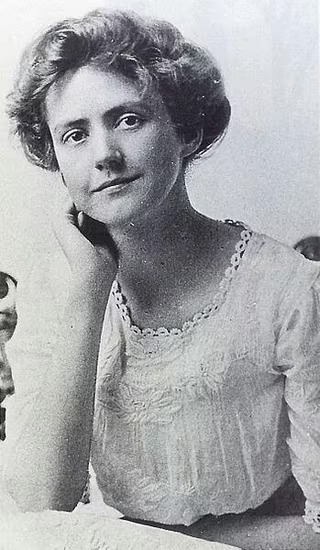
IF Mora Arthur hadn't been so pretty of course we never would have stood for all her talk about the needs of her mind. She had deep dark-blue eyes which I think might honestly be called violet, and a woman with violet eyes has a great many privileges. She had soft curly hair. I liked to watch the dip it made round her ear. I would be thinking of this when tired of listening to her plan for furthering the working of her mind. It made it possible for me to listen a long time — and I presume Hastings and all the others had their little compensations. Anyway it doesn't much matter what you say if you have a vibrant colorful voice for saying it. And she had such an intensity about the starved life of her mind that you felt it must end with "I love you!" It didn't seem the kind of intensity that could be getting anywhere else.
She had come from a terrible home. She would tell us about it with a fury that made you feel she was beating her hands together. So passionate were the pictures she drew of this pinched childhood that I would have the feeling I must instantly get up and knock somebody down. It was the way her mouth quivered while her eyes blazed. Then, when I was away from flashing eye and grieving mouth and would turn over just what it was she had said, I would come to feel that perhaps, after all, such cases could be more calmly dealt with.
Her parents were rich and unintellectual — a terse and unemotional statement of the facts.
"To think of it!" Mora would cry. "When I think of those wasted years I could tear something apart!"
Dear me! We would all get terribly wrought up about it, quite unmindful of the fact that most of our own years were wasted ones.
"And so," she would finish, plaintively, "you see what I have to make up for."
The trouble was, she made up for it so unceasingly. You couldn't venture upon an idea without getting Mora's determined eye and knowing that she was now making up for some fraction of her wasted years. Then you would have to halt your idea to think about her need of it — not a condition in which your mind can function happily.
Functioning was a word of Mora's. "My mind doesn't function" she would say in such angry distress that you would feel for your mind to go on doing what her mind couldn't do was not the part of kindness or good manners. Whenever a really interesting idea was put forth it left Mora indignant to think she had never heard this idea before. The night she met Hastings — a man of ideas — I walked home with her and she walked so fast I could scarcely keep up. She was absolutely outraged to think of how much had been withheld from her.
At her door I made a suggestion. "Don't you think," I said, "that it might be better now to think more about the idea itself and less about the fact that you never heard it before?"
She gave me the strangest look, getting this, and hard. Anything she got she got so hard that you almost hated to see her do it. "Why, yes!" she cried breathlessly, and laughed in her charming way. "Why — what a fool I am!"
"You're like a horse," I said "taken to a beautiful pasture, and so indignant to think of never having been taken to this pasture before that he can do nothing but run round snorting with indignation."
"And never eating a thing!" cried Mora, in that way of hers which gave you the feeling she was clapping her hands. Seeing more in it, "Yes," she said, very earnestly. Then, indignantly, "Now I never would have thought of
THE BUSY DUCK that!" And then, seeing she was doing precisely what she had been admonished not to do, she laughed at herself as she said good night.
She was really a charming child; she was younger than the rest of us; and her eagerness and her fury had much the quality of a child's. Of course, looks or no looks, we never would have put up with her if there hadn't been that freshness and charm in the avidity. And no denying that we were a good deal flattered at her being so bowled over by our knowledge and originality.
She came into our group through Edna Moore, who writes a good deal about what women ought to be and aren't. One night when I asked Edna to come to our place the next Sunday evening, to meet a fellow from South America who was lecturing at the university (no use trying any longer to conceal that I am a teacher), she asked:
"Oh, could I bring poor starved little Mora Arthur? I'm trying to get her into a different atmosphere — poor dear."
As I impolitely hesitated, not unfamiliar with the kind of woman Edna was trying to get in a different atmosphere, she added. "She won't do a bit of harm."
Now if there is anything you don't want at your party it is a girl who won't do a bit of harm. What Edna had said about the different atmosphere made me think this starved Mora Arthur was some one she had picked up on the East Side, and I hadn't meant it to be that kind of a party. If you know people from South America you will understand. So when Edna came in that evening with this young woman who knew so much more about coming in than Edna did, I was delighted to think there had been an exchange of prisoners, so to speak. And when she introduced me to Miss Arthur, of whom she had spoken, I wanted to say to Edna:
"Think you're clever, don't you?"
But before I had a chance to ask Edna what she was up to I rather came to see what she meant. There was something in the exquisite Miss Arthur's attention as humble and as eager as I should have expected from the young woman I had been anticipating. I wish to say that those of us who are university people are the sort of university
people who are always being suspected by universities, so an evening with us is not necessarily as dull as you may imagine. And many of my friends are people who maintain that universities and ideas have nothing in common — a position which I myself am inclined to think extreme. Anyway, that night people were talking interestingly, and suddenly I noticed that Miss Arthur's face had flushed as if she were excited about something. When she bade me good night she said sternly:
"You have talked about things here to-night which I never knew existed!" and she who had entered like a young ladies' finishing-school marched away, leaving her host in doubt as to her opinion of his hospitality. The more I thought about it the surer I was she had left in high dudgeon. I tried to recall what we had talked about that need send a young lady away offended. Of course Menger had gibed at marriage; but even in society isn't that one of the ways of passing an evening? And had the young lady never been taken to the theater? It must have been the biological section of the conversation, when Door had such a good time explaining why certain Africans are what they are. But that was too dry to offend any one. Finally I hit upon it. It was the facetious allusions to our unsuspected depravity as recently revealed through the study of our unconscious minds. Well — next time she could stay away!
But when I saw Edna Moore she exclaimed, "My dear, it's pitiful the time Mora Arthur had at your house the other night!"
"I don't see that there was anything to get so huffy about", said I, huffily.
"Huffy? Why, she's at your feet!"
I should say, rather, she was at our throats demanding we give up all we had.
"My mind needs this "she would say, and with such simple fervor that it wasn't as absurd as it must sound.
After all, there aren't many people who can be naive about their minds. She was one human being who did actually treat ideas as realities. She would go anywhere to get them — take up with any one. The trouble was, she treated them as the only realities. All the other things which enter into our estimates of people simply didn't exist for her. She cared nothing about their morals or their clothes — not conscious of those extraneous things. She went about with me because she liked my mind and my friends. She told me so, not saying whether she liked me or not.
I lead what you might call a double life. At least there is a side of my life which is at loose ends, and at these loose ends are loose friends — people not tied to anything, people with a philosophy which sets them apart from a social order, men and women who not only carry their theories into personal relationships, but who have personal relationships as tests for theories. Some of them are tiresome frauds and some of them are the most brilliant people I know. One night I took Mora to a cafe where they hold forth, and after that I was compelled to go so often to this place that I would wonder how soon I was due to lose my position in the university. Mora simply ate them up — lapped them up, I want to say, for she always gave me the feeling of lapping up ideas.
And then she met Hastings. He's the biggest person of that queer crowd. Well, he's the biggest person I know. At least, now that I try to think of a bigger one and mull over the list of my distinguished friends, I don't find any one I can say matches Hastings. He sees things in new combinations which startle you out of old ones. He would be an important writer if only he would write. But he'd rather entertain himself thinking new things than bother himself writing down the ones already thought. He says that's what makes writers so tiresome and unprofitable — they are always writing about a stale thing. And all they care about in a thing, according to Hastings, is what they can write from it. Exploiters of life — feeling, vision, the whole terror and splendor of life — something to write about. So it is not possible for writers to be pure souls. Hastings has no money, and he makes his living translating various impure souls who lived and wrote in Europe. This is to him a subordinate thing, not threatening his purity. He also does a little frankly subordinate writing — a sort of journal-
ist of ideas. But the thing he cares about in himself — and has a right to care about — he doesn't try to capitalize, or even capture. Laziness probably has something to do with it — impure souls really have to work. But those of us who know him get a lot from him — busily lapping. He's splendidly prodigal, not having the slightest instinct for keeping ideas to himself in order to do something with them. What he cares about is his own satisfaction in seeing a thing. If you happen to be around while he's seeing it you're perfectly welcome to anything you can get out of it.
If Mora hadn't met Hastings, I think she would have married me. Did I want to marry Mora? I don't think I should have had much to say about it. Had she decided she could get more through me than from any one else, she should have made up her mind to marry me, and her violet eyes would have put it through. But of course I'm nothing compared to Hastings. What she gets through me I got through somebody else. I just happened to get it before she did. Hastings creates. She perceived the difference quickly enough.
One night, this after she had met Hastings two or three times, she stopped right in the middle of the street and cried:
"Why, it seems terrible to spend a moment away from him!"
Now you know most girls would never say that.
I suppose she came to see that the only way to save herself the pain of spending a moment away from him was to marry him. This wasn't simple. Hastings was forty-five and had never married. He wasn't at all for marriage. If there was anything he didn't want it was some one who thought it terrible to spend a moment away from him.
I don't think Mora would have got him if he hadn't at this time got a cough. The thing surely would have amused Mora's friends — those friends of her illspent youth — except that they would have been too outraged to be amused. Here was a beautiful well-brought-up girl of twenty-five, a girl with money and what they would call position, trying to marry a man almost twice her age, a penniless writer who had low
THE BUSY DUCK associates, a ne'er-do-well who sat around and talked! And I am unable to conceive what they, would have said (I fancy they would have been speechless) could they have known that the only reason she finally got him was that he contracted a cough which made it possible for her to persuade him he needed to be taken care of!
Mora's father and mother were dead, which I think quite as well for them. Various aunts and cousins, who didn't understand a thirst for ideas, made an ineffectual fuss about "the life she was leading." A brother was what Mora called really troublesome at times, but to Mora these things simply weren't considerations. She didn't reject them — she didn't have to! They just didn't exist for her. The brother had this same singleness of purpose, only what he wanted was money — which, of course, makes him a great deal easier to understand.
So Mora turned her violet eyes upon Hastings, and there came a day when she said to me, "I'm taking John out of town."
"Taking John out of town?" said I, dazed.
She nodded. "Think of a mind like that being threatened! Why, just think," she expanded, in one of her bursts of fury, "what we should all lose if anything happened to him!"
I sat and stared. She struck me then as the most cold-blooded creature I had ever known.
"Do you mean that you're going to marry Hastings, Mora?" I asked.
"Oh yes," she said, indifferently.
"Does Hastings want to be married?" I asked, brutally.
She smiled. "He wants to be taken .
"But, Mora," I demanded, "are you in love with him?"
"I'm in love with his thinking," she said.
"And you think that's enough?" I scoffed.
"For me, yes." She paused. "Because it's all I care about."
Upon my soul, I believe it was! The next day I thought all the things any one naturally would think, and that evening I went to see Mora. But her
brother was there, saying, in his fashion what I had been prepared to say in mine.
"But what does he do?" he of course demanded.
"He talks," said Mora.
Her brother got up and moved from one chair to another, from that to the sofa, then stood up and whirled round.
"And you are going to marry a man because he talks?" he at last found it possible to say.
"What better reason for marrying a man?" asked Mora, quite honestly.
Then the brother talked. And no one would marry him for the way he talked then.
And then Mora talked. "Horace," said she, "you married for money. I want something else and I am marrying for that thing. I congratulated you because you got what you wanted, though it isn't at all what I want. You can't do as much for me because you aren't as practical as I am. So what is there for you to do but do nothing?"
Followed a few terse words about her life and her money being in her own hands. This being true, Horace took leave.
So did I, Horace having shown me how ridiculous you make yourself when you expend energy uselessly. But I was more practical than Horace; I made a little speech befitting the occasion.
"Mora," I said, "I hope with all my heart that your intellectual development will be very happy."
"Thank you," said the betrothed one, happily.
Mora didn't take John so far out of town as to make it impossible for us to go to see him. The first time I went I saw Mora bearing milk to John, who was in the hammock. It would not seem there should be anything disgusting in the sight. A wife carrying a glass of milk to an ailing husband — a beautiful young wife at that — why should an uncared-for bachelor not see this as a happy domestic picture? But I had a moment of wanting to go back to town.
"Feeding him up," thought I, sourly, "so he'll talk. Give him a glass of milk — he may give you an idea."
Quite so. Hastings was glad to see me in the mood for talking, and Mora sat by, getting visibly excited about her increasing wealth. It grew cooler and Mora went to the house for a rug. I was irritated by the way she came hurrying back with it — afraid she would miss something! And yet, she did go for it; so much subordination was her grasping little ego equal to. But, I considered a moment later, if she didn't get the rug John might take a cold and cut off the supply of ideas for at least a week!
I suppose I'm unfair to her; in fact, I know I am — selecting these things from all the other things is a method as absurd as her own. Any one not understanding Mora would have seen her as a charmingly interested woman, quite humble before her husband's astonishing mind. But I did understand her, and I was so stirred up by what I understood that I set out to write an essay on Culture, the point of which was that you didn't get it by trying to get it. I saw that this was not a new idea, though Mora made it seem new. I gave up the essay and thought about Mora, wondering why I was now so down on her. Of course there was the fact that she had selected the crumbs from Hastings's table rather than from my own, but I should have been genuinely distressed had she not met Hastings and made up her mind to marry me. And after seeing her with her husband I was more than ever thankful I wasn't the husband. It would get quite dreadful to have your thoughts hung upon like that. I should think it might in time reduce one to something like imbecility — just as a protection. Fortunately there was little danger of its doing that to Hastings. He was too absorbed in the world of his constant remaking to be aware of a lapping little mind on the outskirts. So far, at least, he hadn't become enough aware of her to mind her. This una wareness was Mora's salvation, as well as his own — saving her from being pushed to farther outskirts. I wondered if she would ever guess how little she mattered. And yet would she mind? It was Hastings's counting for her that she cared about. A queer sort of egoist she was. She wasn't vain; she didn't want to show off. She wanted to have. I once knew a woman who wanted to have spoons. I never knew why she wanted to have them. She didn't show them,
she didn't do anything with them, and, so far as I could see, they didn't do anything to her. But the idea of there being a sort of spoon she didn't have was torture to her. Well, at least no one could say Mora didn't value the mind, and it seems odd a university man should be so upset by this trait.
As I had been all keyed up for writing something and the essay on Culture refused to be reborn, I wrote verses about a duck:
A duck, when first he saw the sea,
Cried, "This must all belong to me!"
To move it to his duck-yard pan,
He took a beakful and began.He was too busy far to swim,
So light a thought unworthy him;
From dawn till dark he waddled fast,
Because the sea was wet and vast.His legs grew thin, his mind distrait.
His mother cried, "What is it, pray?"
"Oh, mother, do not bother me;
I'm busy bringing home the sea."
This put me in so good a humor as to give me more kindly feelings toward Mora. Thinking of her as a perturbed duck made me enjoy going to see her. When about to be irritated by a too fervent manner I would murmur:
"From dawn till dark he waddled fast,
Because the sea was wet and vast,"
and straightway I would have the most amiable feelings in the world. Perhaps my method would not. have the indorsement of our best social usages, and still anything that gives you more kindly feelings must have something to be said for it. Each visit would result in a new verse, as:
Deeper grew the path he wore
Between the duck-yard and the shore;
His beak it was a little thin
To fit the sea quite neatly in.
This might have become one of the longest poems in history had Hastings not grown so much worse as to make it necessary that Mora take him to the Southwest. I couldn't write of her as a pop-eyed duck when her husband's life was in question; some usages of my own saw to that, peculiar though her marriage had been. I missed the fussy duck;
THE BUSY DUCK he had been such a companionable little absurdity. Now my speculations about Mora took on a more serious character. You have to call it pretty hard luck. She was to give him a glass of milk, he give her an idea; now the balance shifts so that her giving the glass of milk is the enormously important thing. Many things may seem more important than living, but nothing remains important before the possibility of not going on living — quite in line with our general absurdity. In Mora's eyes was the light of a fervent determination — the determination to get John well. I must say it was a light with which I was not unfamiliar; I had seen it in Mora's eyes many times when she was trying to wrench an idea from my possession. This does not mean that the determination to get John well was less than it should be, but merely that it was impossible for her to be more determined now than she had been before, there being, after all, a limit to determination. She made no complaint; she was far too zealous for complaint; and I saw them off with the feeling that John would get well — he would simply have to, that being part of Mora's program.
After they had been down there awhile I had a letter from him which worried me about Hastings and set me on a lot of new speculations about Mora. For Hastings wasn't in that letter. The distinctive, the unique thing just wasn't there. I never realized before what sickness can do to us. And Mora? How about it? I must confess I even went so far as to wonder whether Mora would stick. A monstrous wondering, I know, but monstrous, too, was her singleness of purpose. A sick husband might become one of the things which simply did not exist for her.
Later came a letter from Mora — very short, asking me to attend to something for her in New York, and beyond that saying only this:
"John hasn't begun getting better. He is very sick."
Most anything in feeling might be behind those terse sentences. I tried to see behind them.
Then another letter about a business matter, and only this which was personal:
"I think John is now beginning to get better."
I was exasperated by this brevity. Again I tried to figure out the most likely reason for it. Trouble was, you could figure it several ways, and if you knew Mora, you might not interpret it in the way most creditable to human nature.
One evening I met some interesting new people, one man, in particular, who could startle you out of stale thinking a little as Hastings used to. I came away all keyed up, and on the way home it occurred to me, "What a wonderful time Mora would have had to-night!" It brought up the old picture of the earnest duck, and I wondered what the indefatigable duck was doing now that there was so little to be indefatigable about. I got to thinking of Hastings, and it ended with my sitting down and writing them a report of the evening. I myself was much delighted with the letter. It was alive.
Mora's reply bore witness that she was still Mora. She sent me a check and commanded I come to New Mexico at once! It was precisely Mora not to have any of the usual feelings, and not to have any idea of my having them — about the check, I mean. She said my mind was just what she and John needed. As she needed my mind, it was to her a perfectly normal matter, she having money and I not having it, that she buy the ticket which could take my mind to New Mexico. She said, in conclusion:
"Let nothing stand in the way of your coming. John needs you — and so do I."
I enjoyed the "so do I." It was so like old times.
Well, I went. It was vacation-time — and why must one always go to Maine? Certainly, anything I could do for Hastings I should regard as time happily spent, and I had a curiosity to see what had really happened to Mora.
At first I couldn't tell whether anything had really happened to her. She seemed older, she was quieter; she was like one who has been much alone, and alone with worry. And yet I told myself she had not changed fundamentally, that these were but matters of circumstance and only brushed the surface. What backed me up in this was the resolute light which had not died in her eyes; it was a deeper, a more intense light, but this was because she had been long biding her time. That first day I had the feeling that she was watching me, appraising. I would see her watching in her eager way when Hastings and I were talking, as if to see whether I was, after all, bringing as much as she had expected me to bring. Oh no, Mora had not changed!
The change in Hastings was the arresting thing. He was as one who has come back a long way, and he gave me a feeling that it was perhaps only a shadow of him which had come back. Through those first few days he was so much more like an invalid than he was like Hastings. He was pathetically glad to see me, and yet he seemed to be holding off from me. I wondered if it could be that the unique thing, that quality of his mind which was like a beam of sunlight darting through a veiled day — like an escaped thing — had itself been caught in gray. I could not bear to think this, but in those first days no playing thing shot light and color into our talk.
Oddly enough— or should I say neatly enough? — it was a talk about death which brought Hastings to life. I was telling him of a theory one of the men at the university was working on, and suddenly we had it, that dancing beam which could play through another man's thinking, lighting flaws, lighting beauty. Immediately the whole Hastings changed — exhilarated, confident, happy. Mora was there, but I was too delighted with the playing beam to give thought to her, beyond the amused thought that the busy duck was on the job, leaning forward with shining eyes, not going to let a thing escape! Then I forgot all about her — too interested.
I don't know how long we talked, but finally I saw that Hastings was tired, and then I noticed that Mora was not there. I was surprised that I hadn't known she was gone, but astounded at her doing such a thing! Mora leaving? when there were ideas to be had?
I went away, that Hastings might rest. They were living at the outskirts of a little town, in strange desert country which I didn't know whether I liked or
not. I walked along, still all aglow with the pleasure of my talk with Hastings. Ahead was a clump of those bushy things which grow in the desert, and as I made a turn, to go up the mound and sit there — I came upon Mora. Turned from me, she was lying there flat on the ground. I saw that she was crying.
I was too amazed to know what to do; but some sand slid down and Mora raised up and saw me.
She herself did not seem at all embarrassed by her red eyes. She smiled a little, then cried afresh.
"Why — Mora! Why — what did you go away for?" I asked, in the foolish way we try to make conversation with the weeping. "John was talking so wonderfully."
"That's why," she gulped.
I couldn't get my bearings, so I stayed still.
"Td — waited too long," said Mora, crying under her breath. "I'd — been too afraid."
Well, that was possible, I suppose, given her preposterous intensity in having to have what she wanted.
"It's nice to have him himself again," I said, to fill in.
"Nice?" Mora stared at me, then laughed — a laugh which rather offended me, as if I were a person who could have no comprehension of how nice it was.
Then she jumped up. "I must go home. Did John seem tired?" She hurried along so fast it was hard to keep up with her.
As I thought of it I became increasingly puzzled. It wasn't what she had done, erratic though that was; it was her eyes — a light in them which no amount of zeal in intellectual affairs could quite account for. And still, I assured myself, would not the intense duck become emotional if taken back to the sea after long away from it?
Next day something struck me that struck hard. Mora came in the room with a glass of milk for John. It brought back that other time when I saw her with the glass of milk and said to myself, "Give him a glass of milk, he may give you an idea." But as she gave him this it struck me, hard, that she gave it as if expecting nothing in return.
Absurd! How could you tell a thing
THE BUSY DUCK like that? Every time I thought upsetting things I scoffed at them. Mora was one person I understood. On my understanding of Mora I would build my church!
But my church seemed built upon one of those balanced boulders which startle you anew every time you look at them. John and Mora and I had a long talk that night, and after I went to my room it occurred to me we had been three people talking, not two people exchanging ideas and a third clutching at them as they passed. Another notion! It was merely that Mora was a little out of practice in snatching.
But two days later the really outrageous thing happened. Mora and I were out on the porch; we had been talking for an hour or more. Suddenly I jumped up and cried, in hurt astonishment:
"But, Mora, you're a restful person!"
She was momentarily surprised at the violence of the attack, then smiled understandingly.
"But — but look here," I thundered on, "what's become of your mind?"
She smiled again; then her eyes went grave. She was looking over the desert, looking far, not thinking of me. Then she turned her grave eyes to me and said, simply, "I thought John was going to die."
Her eyes — no, I can't describe them. There's a certain dumb look that leaves you dumb.
"So I didn't care about anything else," she finally said. "And after that," she smiled, her face beautifully lighting, "oh, I knew I had the important thing, so — -I could just take other things a little easier."
Again she seemed to have forgotten me, and it was quite as well I should be forgotten! A balanced boulder had tumbled on my brain.
"But," I finally began, "you cared about John for what John could give you. You were to give him a glass of milk," I went on, with growing indignation, "and he was to give you an idea."
Mora laughed. "And I got so interested in giving him the glass of milk — "She broke off,, considered, then said, with something of her old eagerness, but not that thin, flurried eagerness: "Yes — how queer. You want something.
You will do anything to get what you want — but what you do shapes you to a thing that wants something else. Why — what a mean trick!" But Mora laughed, as if it were a trick at which she could afford to laugh.
I did not laugh. I could not afford to. Things were all muddled up and I was indignantly trying to straighten them out. I went back and interpreted in the light I now had, and each time this present light illumined a past thing I would feel newly betrayed. That dumb look in Mora's eyes told why Mora's letters had been so brief. There are things we can't talk about. Mora hadn't sent me the check to come to New Mexico because she herself thirsted for new ideas. I had been peremptorily summoned because I might be just what was needed to bring John back to himself. She hadn't watched me like a hawk to see whether my ideas were going to be worth their salt for her. I was just another kind of glass of milk she could give John! And when she finally saw John himself again she goes running away from what he has to offer to sob out her joy in merely seeing him himself!
Well, it served her quite right. Her means to an end proved a trap that had sprung, and in that trap serenely sat Mora, happily serving. She was so grasping that she had been willing to give in order to grasp, and then giving made her into something which was not grasping. One of life's very neatest little tricks!
My indignation thus settled down into comfortable and not unfriendly gloating; but I wasn't even left in peace with that. In the six weeks I was down there the wind was slowly taken out of the sails of my certitudes. I couldn't even complacently think of Mora's sweet womanliness as just punishment for her avidity, for each day it came home to me anew that, now that she had stopped lapping, she had begun getting. Her dreadful little lapping had dammed the tide. Now things had a chance to flow in. One day it came to me as quite preposterous that Mora actually thought. Fancy Mora taking time to think, and never worrying for fear she would miss something while taking this time off!
"Well, I must say, Mora," I said to her, crossly, the last day I was there, "I never thought to see you become an interesting woman."
" Do you think I am?" she asked, wistfully. "I want to be — because I want to interest John."
Mora wanting to be something in order to give something! On what rock could one build a church? Perhaps the temple of truth would have to be a house-boat, and float.
This made me think of the wet, vast sea and the earnest duck, and so that last night I wrote out all the verses about the busy duck to leave as a farewell present for Mora. This might not seem a gracious return for hospitality,
but I knew Mora would enjoy the picture of herself bearing the sea to her duck-yard pan.
But the poem seemed unfinished, and that wistful note in Mora's voice made me want to write some new verses, leaving with her the picture of the hero triumphant. So thus the poem closes:
And then one day he stopped to swim,
It quite refreshed and changed him.
"It is not good to move the sea;
I'll leave it where it is," said he.So now he rides upon the waves,
And knows that ducks should not be slaves;He contemplates the boundless sea,
And thinks, "This all belongs to me!"