The Hearing Ear
by Susan Glaspell
Originally published in Harper's Magazine, December 1916. Illustrations by Frederick A. Anderson. Text from Internet Archive digital scan of Harper's Magazine vol. 134.
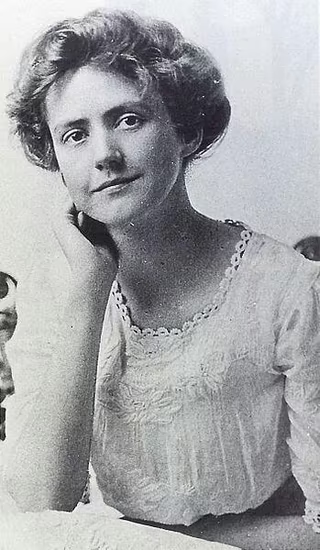
AN hour had gone by since I bade the Hoyts good night, and alone in my charming room at their house I was still trying to figure out why the Hoyts puzzled me. The change was in Katherine, and in Philip's manner toward Katherine, his wife. It wasn't waning interest; indeed, I had never seen him as preoccupied with her. I went on turning over the memory of this word, this glance, and all at once it came to me that that look in Philip's eyes as he watched her was a worried look.
It came to me with a shock, so completely out of line with my feeling about Katherine Hoyt was it that she should excite concern. I had known her — oh, all our lives, but I was seeing her after three years of not having seen her; for the past fifteen years I have only seen her off and on, for back there in the 'nineties I developed a lung which made it necessary I pull up stakes in Chicago and seek sunnier climes. The lung is fairly sound now, but I still seek — just for the love of the seeking.
For the most part our evening had been quite what I had anticipated. I hadn't realized that I had had such an interesting three years. That is what Katherine can do. I suppose there are a number of people who have that same feeling I have of being at their best with her, and of course that makes her immensely popular — for who pleases you so much as the person who causes you to be pleased with yourself? She is called a brilliant conversationalist. To me that is too definite and a little ponderous for Katherine, so light is the touch with which she distils the amusing from everything, and so peculiarly personal her gift for letting the amusing go out as a light over the rest of life. When you are with Katherine things come to life anew.
She had developed since last I saw her, just as she had all along been developing. She had a more poignant wit and a subtler humor than in the days when she made more beautiful debutantes seem an insipid race. And yet, set against that was something else — or why should I be sitting there puzzled and a little disappointed? All at once the word "effort "came into my mind.
It was all very bewildering; I finally went to sleep without having worked it out at all. Katherine had always been so easy in her quickness; and the thing that was too much for me was that in a sense she was more easy now than ever before. But for all that there was something pulling the other way, something like strain. I remembered things now which at the moment had been swamped in the pleasure of the reunion. Particularly I remembered one look over at Philip, and then his going on with the talk, as if relieving her. Naturally I came to the conclusion that she was not well, that she must have been going too much and was nervous.
But next day Katherine took me to a tea where I would see old friends, and it was there something happened which made me determine I would talk to Philip that night — I was close enough to them for that.
The thing I mean isn't much to tell about, for it was only a look which I saw pass between two women when Katherine left them. But it was an unmistakable look of relief. You would need to know Katherine to appreciate how that bewildered and alarmed me.
Though I had made up my mind I would speak to Philip, it was Philip who, late that night as we lingered alone in the library, spoke to me.
"Wyman," he asked, abruptly, "how does Katherine seem to you?"
"She puzzles me," I answered. "There's something I don't understand."
THE HEARING EAR He nodded. "It's her hearing," he said.
I gasped, as one does when light has suddenly broken. I went over the whole thing, and at how completely it did explain it I said, with what I suppose must have been a certain satisfaction, "Oh— that's it."
"You don't think it's very good news, do you?" he asked, a little dryly.
"I see now that I must have been fearing something worse," I explained.
He sighed. "Well, I don't know what you had been fearing, but — Why, stop and think a minute, Wyman. Are there so many things worse than not being able to hear what people are saying?"
I was about to speak of the number of people who had difficulty with their hearing, when Phil changed my line of thinking. "For Katherine, I mean," he added.
There was some time when I did not speak — when I thought. Then I inquired if something couldn't be done.
He shook his head. "They seem to think not," he said, wearily.
He told me all about it; it seemed a relief to him to talk of it, as if he had gone over it too much by himself. It was almost two years before that he began to notice Katherine did not always hear what he said. He didn't really think of it as failing hearing until one night at the theater when he had to repeat many of the things to her. He asked her that night if she noticed any difficulty with her hearing. She wouldn't admit it at first, but finally acknowledged that she did. She said it must be just a little temporary thing that would go away of itself, and she had been distressed at his having remarked it. He insisted upon going to a doctor, and — well, they had been to many doctors since. Her hearing had grown worse — as they had said it would. They said it would go on growing worse.
"Probably you haven't noticed it so much," he said, "because you speak deliberately and clearly, and Katherine doesn't have much trouble with you. But — she doesn't get on so well with most people." He said it curtly, as we say a thing that hurts.
Phil and I talked till late that night, and it was much later still when I went
to sleep, trying to see Katherine as she would be, shut out from people.
It was very hard to picture her so and see her Katherine. It struck at the thing definitely and peculiarly herself. Her gift was social; people were her medium. This threatened her as failing sight would threaten the artist.
As I turned it over that night I wondered, if she did more and more lose that easy communication with others, what new thing it might make of her. It was not hopeful thinking. With all my admiration of Katherine I never felt that she drew from deep roots. I could not see that she would have other resources because of the completeness with which she realized herself right there in her own special province on the surface. It was her gift for people that had given her social supremacy. She was used to that supremacy. In it she lived and moved and had her being.
I had expected to be in Chicago less than a month, but both Philip and Katherine pressed me to stay, and I felt they not only wanted but needed me. And in those three months Katherine never once spoke to me of her difficulty. Phil said she did not admit it to others simply because she was not admitting it to herself. I asked him if he thought this the wise way, and he answered, "Perhaps not the wise way, but it's Katherine's way." He felt we could only help her by aiding her in helping herself after her own fashion. He said, "I know it's hard to see her trying — but it might be harder yet to see her give up."
I could see that there was his fear; like me, he could not see a made-over Katherine. And in the time I was with them I saw what I think I might call one of love's miracles; more soberly speaking, I saw that love makes it possible for us to become what we could not otherwise have been. Philip had always been a quiet, serious-minded fellow, very much absorbed in what he was doing, and given to letting little things pass around him unnoticed. Socially he had always been just a little clumsy. I used to think that one reason he adored Katherine was that so many things which were hard for him were as easy as breathing for her. But now, in her need, his love gave him powers not native to him. It was as if he made himself over that Katherine might remain herself. He who had been slow became quick; he who in little things had seen little, now saw everything; where he had been shy, awkward, he came to be at ease in shaping a situation, in bridging a difficulty. He could watch Katherine without her knowing he was watching her, without making it apparent to others. He never seemed to hurt her confidence or shadow her pleasure by that most inept of all things — help which is not needed — but he had an apparently unfailing instinct for the moment when she should have help. He would join her group and with a light skill I could scarcely believe was Philip Hoyt's he would give things a new start. I have seen her eyes call to him. He had a way of letting her know what she had missed without actually repeating what had been said; he would say the thing in a new way, as a contribution to the conversation. He literally became a new kind of person — the kind of person who could keep the channels of communication open for Katherine.
I saw how she needed him one night when I saw her without him. Katherine and I went alone to a small reception for Zeering — the Chicago painter who had just returned after a number of years in Paris. It was a brilliant little affair — quite Katherine's sort of thing, but for her it went badly from start to finish. It's strange — the difference in our attitudes toward the deaf and the blind. The blind rouse all our tenderness, our chivalry; but we seem to resent deafness, and often we dislike the people who bring us into relation with it. The mistakes of the deaf strike us as funny; we'd hate any one who laughed at the fumblings of the blind. It doesn't speak very well for us, but I've come to the conclusion that we find deafness irritating simply because it makes trouble for us. We don't like the awkwardness of stating our ideas in a loud voice. And we seem to think because they don't hear well there's something the matter with their understanding. Time and again, since Katherine has made deafness a matter of special concern to me, I have noticed really sensible people
talking to the person hard of hearing, not only in a loud voice, but as if he were also simple-minded. At this little affair for Zeering a woman began talking to Katherine as if she were one whose intellect necessitated a simplification of thought — a words-of-one-syllable manner. I saw Katherine flush and turn away. A number of times she said things which showed she had lost the thread of the conversation, and once in particular I remember how cruelly it was brought home to her that she had snarled things up. The expression of the other people made it plain that she had not gone on with what they were saying. After a moment's awkward pause they began talking of something else.
Next day, when we were invited to a dinner at the Lingate's — then the most conspicuous family in Chicago — to meet some English people who were visiting them, Katherine said, "Suppose we don't go to that, Phil." She tried to say it lightly, but she looked older and — • well, as if something had gone from her. Phil said, quickly: "Why, of course we'll go, Katherine. Why not? Henry wants to go; don't you, Wyman?"
It was the last thing I went to in Chicago. I am glad we went, for I carried away an impression of Katherine as a woman who had brilliantly realized that piquant girl of twenty years before. It was amazing, almost incredible, the difference between the evening of the week before and now. It was a flash-up of her spirit that transcended her handicap, as if the thing that was herself, feeling itself threatened, defied the barrier that would shut her in. She was in the current, and I don't think any one else realized that there were several times when she would have veered from it but for the almost unseen touch of her husband. I had never seen her more radiant. The English visitors were delighted with her; she had here, at its purest, that gift of hers for heightening life, for throwing an interesting light over everything. I stood watching her as the center of an entertained group. I hold that picture of her — quick, sensitive, glowing. I noticed Katherine's ear. It was peculiarly formed — rhythmically formed, and gave the impression of an ear within an ear — an inner ear.
THE HEARING EAR I left with a feeling that it must all come right, that Katherine was too vital to break. As I thought about it on the long ride to California, I was a little sorry that, after her triumph that night at the Lingates', I had not ventured to talk with her about her situation. It seemed that the idea of "sensitiveness" was absurd in view of her beautiful power to surmount her difficulty. I would like to have told her that she had nothing to fear, that the closing of any one door could not shut her out from the world; I wished I had assured her of my feeling that the flame in her was too strong to go out under the breath of physical adversity. But I had left without talking to her, so strong is the habit of not intruding, and even that I did not too much regret, secure in my feeling that she herself would bring it right, that the life in her would find its own way. And the more I dwelt upon it the more it seemed to me that this open current between her and Philip should make up to Katherine for the closing of many little surface channels. Katherine would indeed have failed if with time she did not come to see that she had gained more than she had lost. All of my faith in life went into the feeling that she would not fail.
Once in the Pacific, I went clear to Australia, and I was in out-of-the-way places for the next few years. But Chicago people range far, and there were several times when I met people who gave me word of the Hoyts. All that I heard vindicated the feeling of hopefulness with which I had left them. Katherine Hoyt remained the most fascinating and, in an exclusive sort of way, the most popular woman in Chicago, her townspeople assured me. Yes, she was really very hard of hearing, but she was so clever it didn't seem to make much difference; she somehow got the point, and what she said herself was the thing that counted. A little later, in Japan, I met Anna Stephens, one of Katherine's closest friends. She had seen what I saw — that it was Philip who kept the way open for Katherine. "He lets her know the thing necessary for going on," she said. She told me that while she thought Katherine's hearing had grown worse, her way of coping with it had
improved so that it was less conspicuous than it had been at the first. "And the team-work gets better all the time." She thought it had infringed very little upon Katherine's spirit; it had roused her will and called upon new resources. She was really more interesting than ever before.
This talk made vivid all my first feeling about Philip, freshened that sense of them as two people whom love, in a time of need, had swept into special communication with each other, breaking through the barrier of our easygoing normality. It was just after Mrs. Stephens left Japan that I one day opened my Chicago paper to see Philip Hoyt's picture on the front page. He was one of the men who went down with the Dorik.
I couldn't believe it. Even late that night, after I had read it over and over, my mind didn't take it in. He had gone to London on a hurried business trip; his wife was not with him, but was waiting for him in New York. There was a long story, giving the facts of Philip's life. I stared down at his picture and tried to realize that he was dead. It was for me just one of those things which can't happen.
I tried many times to write a letter to Katherine before I got anything that I could send. For what could I say to her? Apart from everything else, how was she going to get along without Philip? I confess that I tried not to think of her — so well did I understand just where this left her. And I tried not to think of Philip. I couldn't bear the thought with which he must have gone down. Clumsy chance seemed making sport of our finest achievement, of that sensitiveness which flowers from our tenderness.
I had no reply from Katherine; at length I wrote to Anna Stephens, who was back in Chicago, asking for word. And she told me the most amazing thing; she said that Katherine had entirely lost her hearing. Katherine said she couldn't hear, and there was every reason to believe she could not. She made no effort to hear. She made no effort of any kind.
Again and still again I wrote to Katherine, but I did not hear from her. From the few things I heard through others I knew what it was that had happened. I knew it was not merely that she did not want to hear, but that she could not hear; but I know enough about the strange underlying life of our minds to suspect she could not hear because of the deep want not to hear.
The next spring I went to Paris. I had made up my mind that in the fall I would go to America. My reason for going there was to see Katherine. I determined that I could not leave her shut in by herself without a real attempt at reaching her. Philip's face would come before me and tell me I must try. I knew that at the first something in her was frozen and wanted nothing but to go to sleep and die; but I know also that time itself carries a breath of life. I thought that by fall, perhaps, Katherine would not refuse to meet me, spiritually meet me, I mean.
But with me, as with millions of others, the war changed all. I had lingered in Paris through the early summer; some American friends were there with their motor, and excursions about France with them had made July pleasant. I was on the eve of going to Norway when the Germans marched out of Germany for Paris.
I could have got away with all the other fleeing Americans, but I had an instinct for staying... . Late in the fall a Chicago surgeon whom I knew came to join the American ambulance corps. Through him I had later word from Katherine. He told me that she had left Chicago, had gone with only a paid companion. He heard through her lawyer that she was living in an isolated little town on the New England coast. She was going to stay there.
He told me it was true Katherine was entirely deaf; he was convinced it was genuine. He said he believed her hearing all along had been worse than we had known, because of her skill in dealing with it — and her husband's skill.
"It's strange, but not impossible," he said, "that hearing should go now. The more we work with bodies the more we have to concede to minds. Can't you see how her whole feeling about his loss might react on those nerves which had made such a particular response to him?
He helped her hear; he kept her wanting to hear. She hadn't him any more — she didn't want to hear — she couldn't hear."
I felt that he was right, but I suspected intricacies in it which were not there for him. I wondered if, added to grief and to helplessness, a dissatisfaction with self was not there as a more insidious blight. Now that she had not Philip and could not hear, I wondered if there had not come a deep revulsion from all those small things which she had spent herself — and him — in trying to hear. This idea was given substance by a letter from Mrs. Stephens later in the winter.
"I went up from New York to see Katherine," she wrote. "I tried to get her to come away with me, but she was immovable. She seems in every sense just that. Of course it is very hard to communicate with her, particularly as she doesn't want to be communicated with. Of this I feel sure — Katherine does not want to come back to us. Perhaps it is that she tried too hard for too long. I wonder if she feels that she lost the best of Philip through that trying— something in her eyes made me think that one night. The only interest she has is in the sea, and I doubt if that is as much an interest in life as in death. Her house is on the outskirts of a little fishing village; it might be pleasant enough in summer, but of course terribly desolate in winter. I did what I could, but there's something in this shut-in Katherine stronger than anything in me."
That she who had been most open to living should now be shut in alone; that Katherine Hoyt, who had stood to me for life at its most vivid, should have become that greatest negation of life — the living who are not alive — was just a part of the whole break-up of those days. I do not suppose those who have their own place in life, and a place far away, can ever understand what the war meant to us who were, in one way or another, caught into it. I was caught into the work of trying to care for the wounded and those who were left destitute.
We went through that winter, through the next summer, and began another winter. I did not forget Katherine, but I did nothing for her. I still had the re-
THE HEARING EAR solve to go to her when I could, but I had lost the feeling of being able to do what I wanted to do. I did not write to her because I had nothing to offer. Those were days when there was not in my spirit either the power or the impulse to summon another back to living. And then one day, on the steps of the hospital, I met the Chicago surgeon of whom I have spoken. He talked a moment of what he had been doing, and as he was turning away he said:
"Oh, by the way, have you heard about your friend Mrs. Hoyt?"
"Heard what?" I asked, sharply.
"That she was dead?"
I do not know whether I stammered, "Dead?" or whether I only tried to.
"My sister wrote me that nobody seemed to know much about it," he was going on. "The woman who lived with her wrote that she always went out in the storms and that she seemed to have no idea of taking care of herself. I suppose that's a vile climate — anyhow, it was pneumonia. She was buried there where she was living — way off there by herself." He stopped talking, as if halted by that last. After a moment he murmured, "She certainly had dropped out, hadn't she?" then hurried along about his business.
The darkest moment I have ever known in my life was the moment that night when I suddenly realized it was a relief to think of Katherine as dead. I have failed utterly in my narrative of her if it is not apparent what that realization meant to me. And as all along in this strange way things had been let in to me through her, so this realization of how I felt about her let in with a rush the sense of how I felt about life. It was as if old things, things simple and happy, had gone out of the world. That world in which Katherine had been so bright a point just did not exist any more. It was back in some other existence that she and I had laughed together over those amusing things that transpired through the pattern of life and lighted it up. The as it should be had gone out of the world. Again things were made meaningful through her. I thought of how Katherine had not fulfilled herself, and, when I knew that, my pain for her was in that I knew why my
spirit was sick. Life was not fulfilling itself.
I said as much several months later at the home of a friend of mine who is a painter, where I had gone to meet a friend of his — Gordon, the well-known sculptor. He had left Paris the first week of the war, expecting to be back soon. He had been living in America that his work might go on undisturbed by the madness of men, but the length of the war was too long a term for him to live away from Paris, and so he had come back and opened the hastily closed studio.
It was Gordon who seemed to know what I meant by my not very cheerful remark. I had been goaded to it by exasperation; Raymonds, my painter friend, had made a smug remark about the war really not affecting the things that counted. And then I asked him if the human race counted. Raymonds merely thought I was a disagreeable guest, but I met Gordon's eye and saw that he got something else. As I was taking leave, he asked me if I wouldn't one day soon come round to his studio.
I went the next afternoon, for he made me feel less alone. He showed me the work he was doing, and we talked of that, and then returned to the thing we had talked of the evening before. In the midst of that he seemed oddly to interrupt himself, for he suddenly said, "There's something I haven't unpacked yet." He got up and went to the back of his studio and took something from a box. As he brought it forward and placed it on the table before me it was still obscured by a little of the packing material. While he was brushing that off he said: "You say we are lost in the night. I wonder what you will think of this."
I can't tell it at all effectively, for the mere recounting of my first feeling affects me so strongly that I have again that feeling of being sick, of being about to sink down. The singular part of it was that I had that feeling before my mind really took in that the bust at which I was looking was a portrait of Katherine Hoyt.
I remember I brushed my hand over my eyes, as if to brush away the too strange fancy. And then I looked again, and I knew it was no fancy. And the thing which made me know that this was Katherine and no other was that strange formation of the ear, which was as an ear within an ear — an inner ear. I suppose I must have looked for that without realizing I was doing so.
Gordon, who had brought the bust out to see its effect on me, was caught into the artist's absorption in his own work which he is seeing after a lapse of time, and so he wasn't noticing me. Of course there was a time when I could not speak: the utter surprise of it, for one thing; the strangeness of it — that Katherine, after she had gone, should come back into my life, that I should have word from her again.
"She wasn't lost in the night, do you think?" he asked me at last.
One can't take in everything at once, and it's quite like us, it seems to me, that I had taken in first the things that were like Katherine — those definite little things of identification. But as I looked now I saw the new thing — the big thing. I looked around the studio to see if other things looked real, as they had a moment before, for the face of this friend whom I thought had died defeated was the most serenely triumphant face into which I have ever looked.
The thing I at last said must have sounded pretty banal to an artist. "But was it a good likeness?" I asked.
"If you had seen her," he said, "you'd know one wouldn't presume to do anything more interesting than a likeness." He looked at his work, then added, with authority, "As a likeness, it's the best thing I ever did."
"But where did you see her?" I asked, and I sat down, for I felt weak.
"Last summer I went to Cape's End," he told me. "I don't suppose you know it — a little neck of land way out at sea, a townful of people whose lives are made by the sea. There's a wide reach of what they call the flats left bare at low tide. One morning I had been out to the traps with the fisherman at whose house I was staying, and just after sunrise I walked in across these flats. The wet sands were magical in that first light, and it was all so fresh and strange
— the freshness of strange things. And this woman was standing just behind one of those pools of color — this 'seeing' look on her face. She gave me the strangest feeling of being on a threshold. The flats suddenly seemed something that reached out — not merely from land to sea, but from life to — something else. Anyhow, she gave me a feeling of being right up to the edge of things. The next day I saw her on the beach with a little boy — a little boy who limped; they were building something in the sand. Before she saw me coming along I saw her regarding him with a certain look of — Well, here, I hope I've got a suggestion of it — the mouth, perhaps." He rose and turned the bust so I could get another aspect. "Well, I wanted to do her. She had something that I wanted to get. I felt that she knew something. I had just had word that Helot — the young Frenchman who worked with me, and who went to war the week I went to America, had been killed. It takes the personal to drive it home, doesn't it? for I suddenly knew what war was. My picture of that boy covering up the figure he was doing and going out to get a uniform and a gun... . It's as you said last night — lost threads, rude interruptions, unfulfilment. And so I had to get her, because with her things were going on!" He paused. "They will always go on with her, don't you think?"
I looked at Katherine. "It seems so," I murmured.
"It's strange," he mused, "how much that sense of some one having something can mean to us all. It is strange," he repeated, after a moment, "but no matter how much may be lost — if we can feel there's something not lost, or, rather, if we can feel that some one has got something that can't be lost— Well," he broke off, "I wanted to do! her, and I suppose the reason I had no hesitancy in asking her to sit for me was the fact that what she had was bigger than herself, and my reason for wanting it was bigger than myself. So I walked up to them as she watched the little boy building on the sands. The tide was coming in, and what was in my mind was that the house the boy was building would soon be washed away, and that it was like all the other
THE HEARING EAR things people had been building. But what I said was — to her through him — 'What a fine, big house!'
"She looked at me a moment and then with a smile she said, 'It's better to build something, even though it may be swept away.'
"I tell you it made me feel queer. She had answered, not what I said, but what I was feeling. I might as well tell you right now that she hadn't heard what I said. She was deaf. But the other thing is the amazing part of it. Because she couldn't hear what I said, she knew what I meant."
I sat looking at Katherine, and as I took that in, as I really got it, my eyes grew so dim I could not see her.
"In a later talk she said to me that she had for a long time been shut out from people because she knew them only through what they said. She laughed — don't get the impression that she is an austere person — and said that blurred things a lot."
If he had not been himself absorbed he would have thought me very strange throughout. I made no reply to this; to me it was way beyond any reply.
"Well," Gordon was going on, "I wrote her a note and asked her to sit for me, and she wrote back most amusingly and said she would expect pay and that she would take it in the form of a large lump of clay, that the little fellow I had seen her with might have something more stationary than sand to work with.
"She told me about him during the sittings. It seemed he had been made lame through an accident the year before. 'He's not used to lameness,' she said, with a look on her face the sculptor hasn't yet lived who could hope to get. He used to lead all the rest, and one day she saw him trying to jump with the others, and he fell very short, and afterward she found him crying. 'I am greatly indebted to him,' she told me, in a simple way she has, 'for I saw something through him.' I thought she was going to tell me what it was she saw, but she fell to thinking, and I wouldn't for the world have disturbed her, because— "He pointed to his work.
He looked at his work, and I looked at Katherine — the quiet beauty of that seeing look, the tender, brooding understanding, the loving wisdom that may follow pain. "Perhaps she meant something in her own life," he ventured. "I feel sure she has not always lived as quietly."
He was called away then, and for a time I remained alone in the studio. I do not know how long a time; I only know that it was the most important time of my life. I lived more in that time than I had lived in all the time before. I saw more. As Katherine had all along in that strange way been as a glass through which I looked, she was now a clear pool through which I saw into things not often seen. I thought of her whole life — of how she had lost where she had been strongest, and how from her weakness she had won what she could not have had through her strength. I knew what it was she had seen through the little lame boy. I saw through her what she had seen through him — that channels cut off may make deeper channels, that the end may be the beginning. Of course I longed for my friend, and yet more than ever before I had my friend. A sense of the whole wonder of life, a deeply refreshing sense of the beauty of life, opened thus from Katherine's experience, after I had thought her gone, coming back into my life — a light in the darkness. And as there was something in her stronger than anything that could happen to her, so I knew now that there was something in life stronger than anything that could happen to life. That was my deathless word from Katherine, a word which had the authority of one bright star in a clouded night.
Gordon came back and stood beside me and looked with me. He is deeply the artist, for he said not a word. At last I thanked him and went away. Once outside it occurred to me as strange that I hadn't told him either that I knew Katherine or that she was dead. But was it strange, after all — when those two things mattered so much less than other things mattered.