Cinderella
by The Brothers Grimm
Are you looking for the Grimm-less version: Cinderella for young children?
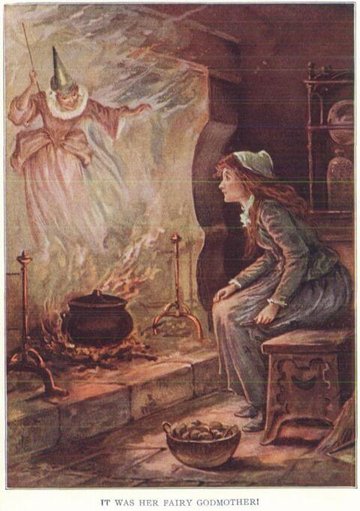
The wife of a rich man fell sick, and as she felt that her end was drawing near, she called her only daughter to her bedside and said, "Dear child, be good and pious, and then the good God will always protect thee, and I will look down on thee from heaven and be near thee." Thereupon she closed her eyes and departed. Every day the maiden went out to her mother's grave, and wept, and she remained pious and good. When winter came the snow spread a white sheet over the grave, and when the spring sun had drawn it off again, the man had taken another wife.
The woman had brought two daughters into the house with her, who were beautiful and fair of face, but vile and black of heart. Now began a bad time for the poor step-child. "Is the stupid goose to sit in the parlour with us?" said they. "He who wants to eat bread must earn it; out with the kitchen-wench." They took her pretty clothes away from her, put an old grey bedgown on her, and gave her wooden shoes. "Just look at the proud princess, how decked out she is!" they cried, and laughed, and led her into the kitchen. There she had to do hard work from morning till night, get up before daybreak, carry water, light fires, cook and wash. Besides this, the sisters did her every imaginable injury — they mocked her and emptied her peas and lentils into the ashes, so that she was forced to sit and pick them out again. In the evening when she had worked till she was weary she had no bed to go to, but had to sleep by the fireside in the ashes. And as on that account she always looked dusty and dirty, they called her Cinderella. It happened that the father was once going to the fair, and he asked his two step-daughters what he should bring back for them. "Beautiful dresses," said one, "Pearls and jewels," said the second. "And thou, Cinderella," said he, "what wilt thou have?" "Father, break off for me the first branch which knocks against your hat on your way home." So he bought beautiful dresses, pearls and jewels for his two step-daughters, and on his way home, as he was riding through a green thicket, a hazel twig brushed against him and knocked off his hat. Then he broke off the branch and took it with him. When he reached home he gave his step-daughters the things which they had wished for, and to Cinderella he gave the branch from the hazel-bush. Cinderella thanked him, went to her mother's grave and planted the branch on it, and wept so much that the tears fell down on it and watered it. And it grew, however, and became a handsome tree. Thrice a day Cinderella went and sat beneath it, and wept and prayed, and a little white bird always came on the tree, and if Cinderella expressed a wish, the bird threw down to her what she had wished for.
It happened, however, that the King appointed a festival which was to last three days, and to which all the beautiful young girls in the country were invited, in order that his son might choose himself a bride. When the two step-sisters heard that they too were to appear among the number, they were delighted, called Cinderella and said, "Comb our hair for us, brush our shoes and fasten our buckles, for we are going to the festival at the King's palace." Cinderella obeyed, but wept, because she too would have liked to go with them to the dance, and begged her step-mother to allow her to do so. "Thou go, Cinderella!" said she; "Thou art dusty and dirty and wouldst go to the festival? Thou hast no clothes and shoes, and yet wouldst dance!" As, however, Cinderella went on asking, the step-mother at last said, "I have emptied a dish of lentils into the ashes for thee, if thou hast picked them out again in two hours, thou shalt go with us." The maiden went through the back-door into the garden, and called, "You tame pigeons, you turtle-doves, and all you birds beneath the sky, come and help me to pick
"The good into the pot,
The bad into the crop."
Then two white pigeons came in by the kitchen-window, and afterwards the turtle-doves, and at last all the birds beneath the sky, came whirring and crowding in, and alighted amongst the ashes. And the pigeons nodded with their heads and began pick, pick, pick, pick, and the rest began also pick, pick, pick, pick, and gathered all the good grains into the dish. Hardly had one hour passed before they had finished, and all flew out again. Then the girl took the dish to her step-mother, and was glad, and believed that now she would be allowed to go with them to the festival. But the step-mother said, "No, Cinderella, thou hast no clothes and thou canst not dance; thou wouldst only be laughed at." And as Cinderella wept at this, the step-mother said, "If thou canst pick two dishes of lentils out of the ashes for me in one hour, thou shalt go with us." And she thought to herself, "That she most certainly cannot do." When the step-mother had emptied the two dishes of lentils amongst the ashes, the maiden went through the back-door into the garden and cried, You tame pigeons, you turtle-doves, and all you birds under heaven, come and help me to pick
"The good into the pot,
The bad into the crop."
Then two white pigeons came in by the kitchen-window, and afterwards the turtle-doves, and at length all the birds beneath the sky, came whirring and crowding in, and alighted amongst the ashes. And the doves nodded with their heads and began pick, pick, pick, pick, and the others began also pick, pick, pick, pick, and gathered all the good seeds into the dishes, and before half an hour was over they had already finished, and all flew out again. Then the maiden carried the dishes to the step-mother and was delighted, and believed that she might now go with them to the festival. But the step-mother said, "All this will not help thee; thou goest not with us, for thou hast no clothes and canst not dance; we should be ashamed of thee!" On this she turned her back on Cinderella, and hurried away with her two proud daughters.
As no one was now at home, Cinderella went to her mother's grave beneath the hazel-tree, and cried,
"Shiver and quiver, little tree,
Silver and gold throw down over me."
Then the bird threw a gold and silver dress down to her, and slippers embroidered with silk and silver. She put on the dress with all speed, and went to the festival. Her step-sisters and the step-mother however did not know her, and thought she must be a foreign princess, for she looked so beautiful in the golden dress. They never once thought of Cinderella, and believed that she was sitting at home in the dirt, picking lentils out of the ashes. The prince went to meet her, took her by the hand and danced with her. He would dance with no other maiden, and never left loose of her hand, and if any one else came to invite her, he said, "This is my partner."
She danced till it was evening, and then she wanted to go home. But the King's son said, "I will go with thee and bear thee company," for he wished to see to whom the beautiful maiden belonged. She escaped from him, however, and sprang into the pigeon-house. The King's son waited until her father came, and then he told him that the stranger maiden had leapt into the pigeon-house. The old man thought, "Can it be Cinderella?" and they had to bring him an axe and a pickaxe that he might hew the pigeon-house to pieces, but no one was inside it. And when they got home Cinderella lay in her dirty clothes among the ashes, and a dim little oil-lamp was burning on the mantle-piece, for Cinderella had jumped quickly down from the back of the pigeon-house and had run to the little hazel-tree, and there she had taken off her beautiful clothes and laid them on the grave, and the bird had taken them away again, and then she had placed herself in the kitchen amongst the ashes in her grey gown.
Next day when the festival began afresh, and her parents and the step-sisters had gone once more, Cinderella went to the hazel-tree and said—-
"Shiver and quiver, my little tree,
Silver and gold throw down over me."
Then the bird threw down a much more beautiful dress than on the preceding day. And when Cinderella appeared at the festival in this dress, every one was astonished at her beauty. The King's son had waited until she came, and instantly took her by the hand and danced with no one but her. When others came and invited her, he said, "She is my partner." When evening came she wished to leave, and the King's son followed her and wanted to see into which house she went. But she sprang away from him, and into the garden behind the house. Therein stood a beautiful tall tree on which hung the most magnificent pears. She clambered so nimbly between the branches like a squirrel that the King's son did not know where she was gone. He waited until her father came, and said to him, "The stranger-maiden has escaped from me, and I believe she has climbed up the pear-tree." The father thought, "Can it be Cinderella?" and had an axe brought and cut the tree down, but no one was on it. And when they got into the kitchen, Cinderella lay there amongst the ashes, as usual, for she had jumped down on the other side of the tree, had taken the beautiful dress to the bird on the little hazel-tree, and put on her grey gown.
On the third day, when the parents and sisters had gone away, Cinderella went once more to her mother's grave and said to the little tree—-
"Shiver and quiver, my little tree,
Silver and gold throw down over me."
And now the bird threw down to her a dress which was more splendid and magnificent than any she had yet had, and the slippers were golden. And when she went to the festival in the dress, no one knew how to speak for astonishment. The King's son danced with her only, and if any one invited her to dance, he said, "She is my partner."
When evening came, Cinderella wished to leave, and the King's son was anxious to go with her, but she escaped from him so quickly that he could not follow her. The King's son had, however, used a strategem, and had caused the whole staircase to be smeared with pitch, and there, when she ran down, had the maiden's left slipper remained sticking. The King's son picked it up, and it was small and dainty, and all golden. Next morning, he went with it to the father, and said to him, "No one shall be my wife but she whose foot this golden slipper fits." Then were the two sisters glad, for they had pretty feet. The eldest went with the shoe into her room and wanted to try it on, and her mother stood by. But she could not get her big toe into it, and the shoe was too small for her. Then her mother gave her a knife and said, "Cut the toe off; when thou art Queen thou wilt have no more need to go on foot." The maiden cut the toe off, forced the foot into the shoe, swallowed the pain, and went out to the King's son. Then he took her on his his horse as his bride and rode away with her. They were, however, obliged to pass the grave, and there, on the hazel-tree, sat the two pigeons and cried,
"Turn and peep, turn and peep,
There's blood within the shoe,
The shoe it is too small for her,
The true bride waits for you."
Then he looked at her foot and saw how the blood was streaming from it. He turned his horse round and took the false bride home again, and said she was not the true one, and that the other sister was to put the shoe on. Then this one went into her chamber and got her toes safely into the shoe, but her heel was too large. So her mother gave her a knife and said, "Cut a bit off thy heel; when thou art Queen thou wilt have no more need to go on foot." The maiden cut a bit off her heel, forced her foot into the shoe, swallowed the pain, and went out to the King's son. He took her on his horse as his bride, and rode away with her, but when they passed by the hazel-tree, two little pigeons sat on it and cried,
"Turn and peep, turn and peep,
There's blood within the shoe
The shoe it is too small for her,
The true bride waits for you."
He looked down at her foot and saw how the blood was running out of her shoe, and how it had stained her white stocking. Then he turned his horse and took the false bride home again. "This also is not the right one," said he, "have you no other daughter?" "No," said the man, "There is still a little stunted kitchen-wench which my late wife left behind her, but she cannot possibly be the bride." The King's son said he was to send her up to him; but the mother answered, "Oh, no, she is much too dirty, she cannot show herself!" He absolutely insisted on it, and Cinderella had to be called. She first washed her hands and face clean, and then went and bowed down before the King's son, who gave her the golden shoe. Then she seated herself on a stool, drew her foot out of the heavy wooden shoe, and put it into the slipper, which fitted like a glove. And when she rose up and the King's son looked at her face he recognized the beautiful maiden who had danced with him and cried, "That is the true bride!" The step-mother and the two sisters were terrified and became pale with rage; he, however, took Cinderella on his horse and rode away with her. As they passed by the hazel-tree, the two white doves cried—-
"Turn and peep, turn and peep,
No blood is in the shoe,
The shoe is not too small for her,
The true bride rides with you,"
and when they had cried that, the two came flying down and placed themselves on Cinderella's shoulders, one on the right, the other on the left, and remained sitting there.
When the wedding with the King's son had to be celebrated, the two false sisters came and wanted to get into favour with Cinderella and share her good fortune. When the betrothed couple went to church, the elder was at the right side and the younger at the left, and the pigeons pecked out one eye of each of them. Afterwards as they came back, the elder was at the left, and the younger at the right, and then the pigeons pecked out the other eye of each. And thus, for their wickedness and falsehood, they were punished with blindness as long as they lived.
You may also enjoy reading a "fractured fairy tale" version of this story in rhyme, How Cinderella Disposed of Her Shoe.
Frequently Asked Questions about Cinderella
What is "Cinderella" by the Brothers Grimm about?
Cinderella (originally titled Aschenputtel) is a fairy tale by about a kind and pious young girl who is cruelly mistreated by her stepmother and stepsisters after her mother dies and her father remarries. Forced to sleep among the ashes and perform all the household drudgery, Cinderella plants a hazel twig on her mother's grave that grows into a magical tree inhabited by a white bird that grants her wishes. When the King holds a three-day festival so his son can choose a bride, the tree provides Cinderella with increasingly magnificent dresses and golden slippers. The prince dances only with her each night, but she escapes before he can learn her identity. On the final night, her golden slipper remains stuck on a pitch-covered staircase, and the prince uses it to find his true bride — rejecting the stepsisters who mutilate their own feet to fit the shoe, exposed by pigeons who cry out that blood is in the shoe. When Cinderella's foot fits perfectly, she is recognized as the true bride, and at the wedding the pigeons peck out the stepsisters' eyes as punishment for their cruelty.
What are the main themes of "Cinderella" by the Brothers Grimm?
The central themes of Cinderella are virtue rewarded and wickedness punished, perseverance through suffering, and the triumph of inner beauty over outward appearance. Cinderella endures years of abuse while remaining pious and good, as her dying mother instructed, and her faithfulness is ultimately rewarded with recognition and love. The stepsisters, though described as "beautiful and fair of face," are "vile and black of heart" — and their punishment (blindness) symbolically matches their inner ugliness to their outward condition. The story also explores the power of maternal love beyond death, as Cinderella's deceased mother continues to protect and provide for her through the hazel tree and the white bird. Finally, the tale addresses sibling rivalry and social injustice, portraying how Cinderella's degraded position is ultimately overturned by her inherent goodness rather than by any act of revenge.
How is the Brothers Grimm version of "Cinderella" different from the Disney version?
The Brothers Grimm's Cinderella differs dramatically from the Disney adaptation in several key ways. First, there is no fairy godmother — instead, Cinderella receives magical help from a hazel tree growing on her mother's grave and a white bird that perches upon it. Second, the slippers are golden, not glass (the glass slipper comes from Charles Perrault's earlier French version). Third, the festival lasts three nights rather than one, with Cinderella receiving a more splendid dress each evening and escaping through different means — hiding in a pigeon-house, climbing a pear tree, and finally losing her slipper on a pitch-covered staircase. Most strikingly, the Grimm version is far more violent: the stepsisters cut off parts of their own feet (a toe and a heel, respectively) to fit the golden slipper, and at the wedding, pigeons peck out both their eyes as divine punishment. There is no forgiveness or reconciliation — wickedness meets a grim, permanent consequence.
What does the hazel tree symbolize in "Cinderella"?
The hazel tree in Cinderella is one of the story's most powerful symbols, representing the enduring connection between Cinderella and her deceased mother. Cinderella plants a hazel twig on her mother's grave and waters it with her tears until it grows into a handsome tree — an act that symbolizes how grief, when channeled through devotion, can produce something living and beautiful. The white bird that inhabits the tree and grants Cinderella's wishes acts as an intermediary between the earthly and spiritual worlds, essentially serving as the Grimm version's replacement for the fairy godmother. The tree also represents nature as a source of divine justice: while humans (the stepmother, the father) fail to protect Cinderella, the natural world responds to her goodness. The hazel branch was the one gift Cinderella requested from her father — not jewels or dresses — which underscores her humility and spiritual values over material wealth.
What is the moral of "Cinderella" by the Brothers Grimm?
The moral of the Brothers Grimm's Cinderella is that true goodness and piety will be rewarded, while cruelty and falsehood lead to ruin. Cinderella's dying mother sets this moral framework in the story's opening line: "Dear child, be good and pious, and then the good God will always protect thee." Everything that follows fulfills this promise — Cinderella's virtue attracts supernatural aid, while the stepsisters' wickedness leads to their mutilation and blindness. Unlike Charles Perrault's version, which emphasizes grace and forgiveness, the Grimm version delivers a strict moral justice where punishment is permanent and physical. The story also teaches that inner character matters more than outward appearance — the stepsisters are beautiful but cruel, and their final blinding makes their exterior match their interior. As devout Christians, the Brothers Grimm embedded a clear religious message: faithfulness to God's commandments, even through suffering, ultimately leads to redemption and reward.
What happens to the stepsisters at the end of "Cinderella"?
The stepsisters in the Brothers Grimm's Cinderella face a gruesome fate that unfolds in two stages. First, in their attempt to claim the prince, each mutilates her own foot at her mother's urging — the eldest cuts off her big toe, and the younger slices off part of her heel — to force their feet into the golden slipper. Each time, the prince is initially deceived but is warned by two pigeons sitting on the hazel tree who cry, "Turn and peep, turn and peep, / There's blood within the shoe." Then, at Cinderella's wedding, when the two false sisters try to ingratiate themselves with the new princess, the pigeons peck out one eye from each sister during the procession to the church, and the remaining eye from each sister on the way back. The story concludes: "And thus, for their wickedness and falsehood, they were punished with blindness as long as they lived." There is no mercy, no redemption — the punishment is absolute and permanent.
What role do birds play in "Cinderella" by the Brothers Grimm?
Birds serve as agents of divine justice and maternal protection throughout the Brothers Grimm's Cinderella. The white bird perched on the hazel tree at Cinderella's mother's grave acts as the primary magical helper, throwing down the gold and silver dresses and golden slippers that allow Cinderella to attend the festival. When Cinderella needs help sorting lentils from ashes — the impossible tasks set by her stepmother — she calls on pigeons, turtle-doves, and "all you birds beneath the sky," who come swarming in to separate the good grains from the bad. Most dramatically, two pigeons on the hazel tree serve as truth-tellers, warning the prince that the stepsisters' shoes contain blood: "Turn and peep, turn and peep, / There's blood within the shoe." These same pigeons confirm Cinderella as the true bride by singing, "No blood is in the shoe," and they settle on her shoulders in blessing. Finally, at the wedding, they deliver the story's harshest punishment by pecking out the stepsisters' eyes. The birds thus function as extensions of the dead mother's will — rewarding goodness and punishing deception.
What is the significance of the number three in "Cinderella"?
The number three is woven throughout the Brothers Grimm's Cinderella as a structural and symbolic device rooted in folk tradition and Christian symbolism. The king's festival lasts three days, with Cinderella receiving three increasingly magnificent dresses. She visits her mother's grave three times a day to weep and pray. The stepmother sets sorting tasks that must be completed in progressively shorter times. There are three female antagonists (the stepmother and two stepsisters) and three attempts to fit the slipper — first the eldest stepsister, then the younger, then Cinderella. The pigeons' warning chant repeats in three variations, twice exposing the false brides and once confirming the true one. In Christian tradition, three is among the most sacred numbers — representing the Holy Trinity and echoing the three days between Christ's death and resurrection. The Grimm brothers, who were devout Christians, used this pattern to reinforce the story's themes of faith, trial, and ultimate redemption.
What literary devices are used in "Cinderella" by the Brothers Grimm?
The Brothers Grimm employ several literary devices in Cinderella that give the story its enduring power. Repetition is the most prominent — the three-night festival, the repeated sorting tasks, and the pigeons' chant ("Turn and peep, turn and peep") create a rhythmic, incantatory quality typical of oral folk tales. Symbolism pervades the narrative: ashes represent Cinderella's grief and degradation, the hazel tree embodies her mother's continuing protection, gold and silver signify her true worth, and the slipper represents identity and destiny. Juxtaposition contrasts inner and outer beauty — the stepsisters are fair-faced but black-hearted, while Cinderella is covered in soot but pure of soul. Foreshadowing appears in the mother's deathbed promise that God will protect Cinderella, which the entire plot fulfills. The story also uses poetic justice (the punishment fitting the crime) and dramatic irony, as the reader knows Cinderella is the mysterious maiden while the prince, stepmother, and even her father do not. The embedded verse — the pigeons' songs and Cinderella's chant to the tree — adds a lyrical quality that distinguishes the Grimm version from prose-only retellings.
When was "Cinderella" by the Brothers Grimm first published?
Cinderella (originally titled Aschenputtel in German) was first published by in the first edition of their collection Kinder- und Hausmärchen (Children's and Household Tales) in 1812. The story was substantially revised for the second edition in 1819, which is the version most widely read today. The Grimm brothers collected their tales from oral sources in the German-speaking world, and their Cinderella draws on a tradition stretching back centuries. The earliest known literary version of the Cinderella story is the ancient Greek tale of Rhodopis, recorded by the geographer Strabo around 7 BC. The most famous predecessor to the Grimm version is Charles Perrault's Cendrillon, published in France in 1697, which introduced the fairy godmother and the glass slipper. The Grimm brothers' version consciously returned to darker, more Germanic folk roots, replacing Perrault's refined French fairy godmother with a spirit-inhabited tree and emphasizing harsh moral justice over courtly elegance.
Save stories, build your reading list, and access all study tools — completely free.
Save Cinderella to your library — it's free!Need help with Cinderella?
Study tools to help with homework, prepare for quizzes, and deepen your understanding.
Flashcards → | Vocabulary → | Study Guide →