Rumpelstiltskin
by The Brothers Grimm
One of the Brothers Grimm's most enduring fairy tales, Rumpelstiltskin was first published in their collection, "Kinder- und Hausmärchen," translated as Children's and Household Tales (1812). They didn't invent the story -- its origins may go back over four thousand years -- but the Grimms made it a childhood classic.
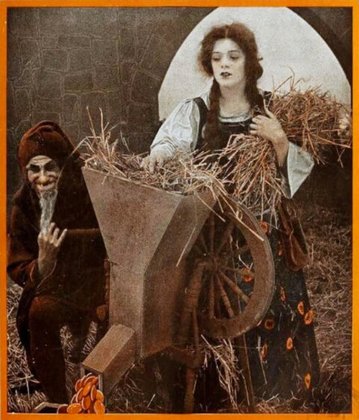
Once there was a miller who was poor, but who had a beautiful daughter. Now it happened that he had to go and speak to the King, and in order to make himself appear important he said to him, "I have a daughter who can spin straw into gold." The King said to the miller, "That is an art which pleases me well; if your daughter is as clever as you say, bring her to-morrow to my palace, and I will try what she can do."
And when the girl was brought to him he took her into a room which was quite full of straw, gave her a spinning-wheel and a reel, and said, "Now set to work, and if by to-morrow morning early you have not spun this straw into gold during the night, you must die." Thereupon he himself locked up the room, and left her in it alone. So there sat the poor miller's daughter, and for the life of her could not tell what to do; she had no idea how straw could be spun into gold, and she grew more and more miserable, until at last she began to weep.
But all at once the door opened, and in came a little man, and said, "Good evening, Mistress Miller; why are you crying so?" "Alas!" answered the girl, "I have to spin straw into gold, and I do not know how to do it." "What will you give me," said the manikin, "if I do it for you?" "My necklace," said the girl. The little man took the necklace, seated himself in front of the wheel, and "whirr, whirr, whirr," three turns, and the reel was full; then he put another on, and whirr, whirr, whirr, three times round, and the second was full too. And so it went on until the morning, when all the straw was spun, and all the reels were full of gold. By daybreak the King was already there, and when he saw the gold he was astonished and delighted, but his heart became only more greedy. He had the miller's daughter taken into another room full of straw, which was much larger, and commanded her to spin that also in one night if she valued her life. The girl knew not how to help herself, and was crying, when the door again opened, and the little man appeared, and said, "What will you give me if I spin that straw into gold for you?" "The ring on my finger," answered the girl. The little man took the ring, again began to turn the wheel, and by morning had spun all the straw into glittering gold.
The King rejoiced beyond measure at the sight, but still he had not gold enough; and he had the miller's daughter taken into a still larger room full of straw, and said, "You must spin this, too, in the course of this night; but if you succeed, you shall be my wife." "Even if she be a miller's daughter," thought he, "I could not find a richer wife in the whole world."
When the girl was alone the manikin came again for the third time, and said, "What will you give me if I spin the straw for you this time also?" "I have nothing left that I could give," answered the girl. "Then promise me, if you should become Queen, your first child." "Who knows whether that will ever happen?" thought the miller's daughter; and, not knowing how else to help herself in this strait, she promised the manikin what he wanted, and for that he once more span the straw into gold.
And when the King came in the morning, and found all as he had wished, he took her in marriage, and the pretty miller's daughter became a Queen.
A year after, she had a beautiful child, and she never gave a thought to the manikin. But suddenly he came into her room, and said, "Now give me what you promised." The Queen was horror-struck, and offered the manikin all the riches of the kingdom if he would leave her the child. But the manikin said, "No, something that is living is dearer to me than all the treasures in the world." Then the Queen began to weep and cry, so that the manikin pitied her. "I will give you three days' time," said he, "if by that time you find out my name, then shall you keep your child."
So the Queen thought the whole night of all the names that she had ever heard, and she sent a messenger over the country to inquire, far and wide, for any other names that there might be. When the manikin came the next day, she began with Caspar, Melchior, Balthazar, and said all the names she knew, one after another; but to every one the little man said, "That is not my name." On the second day she had inquiries made in the neighborhood as to the names of the people there, and she repeated to the manikin the most uncommon and curious. "Perhaps your name is Shortribs, or Sheepshanks, or Laceleg?" but he always answered, "That is not my name."
On the third day the messenger came back again, and said, "I have not been able to find a single new name, but as I came to a high mountain at the end of the forest, where the fox and the hare bid each other good night, there I saw a little house, and before the house a fire was burning, and round about the fire quite a ridiculous little man was jumping: he hopped upon one leg, and shouted—-
"To-day I bake, to-morrow brew,
The next I'll have the young Queen's child.
Ha! glad am I that no one knew
That Rumpelstiltskin I am styled."
You may think how glad the Queen was when she heard the name! And when soon afterwards the little man came in, and asked, "Now, Mistress Queen, what is my name?" at first she said, "Is your name Conrad?" "No." "Is your name Harry?" "No."
"Perhaps your name is Rumpelstiltskin?"
"The devil has told you that! the devil has told you that!" cried the little man, and in his anger he plunged his right foot so deep into the earth that his whole leg went in; and then in rage he pulled at his left leg so hard with both hands that he tore himself in two.
Frequently Asked Questions about Rumpelstiltskin
What is "Rumpelstiltskin" about?
Rumpelstiltskin is a fairy tale by about a miller who boasts to the King that his daughter can spin straw into gold. The King imprisons the girl and orders her to prove it or die. A mysterious little man appears and offers to spin the straw in exchange for increasingly precious payments — first her necklace, then her ring, and finally her firstborn child. The girl becomes Queen, but when the little man returns to claim her baby, he offers one last chance: if she can guess his name within three days, she may keep the child. A messenger discovers the creature dancing in the forest and singing his own name, and when the Queen reveals it — Rumpelstiltskin — the little man destroys himself in a rage.
What is the moral of "Rumpelstiltskin"?
The primary moral is that dishonesty and greed lead to dangerous consequences. The miller's lie about his daughter's abilities sets the entire chain of events in motion, placing her in mortal danger. The King's greed — locking a girl in a room and threatening death unless she produces gold — is portrayed as callous and exploitative. The story also warns against making reckless promises: the miller's daughter agrees to give up her firstborn child without truly considering the cost, simply because the crisis feels immediate and the consequence feels distant. A secondary moral is that resourcefulness and persistence can overcome seemingly impossible situations — the Queen ultimately saves her child not through magic or wealth but through determined investigation.
What are the main themes in "Rumpelstiltskin"?
Several major themes run through the tale. Greed and exploitation drive the plot — the miller exploits his daughter to impress the King, the King exploits her supposed talent for wealth, and Rumpelstiltskin exploits her desperation to claim a child. The power of names is the tale's most distinctive theme: knowing Rumpelstiltskin's true name gives the Queen power over him, reflecting ancient beliefs that to name something is to control it. Deception and its consequences appear at every level, from the miller's original lie to the escalating bargains. The vulnerability of women in patriarchal structures is also central — the miller's daughter is traded, threatened, and used as a commodity by every male figure in the story until she finally takes control of her own fate.
What does the name "Rumpelstiltskin" mean?
The name Rumpelstiltskin comes from German and is usually interpreted as meaning "little rattle stilt." It derives from rumpeln (to make noise, to rattle) and Stelze (a stilt or post), with the diminutive suffix -chen. In German folklore, a Rumpelstilz was a type of goblin or poltergeist believed to rattle posts and make noises in houses. The name itself carries a sense of mischief and disturbance — fitting for a character who appears uninvited and demands impossible prices. The tale's German title is simply Rumpelstilzchen, and variants of the story exist across Europe under different names: Tom Tit Tot in England, Whuppity Stoorie in Scotland, and Třasořitka in Czech tradition.
Why is knowing Rumpelstiltskin's name so important?
The power of naming is one of the oldest motifs in mythology and folklore. In many ancient traditions — from the Egyptian god Ra to the biblical naming of animals in Genesis — to know a being's true name is to hold power over it. Rumpelstiltskin's name is his one vulnerability; as long as it remains secret, his bargain is unbreakable. When the Queen speaks it aloud, the contract dissolves instantly, and the creature is so enraged that he tears himself apart. This reflects a folk belief that supernatural beings operate under strict rules and that mortals can defeat them by discovering the hidden terms. The tale belongs to a classification known as "Name of the Helper" stories, found across cultures worldwide, all built on this same ancient idea.
What happens at the end of "Rumpelstiltskin"?
The ending is one of the most dramatic in all fairy tales. On the third and final day, the Queen's messenger reports discovering a strange little man dancing around a fire near a house at the edge of the forest, singing: "To-day I bake, to-morrow brew, / The next I'll have the young Queen's child. / Ha! glad am I that no one knew / That Rumpelstiltskin I am styled." When the little man arrives to collect the child, the Queen teases him with wrong guesses — Conrad, Harry — before revealing his true name. Rumpelstiltskin flies into such a rage that he stamps his right foot into the ground so deeply it gets stuck, then tears himself in two trying to pull free. This violent self-destruction is unique to the Grimms' version; in earlier tellings, the creature simply flees.
Who wrote "Rumpelstiltskin" and when was it published?
Rumpelstiltskin was collected by Jacob and Wilhelm Grimm and published in their first edition of Kinder- und Hausmärchen (Children's and Household Tales) in 1812, where it appears as tale number 55. The Grimms gathered it from oral tradition in Germany, though the story type is far older — researchers at Durham University have traced "Name of the Helper" tales back approximately 4,000 years, making variants of Rumpelstiltskin roughly contemporaneous with the earliest versions of the Epic of Gilgamesh. The Grimms revised the tale across seven editions, and the self-destruction ending was added in their 1857 final edition; in the original 1812 version, Rumpelstiltskin simply ran away.
What does spinning straw into gold symbolize in "Rumpelstiltskin"?
The central image of turning straw into gold has attracted many symbolic interpretations. The most common reading is that it represents the impossible demands placed on ordinary people by those in power — the miller's daughter is expected to perform a miracle simply because a man boasted about her, and failure means death. Some folklorists interpret the gold as a metaphor for grain and agricultural production, reflecting a time when peasants had to produce crops for their monarchs under threat of punishment. On a psychological level, the spinning can symbolize transforming the raw material of life into something valuable through labor and sacrifice, with Rumpelstiltskin representing the hidden costs of shortcuts and deals made under duress. The escalating rooms of straw also symbolize unchecked greed — no amount of gold is ever enough for the King.
What literary devices are used in "Rumpelstiltskin"?
The tale employs several classic fairy-tale devices. The rule of three structures the entire narrative: three rooms of straw, three payments (necklace, ring, firstborn), and three days to guess the name — a pattern that builds tension and satisfies narrative expectations. Dramatic irony operates powerfully in the climax, when the reader (through the messenger's discovery) knows the name before the Queen reveals it. Repetition with escalation drives the first half — each room is larger, each payment more costly — creating a sense of mounting dread. The tale also uses contrast between humble origins and royal wealth, between the miller's boast and his daughter's helplessness, and between Rumpelstiltskin's small size and his enormous power. The rhyming song Rumpelstiltskin sings is an example of embedded verse, a technique the Grimms used to make key moments more memorable for oral retelling.
How old is the story of "Rumpelstiltskin"?
While the Brothers Grimm published their version in 1812, the story itself is extraordinarily ancient. Researchers at Durham University and the NOVA University of Lisbon used phylogenetic analysis — a technique borrowed from evolutionary biology — to trace the origins of "Name of the Helper" tales like Rumpelstiltskin back approximately 4,000 years, predating Homer by over a millennium and making it roughly contemporary with the earliest surviving versions of the Epic of Gilgamesh. Variants of the story appear across Europe under different names: Tom Tit Tot in England, Whuppity Stoorie in Scotland, Ricdin-Ricdon in France, and Joaidane in Arabic tradition. The core motif — a supernatural helper whose power is broken by discovering its name — appears to be one of the oldest story structures in human civilization.
Save stories, build your reading list, and access all study tools — completely free.
Save Rumpelstiltskin to your library — it's free!Need help with Rumpelstiltskin?
Study tools to help with homework, prepare for quizzes, and deepen your understanding.
Flashcards → | Vocabulary → | Study Guide →