The Elves and The Shoemaker
by The Brothers Grimm
The Elves and the Shoemaker is one of our Favorite Fairy Tales and Christmas Stories.
FIRST STORY
A shoemaker, by no fault of his own, had become so poor that at last he had nothing left but leather for one pair of shoes. So in the evening, he cut out the shoes which he wished to begin to make the next morning, and as he had a good conscience, he lay down quietly in his bed, commended himself to God, and fell asleep. In the morning, after he had said his prayers, and was just going to sit down to work, the two shoes stood quite finished on his table. He was astounded, and knew not what to say to it. He took the shoes in his hands to observe them closer, and they were so neatly made that there was not one bad stitch in them, just as if they were intended as a masterpiece. Soon after, a buyer came in, and as the shoes pleased him so well, he paid more for them than was customary, and, with the money, the shoemaker was able to purchase leather for two pairs of shoes. He cut them out at night, and next morning was about to set to work with fresh courage; but he had no need to do so, for, when he got up, they were already made, and buyers also were not wanting, who gave him money enough to buy leather for four pairs of shoes. The following morning, too, he found the four pairs made; and so it went on constantly, what he cut out in the evening was finished by the morning, so that he soon had his honest independence again, and at last became a wealthy man. Now it befell that one evening not long before Christmas, when the man had been cutting out, he said to his wife, before going to bed, "What think you if we were to stay up to-night to see who it is that lends us this helping hand?" The woman liked the idea, and lighted a candle, and then they hid themselves in a corner of the room, behind some clothes which were hanging up there, and watched. When it was midnight, two pretty little naked men came, sat down by the shoemaker's table, took all the work which was cut out before them and began to stitch, and sew, and hammer so skilfully and so quickly with their little fingers that the shoemaker could not turn away his eyes for astonishment. They did not stop until all was done, and stood finished on the table, and they ran quickly away.
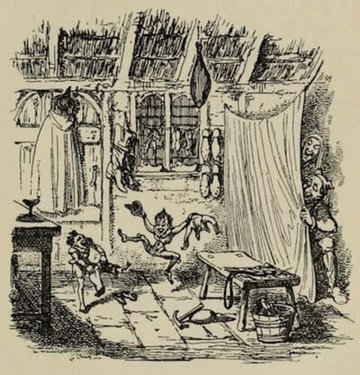
Next morning the woman said, "The little men have made us rich, and we really must show that we are grateful for it. They run about so, and have nothing on, and must be cold. I'll tell thee what I'll do: I will make them little shirts, and coats, and vests, and trousers, and knit both of them a pair of stockings, and do thou, too, make them two little pairs of shoes." The man said, "I shall be very glad to do it;" and one night, when everything was ready, they laid their presents all together on the table instead of the cut-out work, and then concealed themselves to see how the little men would behave. At midnight they came bounding in, and wanted to get to work at once, but as they did not find any leather cut out, but only the pretty little articles of clothing, they were at first astonished, and then they showed intense delight. They dressed themselves with the greatest rapidity, putting the pretty clothes on, and singing,
"Now we are boys so fine to see,
Why should we longer cobblers be?"
Then they danced and skipped and leapt over chairs and benches. At last they danced out of doors. From that time forth they came no more, but as long as the shoemaker lived all went well with him, and all his undertakings prospered.
SECOND STORY
There was once a poor servant-girl, who was industrious and cleanly, and swept the house every day, and emptied her sweepings on the great heap in front of the door. One morning when she was just going back to her work, she found a letter on this heap, and as she could not read, she put her broom in the corner, and took the letter to her master and mistress, and behold it was an invitation from the elves, who asked the girl to hold a child for them at its christening. The girl did not know what to do, but at length, after much persuasion, and as they told her that it was not right to refuse an invitation of this kind, she consented. Then three elves came and conducted her to a hollow mountain, where the little folks lived. Everything there was small, but more elegant and beautiful than can be described. The baby's mother lay in a bed of black ebony ornamented with pearls, the coverlids were embroidered with gold, the cradle was of ivory, the bath of gold. The girl stood as godmother, and then wanted to go home again, but the little elves urgently entreated her to stay three days with them. So she stayed, and passed the time in pleasure and gaiety, and the little folks did all they could to make her happy. At last she set out on her way home. Then first they filled her pockets quite full of money, and after that they led her out of the mountain again. When she got home, she wanted to begin her work, and took the broom, which was still standing in the corner, in her hand and began to sweep. Then some strangers came out of the house, who asked her who she was, and what business she had there? And she had not, as she thought, been three days with the little men in the mountains, but seven years, and in the meantime her former masters had died.
THIRD STORY
A certain mother's child had been taken away out of its cradle by the elves, and a changeling with a large head and staring eyes, which would do nothing but eat and drink, laid in its place. In her trouble she went to her neighbour, and asked her advice. The neighbour said that she was to carry the changeling into the kitchen, set it down on the hearth, light a fire, and boil some water in two egg-shells, which would make the changeling laugh, and if he laughed, all would be over with him. The woman did everything that her neighbour bade her. When she put the egg-shells with water on the fire, the imp said, "I am as old now as the Wester forest, but never yet have I seen any one boil anything in an egg-shell!" And he began to laugh at it. Whilst he was laughing, suddenly came a host of little elves, who brought the right child, set it down on the hearth, and took the changeling away with them.
This story is featured in our selection of Children's Christmas Stories and Favorite Fairy Tales.
Frequently Asked Questions about The Elves and The Shoemaker
What is "The Elves and the Shoemaker" about?
The Elves and the Shoemaker is actually a collection of three related fairy tales by , all involving elves. In the most famous first story, a poor but honest shoemaker discovers that two tiny naked elves have been secretly finishing his shoes overnight, transforming them into masterpieces that sell for premium prices. As his fortunes rise, the shoemaker and his wife stay up one night to witness the elves at work. Out of gratitude, they sew tiny clothes and cobble miniature shoes for the elves, who dance with delight upon receiving the gifts — and never return again. The second story follows a servant girl invited to be godmother to an elf baby, who discovers that three days underground were actually seven years. The third tells of a changeling left in place of a stolen human child.
What is the moral of "The Elves and the Shoemaker"?
The central moral is that gratitude and kindness are always rewarded. The shoemaker does not simply accept the elves' help and move on — he and his wife go out of their way to repay the favor with handmade clothing and shoes. Their generosity is genuine, not transactional, and after the elves depart, the shoemaker continues to prosper for the rest of his life. The story also teaches that honest hard work invites good fortune: the shoemaker falls on hard times through no fault of his own, maintains a clear conscience, and continues to do his best with what little he has. It is precisely this humility and diligence that makes him worthy of the elves' miraculous assistance.
What are the main themes in "The Elves and the Shoemaker"?
The tale explores several interconnected themes. Gratitude is the driving force of the plot — the shoemaker and his wife recognize that they owe their transformation to the elves and act on that recognition. Generosity without expectation appears on both sides: the elves ask nothing for their labor, and the couple gives their gifts freely. Faith and piety run quietly through the story, as the shoemaker commends himself to God each night and says his prayers each morning, suggesting that divine providence works through the elves. The dignity of honest labor is also central — the shoemaker never stops cutting leather and preparing his craft, even when magical helpers do the finishing work.
Why do the elves leave after receiving clothes in "The Elves and the Shoemaker"?
This is one of the most debated aspects of the tale. In European folklore, giving clothes to a household spirit frees it from service — a motif that appears across Germanic, Celtic, and Scandinavian traditions. The elves' joyful song, "Now we are boys so fine to see, / Why should we longer cobblers be?" suggests they view the clothing as liberation rather than dismissal. By dressing them, the shoemaker inadvertently transforms them from bound helpers into free beings. Importantly, the tale frames their departure positively: the shoemaker continues to prosper, suggesting the gift was a proper conclusion to the relationship rather than a mistake. This same folklore motif was famously adapted by J.K. Rowling for the house-elves in the Harry Potter series, where giving a sock frees the elf Dobby.
Who wrote "The Elves and the Shoemaker" and when was it published?
The Elves and the Shoemaker was collected by Jacob and Wilhelm Grimm and published in 1812 as part of their first volume of Kinder- und Hausmärchen (Children's and Household Tales). It appears as tale number 39 under the German title Die Wichtelmänner ("The Little Men"). The Grimms did not invent the story but gathered it from oral tradition in the Hesse region of Germany. The tale actually consists of three separate stories about elves, though only the first — about the shoemaker — became widely known and retold. The collection went through seven editions during the Grimms' lifetime, with the tales becoming progressively more polished for a children's audience.
Is "The Elves and the Shoemaker" a Christmas story?
While not a Christmas story in the traditional sense, the tale has a strong Christmas connection. The Grimms specify that the shoemaker and his wife decide to stay up and spy on the elves "one evening not long before Christmas," placing the climactic discovery scene in the Advent season. The themes of generosity, gift-giving, and rewarding goodness align naturally with Christmas values, which is why the story has become a popular holiday read-aloud and has been adapted into numerous Christmas specials and picture books. The act of making tiny clothes for the elves mirrors the spirit of Christmas gift-giving — the couple crafts something personal and thoughtful rather than simply offering payment.
What literary devices are used in "The Elves and the Shoemaker"?
The tale employs several classic fairy-tale literary techniques. Repetition drives the first half of the story: each night the shoemaker cuts leather, each morning the finished shoes appear, and each day buyers pay handsomely — this pattern builds both suspense and a sense of magical rhythm. Dramatic irony operates as readers understand the supernatural origin of the shoes before the shoemaker does. The story uses contrast between the shoemaker's poverty and eventual wealth, and between the elves' nakedness and the fine clothes they receive. Personification gives the elves human qualities — they sing, dance, and express joy. The tale also features a compact three-act structure: hardship and mysterious help, discovery and gratitude, and a happy resolution.
What do the elves symbolize in "The Elves and the Shoemaker"?
The elves carry multiple layers of symbolic meaning. On the surface, they represent unseen help and divine providence — assistance that arrives when honest people have exhausted their own resources. In Germanic folklore tradition, elves and household spirits (Wichtelmänner or "little men") were believed to inhabit homes and reward virtuous families with prosperity. The elves' nakedness symbolizes selfless service: they own nothing and seek nothing, working purely out of benevolence. Their departure after receiving clothing can be read as a symbol of the proper cycle of generosity — help is given, gratitude is shown, and both parties move forward enriched. Some folklorists also interpret the elves as a metaphor for the mysterious creative process itself, where inspiration arrives unbidden to those who prepare diligently.
What is a changeling in "The Elves and the Shoemaker"?
The third story in the Grimms' collection involves a changeling — a common figure in European folklore. A changeling is an elf or fairy child secretly swapped for a human baby. In this tale, a mother's child is stolen from its cradle and replaced with a creature that has "a large head and staring eyes" and does nothing but eat and drink. A neighbor advises the mother to boil water in two eggshells on the hearth; the bizarre sight compels the changeling to exclaim, "I am as old now as the Wester forest, but never yet have I seen any one boil anything in an egg-shell!" His laughter breaks the spell, and the real child is returned. Changeling stories reflected real anxieties about infant illness and developmental differences in pre-modern Europe, providing a supernatural explanation for children who seemed suddenly different.
How many stories are in "The Elves and the Shoemaker" by the Brothers Grimm?
The Grimms' original tale, numbered 39 in Children's and Household Tales, actually contains three separate stories about elves, not just one. The first and most famous tells of the poor shoemaker and the two helpful elves who craft shoes overnight. The second follows a servant girl who accepts an invitation to be godmother at an elf christening inside a hollow mountain — she believes she stays three days, but seven years pass in the human world. The third is a changeling tale about a mother tricking an elf imposter into revealing itself. Most modern retellings and picture books only adapt the first story, so many readers are surprised to discover the two lesser-known companion tales.
Save stories, build your reading list, and access all study tools — completely free.
Save The Elves and The Shoemaker to your library — it's free!Need help with The Elves and The Shoemaker?
Study tools to help with homework, prepare for quizzes, and deepen your understanding.
Flashcards → | Vocabulary → | Study Guide →