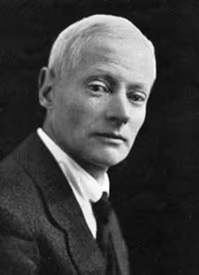
Quick Facts
William Wymark Jacobs
Pen Name: W.W. Jacobs
Born: Sep 8, 1863
Died: Sep 1, 1943
Nationality: British
Genres: Horror, Mystery, Humor
Notable Works: The Monkey's Paw, The Toll-House, The Lady of the Barge, The Skipper's Wooing, Many Cargoes
👶 Early Life and Education
William Wymark Jacobs was born on September 8, 1863, in Wapping, London, the son of William Gage Jacobs, a wharf manager on the South Devon Wharf. Growing up along the Thames waterfront, the young Jacobs absorbed the sights, sounds, and characters of London's docklands — the bargees, longshoremen, and merchant sailors whose lives would later populate his fiction. His mother, Sophia, died when he was still young, and his father remarried and had seven more children, including illustrator Helen Jacobs.
Jacobs attended a private school in London before enrolling at Birkbeck Literary and Scientific Institution (now Birkbeck, University of London). In 1879, at age sixteen, he entered the civil service as a clerk, transferring to the savings bank department of the Post Office in 1883 — a position he would hold for sixteen years while quietly building a second career as a writer.
📖 Career and Literary Breakthrough
Jacobs began writing in his spare time, and his first published work — a humorous sketch — appeared in the magazine Punch in 1885. His stories soon appeared in The Strand Magazine, The Idler, and other popular periodicals. In 1896, he published his first collection, Many Cargoes, to immediate popular success. The book established his reputation as a master of comic maritime fiction, and its sales allowed him to leave the civil service in 1899 to write full-time.
A stream of successful collections followed: More Cargoes (1897), Light Freights (1901), Odd Craft (1903), Captains All (1905), Short Cruises (1907), Sailors' Knots (1909), and Ship's Company (1911), among others. In total, Jacobs published thirteen short story collections and five novels during his lifetime. He also wrote for the stage — his play The Ghost of Jerry Bundler opened in London in 1899 and was revived several times.
✒️ Notable Works
Jacobs is best known for The Monkey's Paw (1902), a horror masterpiece about a cursed talisman that grants three wishes at a terrible cost. First published in the collection The Lady of the Barge, the story has been adapted into countless plays, films, radio dramas, and television episodes, and remains one of the most anthologized horror stories in the English language.
Other notable works include The Toll-House, a classic ghost story of a dare gone wrong; The Well, a tale of guilt and paranoia; Jerry Bundler, a chilling fireside ghost story; and In the Library, which blends suspense with Jacobs's characteristic dry humor. His comic stories — featuring scheming night watchmen, hapless sailors, and domestic misadventures — are equally accomplished, if less widely remembered.
🌿 Writing Style
Jacobs wrote in two distinct modes that rarely overlapped. His humorous stories, which form the bulk of his output, feature phonetic Cockney dialect, situational irony, and absurd predicaments — longshoremen and bargees scheming their way in and out of romantic entanglements, financial difficulties, and petty rivalries. These comedies are tightly plotted with surprise endings and an economy of prose that influenced later British humorists.
His horror and supernatural tales — perhaps a dozen stories out of more than 150 — are strikingly different in tone: restrained, atmospheric, and psychologically precise. A frequent subject is the guilt-hounded murderer, the slow realization that something is terribly wrong. Where his comedies are crowded with colorful characters, his horror stories pare everything down to dread.
🏡 Personal Life
In 1900, Jacobs married Agnes Eleanor Williams, a suffragette and social reformer. The couple had two sons and three daughters and settled in Loughton, Essex, first at the Outlook in Park Hill and later at Feltham House in Goldings Hill. Jacobs was by all accounts a quiet, private man — a marked contrast to the boisterous characters in his fiction.
✨ Legacy and Death
Jacobs's literary output slowed after the First World War, and his final collection, Sea Whispers, appeared in 1926. An omnibus edition, Snug Harbour, collecting some seventeen volumes, was published in 1931. He died on September 1, 1943, at the age of 79, in a nursing home in North London.
Though Jacobs wrote more than 150 stories, his fame rests almost entirely on The Monkey's Paw — a fact that would likely amuse the author of so many stories about the irony of fate. His horror tales sit comfortably alongside those of Edgar Allan Poe and Robert Louis Stevenson in their psychological intensity, while his comic maritime stories remain a unique contribution to English short fiction. Although we feature him on an American literature site, W. W. Jacobs was thoroughly English — we include him because great stories know no borders.
Frequently Asked Questions about W. W. Jacobs
Where can I find study guides for W. W. Jacobs's stories?
We offer free interactive study guides for the following W. W. Jacobs stories:
- The Monkey's Paw — comprehension questions, vocabulary review, and discussion prompts
- The Three Sisters — comprehension questions, vocabulary review, and discussion prompts
- The Toll-House — comprehension questions, vocabulary review, and discussion prompts
- The Well — comprehension questions, vocabulary review, and discussion prompts
What is W. W. Jacobs best known for?
W. W. Jacobs is best known for The Monkey's Paw (1902), a horror story about a cursed talisman that grants three wishes at a terrible cost. The story, first published in the collection The Lady of the Barge, has been adapted into numerous plays, films, and television episodes and remains one of the most anthologized horror stories in the English language.
What was W. W. Jacobs's writing style?
Jacobs wrote in two distinct modes. His humorous stories — the bulk of his output — feature phonetic Cockney dialect, situational irony, and absurd predicaments involving longshoremen, bargees, and sailors. His horror and supernatural tales, by contrast, are restrained, atmospheric, and psychologically precise, often exploring guilt-hounded murderers and the slow realization that something is terribly wrong.
When was W. W. Jacobs born and when did he die?
William Wymark Jacobs was born on September 8, 1863, in Wapping, London. He died on September 1, 1943, at the age of 79, in a nursing home in North London. He was buried in Highgate Cemetery.
How many stories did W. W. Jacobs write?
Jacobs published more than 150 short stories across thirteen collections during his lifetime, beginning with Many Cargoes (1896) and ending with Sea Whispers (1926). He also wrote five novels, including The Skipper's Wooing (1897) and At Sunwich Port (1902).
Was W. W. Jacobs an American or British writer?
Jacobs was thoroughly British. He was born in Wapping, London, and spent his entire life in England. He appears on American literature sites because The Monkey's Paw is so widely taught in American schools that it has become part of the American literary curriculum, despite its English authorship.
Was W. W. Jacobs married and did he have children?
Jacobs married Agnes Eleanor Williams, a suffragette and social reformer, in 1900 at West Ham, Essex. The couple had two sons and three daughters. They settled in Loughton, Essex, where Jacobs lived for much of his adult life.
What are W. W. Jacobs's best horror stories?
Beyond The Monkey's Paw, Jacobs's best horror stories include The Toll-House, a ghost story about a dare to spend the night in a haunted house; The Well, a psychological tale of guilt and paranoia; and Jerry Bundler, a chilling fireside ghost story.