Song of the Witches (Macbeth)
by William Shakespeare
Song of the Witches is excerpted from Macbeth Act IV, Scene I, especially for Halloween! While throwing poisoned entrails and sweated venom sleeping got into your favorite pot, use your best witch-voice to recite it (pointy hat optional).
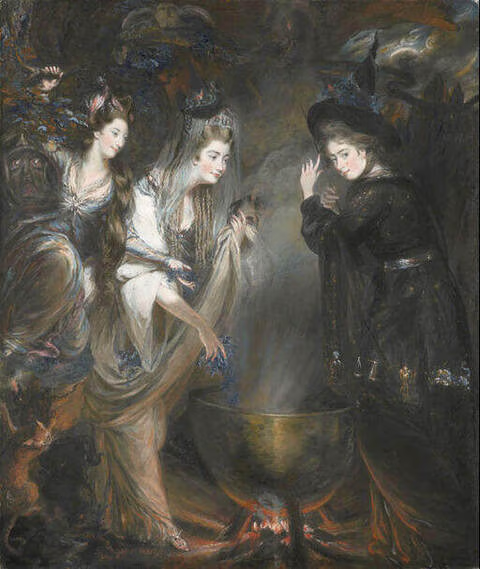
Round about the cauldron go:
In the poisoned entrails throw.
Toad, that under cold stone
Days and nights has thirty-one
Sweated venom sleeping got,
Boil thou first i’ the charmed pot.

Double, double toil and trouble;
Fire burn and cauldron bubble.

Fillet of a fenny snake,
In the cauldron boil and bake;
Eye of newt and toe of frog,
Wool of bat and tongue of dog,
Adder's fork and blind-worm's sting,
Lizard's leg and owlet's wing.
For a charm of powerful trouble,
Like a hell-broth boil and bubble.

Double, double toil and trouble;
Fire burn and cauldron bubble.

Scale of dragon, tooth of wolf,
Witch's mummy, maw and gulf
Of the ravin'd salt-sea shark,
Root of hemlock digg'd i’ the dark,
Liver of blaspheming Jew;
Gall of goat; and slips of yew
Sliver'd in the moon's eclipse;
Nose of Turk, and Tartar's lips;
Finger of birth-strangled babe
Ditch-deliver'd by a drab,
Make the gruel thick and slab:
Add thereto a tiger's chaudron,
For the ingredients of our cauldron.

Double, double toil and trouble,
Fire burn and cauldron bubble.

Cool it with a baboon's blood,
Then the charm is firm and good.
Featured in our collections Poetry for Students, Halloween Stories and Halloween Stories for Children
Frequently Asked Questions about Song of the Witches (Macbeth)
What is "Double, Double Toil and Trouble" about?
Song of the Witches is the famous cauldron scene from Act IV, Scene 1 of Shakespeare's Macbeth. The three witches (the Weird Sisters) are preparing a supernatural potion by throwing increasingly grotesque ingredients — from toad venom and snake fillet to human body parts — into a boiling cauldron. Their chant, with its iconic refrain "Double, double toil and trouble; Fire burn and cauldron bubble," is both an incantation to summon dark powers and a ritual preparation for the apparitions they will show Macbeth, whose equivocal prophecies will drive him deeper into tyranny and destruction.
What does "Double, double toil and trouble" mean?
The refrain operates on multiple levels of meaning. On the surface, the witches are calling for their efforts ("toil") and the chaos they cause ("trouble") to be doubled — intensified with each round of ingredients. But "double" also refers to equivocation and duplicity, a central theme in Macbeth. The witches speak in double meanings, telling Macbeth truths that mislead him. "Fire burn and cauldron bubble" invokes the literal brewing process while also symbolizing the political turmoil and moral corruption that Macbeth's ambition has unleashed across Scotland.
What are the witches' cauldron ingredients in Macbeth?
The ingredients escalate in three rounds, each more disturbing than the last. The first round begins with a toad that has "sweated venom" for thirty-one days. The second round adds animal parts: "eye of newt and toe of frog, / Wool of bat and tongue of dog," along with snake, lizard, and owl pieces. The third round shifts to human and exotic components: wolf's tooth, dragon's scale, hemlock root, and finally a "finger of birth-strangled babe." This escalation from animal to human ingredients mirrors the play's theme of moral degradation — each step takes the witches (and Macbeth) further from the natural order.
What does "eye of newt" mean in Macbeth?
A popular modern theory claims that "eye of newt" and similar ingredient names are folk names for herbs — with "eye of newt" supposedly meaning mustard seed and "toe of frog" meaning buttercup. However, this interpretation has no historical sources before the 1980s and likely originates with modern Wiccan authors. In Shakespeare's context, the ingredients are meant to be taken literally as grotesque animal and human body parts. The horror of the recipe is the point — it signals the witches' association with the unnatural and the profane, reinforcing the play's atmosphere of evil and moral corruption.
What literary devices are used in the witches' chant?
The chant employs several distinctive devices. Most notable is the trochaic tetrameter — a falling rhythm (stressed-unstressed) that sounds fundamentally different from Shakespeare's usual iambic pentameter, giving the witches an otherworldly, incantatory voice. The AABB rhyme scheme creates a nursery-rhyme quality that makes the horrific content even more unsettling. Repetition of the refrain functions as a ritual incantation. Catalogue (listing) builds cumulative horror as ingredients grow more grotesque. And imagery appeals to disgust and fear — "poisoned entrails," "sweated venom," "hell-broth" — making the cauldron a vivid symbol of the corruption at the heart of Macbeth.
Why do the witches speak in a different rhythm than the rest of Macbeth?
The witches speak in trochaic tetrameter (four stressed-unstressed beats per line: "DOUble, DOUble, TOIL and TROUble") while the rest of the play uses iambic pentameter. Shakespeare uses this metrical contrast to mark the witches as supernatural beings who exist outside the human world. The shorter, choppier rhythm sounds like a chant or spell, emphasizing their role as agents of chaos. The falling trochaic rhythm also creates an unsettled, off-balance feeling — the opposite of iambic pentameter's rising, natural speech pattern. When Macbeth enters the scene and speaks in his usual meter, the clash between the two rhythms underscores the collision of mortal ambition and supernatural forces.
What is the purpose of the cauldron scene in Macbeth?
The cauldron scene (Act IV, Scene 1) serves several dramatic purposes. It prepares the supernatural apparitions that deliver equivocal prophecies to Macbeth — "none of woman born shall harm Macbeth" and "until Birnam Wood do come to Dunsinane" — which give him false confidence. It deepens the play's atmosphere of evil, showing that Macbeth has moved from passively receiving prophecies to actively seeking them. The grotesque ingredients mirror the corruption of Scotland under Macbeth's rule — the natural order has been so perverted that even human body parts go into the brew. The scene is also the turning point after which Macbeth abandons all restraint, ordering the murder of Macduff's family.
Who are the three witches in Macbeth?
The three witches — also called the Weird Sisters (from the Old English "wyrd" meaning fate or destiny) — are supernatural beings who set Macbeth's tragedy in motion with their prophecies. They first appear in Act I to predict that Macbeth will become king, planting the seed of ambition that leads to murder and tyranny. In the cauldron scene, they return to manipulate him further with misleading visions. Shakespeare drew on Raphael Holinshed's Chronicles and contemporary beliefs about witchcraft — a topic of intense interest to King James I, who had written a treatise on demonology. The witches represent the destructive power of unchecked ambition and moral corruption.
Is "Song of the Witches" a poem or part of a play?
It is both. The text comes from Act IV, Scene 1 of Shakespeare's tragedy Macbeth (c. 1606), where it functions as a dramatic chant performed by the three witches. However, because of its self-contained structure, vivid imagery, and distinctive rhythm, it has been widely anthologized as a standalone poem for centuries — the Poetry Foundation, for example, publishes it under the title "Song of the Witches." Its incantatory quality and memorable refrain have made it one of the most recognized passages in English literature, frequently quoted at Halloween and in popular culture far removed from its theatrical origins.
Why is the witches' chant associated with Halloween?
The witches' chant has become a cultural shorthand for all things supernatural and spooky. Several factors explain the association: the scene features the archetypal image of witches stirring a cauldron — one of Halloween's most enduring visual symbols. The chant's nursery-rhyme rhythm makes it easy to memorize and recite, and the grotesque ingredient list ("eye of newt," "toe of frog") perfectly captures the playful horror of the holiday. The phrase "Double, double toil and trouble" has entered everyday English as an expression of impending mischief. Films, TV shows, and Halloween events have reinforced the connection for centuries, making this passage from Macbeth perhaps the most quoted piece of Shakespeare in popular culture.
Save stories, build your reading list, and access all study tools — completely free.
Save Song of the Witches (Macbeth) to your library — it's free!Need help with Song of the Witches (Macbeth)?
Study tools to help with homework, prepare for quizzes, and deepen your understanding.
Flashcards →