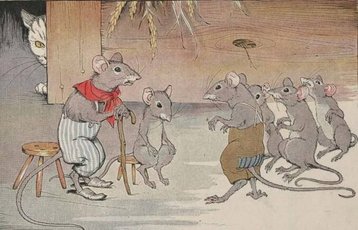
Belling the Cat (Perry Index 613) is one of the most widely recognized fables in the Western tradition, though it was not recorded before the Middle Ages. The earliest known version appears in Odo of Cheriton's Parabolae (c. 1200), where it served as a critique of the clergy. The story was retold in William Langland's allegorical poem Piers Plowman (1377), in which the parliament of rats and mice was said to represent the English Parliament of 1376 and its failed attempts to curb noble abuses. The phrase "to bell the cat" has since entered the English language as an idiom meaning to undertake a dangerous task that others only talk about.
The Mice once called a meeting to decide on a plan to free themselves of their enemy, the Cat. At the very least, they wished to find some way of knowing when she was coming so they might have time to run away. Indeed, something had to be done, for they lived in such constant fear of her claws that they hardly dared stir from their dens by night or day.
Many plans were discussed, but none of them was thought good enough. At last, a very young Mouse got up and said:
"I have a plan that seems very simple, but I know it will be successful. All we have to do is hang a bell about the Cat's neck. When we hear the bell ringing, we will know immediately that our enemy is coming."
All the Mice were much surprised that they had not thought of such a plan before. But in the midst of the rejoicing over their good fortune, an old Mouse arose and said:
"I will say that the plan of the young Mouse is very good. But let me ask one question: Who will bell the Cat?"
It is one thing to say that something should be done, but quite a different matter to do it.
The Mice once called a meeting to decide on a plan to free themselves of their enemy, the Cat. At least they wished to find some way of knowing when she was coming, so they might have time to run away. Indeed, something had to be done, for they lived in such constant fear of her claws that they hardly dared stir from their dens by night or day.
Many plans were discussed, but none of them was thought good enough. At last a very young Mouse got up and said:
"I have a plan that seems very simple, but I know it will be successful. All we have to do is to hang a bell about the Cat's neck. When we hear the bell ringing we will know immediately that our enemy is coming."
All the Mice were much surprised that they had not thought of such a plan before. But in the midst of the rejoicing over their good fortune, an old Mouse arose and said:
"I will say that the plan of the young Mouse is very good. But let me ask one question: Who will bell the Cat?"
It is one thing to say that something should be done, but quite a different matter to do it
The moral is "It is one thing to say that something should be done, but quite a different matter to do it." The fable teaches that a plan is only as good as its execution. The Mice devise a brilliant idea—hanging a bell on the Cat—but no one is willing to carry it out. Aesop warns us to evaluate plans not just by how appealing they sound, but by whether anyone can realistically accomplish them.
What does "to bell the cat" mean as an idiom?
"To bell the cat" is an English idiom meaning to undertake a dangerous or risky task that benefits everyone but that no one is willing to do. It comes directly from this fable. When someone says "Who will bell the cat?" they are asking who will volunteer to take on a difficult responsibility that others only talk about. The phrase has been in use since the Middle Ages.
What is the Perry Index number for Belling the Cat?
Belling the Cat is catalogued as Perry Index 613. The Perry Index is the standard classification system for Aesop's fables, created by scholar Ben Edwin Perry. The number 613 falls in the range reserved for medieval attributions to Aesop that are not found in the ancient Greek or Latin collections. The earliest known version appears in Odo of Cheriton's Parabolae, written around 1200 CE.
Who wrote Belling the Cat?
The fable is traditionally attributed to Aesop, but it was not recorded before the Middle Ages. The earliest written version comes from Odo of Cheriton, an English clergyman who included it in his Parabolae around 1200 CE as a parable criticizing corrupt clergy. The story was later retold by William Langland in Piers Plowman (1377) and by the French poet Eustache Deschamps. It became firmly associated with Aesop through centuries of retelling.
What is the difference between Belling the Cat and The Cat and the Mice?
These are two separate fables that are often confused. In Belling the Cat (Perry Index 613), mice propose hanging a bell on a cat but no one volunteers to do it—the moral is about impractical plans. In The Cat and the Mice (Perry Index 79), a cat disguises itself to trick the mice, but the mice see through the deception—the moral is about learning from experience. The Cat and the Mice is of genuine ancient Greek origin, while Belling the Cat is a medieval addition to the Aesopic tradition.
What lesson does Belling the Cat teach children?
The fable teaches children that good ideas are not enough—you also need a realistic way to carry them out. It encourages critical thinking: before celebrating a solution, ask whether it is actually possible. The story also demonstrates the value of speaking up like the old Mouse, who had the courage to ask the uncomfortable question that everyone else avoided. It is a gentle introduction to the concept that plans must be practical, not just clever.
Why did the old Mouse question the plan?
The old Mouse questioned the plan because he recognized the fatal flaw that everyone else had overlooked: no Mouse could actually get close enough to the Cat to hang a bell around her neck without being caught and killed. His experience gave him the wisdom to see past the excitement of the moment and test the idea against reality. Aesop uses the old Mouse to represent practical wisdom—the ability to ask "how?" when everyone else is still asking "why not?"
What other Aesop fables have a similar moral to Belling the Cat?
Several Aesop fables explore the gap between words and action. The Miller, His Son, and the Ass shows how trying to please everyone leads to disaster. The Milkmaid and Her Pail warns against counting on plans that have not yet been carried out. The Boy Who Cried Wolf demonstrates how credibility is lost when words are not backed by truth. And The Tortoise and the Ducks cautions against vanity overriding practical judgment.
Save stories, build your reading list, and access all study tools — completely free.
Belling the Cat is one of Aesop's most incisive fables, and its genius lies in its devastating simplicity. The Mice have a genuine problem—a Cat that terrorizes them day …
...
Advertisement
Understanding Belling The Cat
A short summary of the story
Easier Said Than Done
Belling the Cat is one of Aesop's most incisive fables, and its genius lies in its devastating simplicity. The Mice have a genuine problem—a Cat that terrorizes them day and night—and they convene a meeting to solve it. Ideas are proposed and rejected. Then a young Mouse offers what seems like a brilliant solution: tie a bell around the Cat's neck so they can hear her coming. The room erupts in celebration. Problem solved. Except it isn't.
The old Mouse's single question—"Who will bell the Cat?"—punctures the collective fantasy in an instant. The plan is flawless in theory and impossible in practice. No Mouse is willing to approach the very predator they are trying to escape. The meeting, which began with so much hope, collapses into silence.
The fable's moral—"It is one thing to say that something should be done, but quite a different matter to do it"—cuts across centuries because the behavior it describes is universal. In boardrooms, legislatures, and classrooms alike, people routinely applaud solutions without asking the hard question: who will actually carry this out, and at what cost? The young Mouse is not wrong about the bell. He is wrong about the world. His plan ignores the gap between a good idea and a workable one, and that gap is where most plans go to die.
There is also a quiet commentary on the dynamics of groups. Notice that all the Mice celebrate the plan. The groupthink is unanimous—until the old Mouse breaks the spell. Aesop suggests that wisdom is not about having clever ideas but about testing them against reality. The old Mouse does not propose a better plan. He simply asks the question no one else dared to ask, and that is enough to reveal the truth.
The fable resonates with other Aesop tales about the gap between words and action. In The Milkmaid and Her Pail, a young woman's daydreams about future wealth collapse when she spills the milk she is counting on. In both stories, the characters confuse planning with doing and ambition with achievement. The lesson is the same: a plan that cannot survive contact with reality is no plan at all.
"Belling the Cat" endures because it names something we all recognize but rarely admit: the human tendency to celebrate solutions we have no intention of carrying out ourselves.
Advertisement
Find this helpful? Create a free account to bookmark stories and save explanations for quick reference.