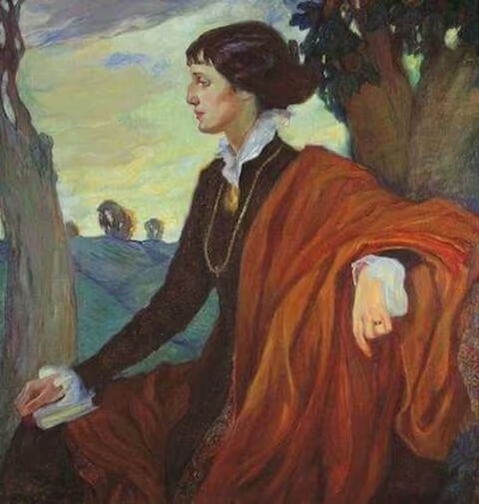
Quick Facts
Anna Andreyevna Gorenko
Pen Name: Anna Akhmatova
Born: June 23, 1889
Died: March 5, 1966
Nationality: Russian
Genres: Modernism, Poetry
Notable Works: Requiem, Poem Without a Hero, Evening, Rosary, White Flock
👶 Early Life and Pen Name
Anna Akhmatova was born Anna Andreyevna Gorenko on June 23, 1889, near Odessa in the Russian Empire (now Ukraine). She grew up in Tsarskoye Selo, the imperial town outside St. Petersburg, where she absorbed the literary atmosphere that had once inspired Alexander Pushkin. When she began writing poetry as a teenager, her father forbade her from publishing under the family name, so she adopted her maternal grandmother's Tatar surname, Akhmatova — a name she traced to Khan Akhmat, the last ruler of the Golden Horde.
📖 Acmeism and Early Fame
In 1910, Akhmatova married the poet Nikolai Gumilev. Together with their friend Osip Mandelstam, they co-founded the Acmeist movement around 1912, rejecting the mystical vagueness of Russian Symbolism in favor of clarity, precision, and concrete imagery. Her first collection, Evening (1912), brought her immediate fame, followed by Rosary (1914), which was reprinted multiple times and established her as Russia's leading female poet.
Relying on an economy of words and emotional restraint, her style set her apart from her contemporaries, and she became a defining voice in Russian literature. Her popularity set off a wave of imitators, causing her to quip: "I taught our women how to speak, but don't know how to make them silent."
🌿 Writing Style
Akhmatova's poetry is marked by emotional precision, spare language, and an intimate conversational tone. She favored short lyric forms, using concrete details — a glove pulled on the wrong hand, a candle flame, the sound of footsteps — to convey complex psychological states. Her early work explored the drama of love and its aftermath; her later poetry expanded to encompass historical suffering, memory, and moral witness. Later in life, she cast a self-critical look at her early success and wondered how "naive poems by a frivolous girl for some reason were reprinted thirteen times." The poems were never naive — they only seemed simple because her craft was so precise.
💔 Personal Tragedy and Persecution
Akhmatova's personal life was marked by relentless loss. She divorced Gumilev in 1918; he was executed by the Bolshevik secret police on August 25, 1921. Her second husband, the Assyriologist Vladimir Shileiko, was jealous and controlling — he reportedly burned some of her manuscripts. Her third partner, the art historian Nikolai Punin, was arrested in 1949 and died in a Siberian labor camp in 1953.
Her son Lev Gumilev was arrested repeatedly — in 1935, 1938, and again in 1949, when he was sentenced to ten years in the Gulag. She spent seventeen months standing in prison lines in Leningrad, an experience that became the foundation of her masterpiece, Requiem (written 1935–1940, first published abroad in 1963). When another woman in the line recognized her and whispered, "Can you describe this?" Akhmatova answered, "Yes, I can."
In 1946, Stalin's cultural enforcer Andrei Zhdanov singled out Akhmatova in a decree that called her poetry a mixture of "eroticism, mysticism, and political indifference" and labeled her "half harlot, half nun." She was expelled from the Soviet Writers' Union and effectively banned from publishing for over a decade.
✒️ Notable Works
Beyond her celebrated early collections — Evening (1912), Rosary (1914), White Flock (1917), Plantain (1921), and Anno Domini MCMXXI (1922) — Akhmatova's two greatest works came from her years of persecution:
- Requiem (1935–1940) — A cycle of poems documenting the Stalinist Terror through the eyes of a mother waiting outside a prison, it is considered one of the most powerful works of witness literature in any language.
- Poem Without a Hero (1940–1962) — A complex, allusive long poem reflecting on the Silver Age of Russian poetry and the guilt of a generation, it occupied Akhmatova for over twenty years.
During the years she was banned from publishing original poetry, she turned to literary scholarship, producing acclaimed studies of Pushkin.
🎨 Akhmatova and Modigliani
During her honeymoon trip to Paris in 1910, Akhmatova met the Italian artist Amedeo Modigliani, then an unknown sculptor. They shared a brief but intense connection, and she returned to Paris alone in 1911. Modigliani created sixteen nude drawings of her — she kept one above her sofa for the rest of her life. The encounter left a lasting mark on both artists.
❤️ Rehabilitation and Late Recognition
After Stalin's death in 1953, Akhmatova was gradually rehabilitated. Her son Lev was released from the Gulag in 1956, though an estrangement developed between them — he believed some of her more politically provocative poems had prolonged his imprisonment. In 1964 she received the Etna-Taormina Prize in Italy, and in 1965 Oxford University awarded her an honorary doctorate — her first trip outside Russia since 1912. She was nominated for the Nobel Prize in Literature in both 1965 and 1966.
In 1993, the extent of Soviet surveillance on Akhmatova came to light: the authorities had bugged her flat and accumulated 900 pages of material to use against her.
✨ Death and Legacy
Akhmatova suffered a heart attack in late 1965 and died of heart failure on March 5, 1966, in a sanatorium near Moscow. Thousands attended memorial services in Moscow and Leningrad, and she was buried at Komarovo Cemetery outside St. Petersburg.
She is widely regarded as the greatest woman poet in the Russian language and one of the most important poets of the twentieth century. Along with Pushkin, Dostoevsky, and Tolstoy, she stands among the towering figures of Russian literature. Her friend the Nobel laureate Joseph Brodsky called her "the keening muse" — a poet who transformed personal grief into universal art.
Akhmatova is featured in our collection of Russian Writers.