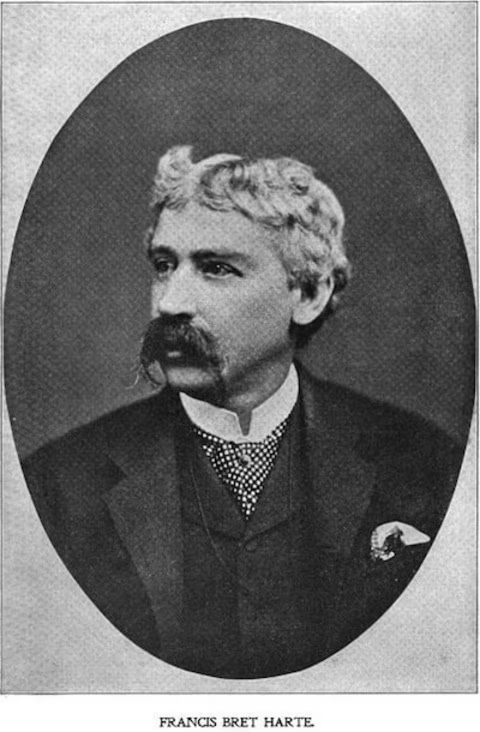
Quick Facts
Francis Bret Harte
Pen Name: Bret Harte
Born: August 25, 1836
Died: May 6, 1902
Nationality: American
Genres: Realism, Regional Fiction
Notable Works: A Ward of the Golden Gate, Devil's Ford, In a Hollow of the Hills
Francis Bret Harte (1836 - 1902) was an American author and poet, who worked in a number of different professional capacities including miner, teacher, messenger and journalist before turning to full time writing in 1871.
Bret Harte moved to California in 1853 and spent part of his life in a mining camp near Humboldt Bay (the current town of Arcata), a setting which provided material for some of his works. While The Luck of Roaring Camp (published in 1968) made Bret Harte famous nationwide and helped him to land a writing contract with a publisher in 1871, he faltered and was without a contract by 1872. In 1878 Bret Harte was appointed as United States Consul in Krefeld, Germany and then to Glasgow in 1880. He spent thirty years in Europe, moving to London in 1885. He died in England of throat cancer in 1902.
Bret Harte's literary output improved while he was in Europe and helped to revive his popularity. The Outcasts of Poker Flat and Tennessee's Partner join The Luck of Roaring Camp on the list of his influential works. If you enjoy Harte's works set in western mining camps, you may also enjoy stories by Mary Hallock Foote and Harriet Prescott Spofford.
Frequently Asked Questions about Bret Harte
Who was Bret Harte?
Bret Harte (1836–1902) was an American short story writer and poet best known for vivid, colorful tales set in the California Gold Rush mining camps. Born Francis Brett Hart in Albany, New York, he moved to California in 1853 and drew on his experiences in towns like Arcata near Humboldt Bay. His breakthrough story, The Luck of Roaring Camp (1868), made him a national celebrity and led to a record-breaking contract with The Atlantic Monthly for $10,000 a year — the highest figure offered to an American writer at that time.
What are Bret Harte's most famous works?
Harte's most celebrated works are his short stories of the California Gold Rush. The Luck of Roaring Camp (1868) tells of a baby born in a mining camp who transforms the rough men around him. The Outcasts of Poker Flat (1869) follows a group of outcasts banished from a frontier town who face a deadly snowstorm. Tennessee's Partner is a moving story of loyalty between two miners. His humorous poem "Plain Language from Truthful James" (1870), also known as "The Heathen Chinee," became a national sensation, though its racial caricature has made it controversial.
What is local color writing, and why is Bret Harte important to it?
Local color is a literary style that emphasizes the distinctive customs, dialects, scenery, and character types of a particular region. Bret Harte is considered one of the founders of the local color movement in American fiction. His stories captured the rough humor, regional speech patterns, and moral complexity of the California mining camps for Eastern readers who had never been west. By blending realistic regional detail with romantic and sentimental plotting, Harte helped transition American literature from pure Romanticism toward Realism and paved the way for later regionalist writers.
What themes appear in Bret Harte's stories?
Harte's stories return to several recurring themes. Redemption and moral transformation are central — rough, disreputable characters such as gamblers, outlaws, and prostitutes reveal unexpected nobility under pressure. Social exclusion and community judgment drive the plots of stories like The Outcasts of Poker Flat, where society's outcasts prove more virtuous than those who banished them. Loyalty and sacrifice appear throughout, particularly in Tennessee's Partner. Nature also plays a powerful role, often serving as an indifferent or destructive force that tests human character.
What character types did Bret Harte create?
Harte invented many of the prototypical Western character types that became staples of American popular culture. These include the cynical but honorable gambler, the grizzled prospector, the tough frontier cowboy, the greedy banker, and — perhaps most famously — the "prostitute with a heart of gold." These stock characters appeared first in Harte's fiction and were later adopted by countless Western novels, films, and television shows. Harte's portrayals gave Americans a mythologized vocabulary for understanding the culture of the Old West.
How did Bret Harte influence Mark Twain and other writers?
Harte was a direct influence on Mark Twain, whom he mentored during their overlapping years in San Francisco in the 1860s. Harte edited Twain's early work and encouraged the use of Western dialect and humor that would define Twain's career. Harte's success also helped make possible the careers of other frontier and regional writers, including Ambrose Bierce and Artemus Ward. More broadly, his local color approach influenced a generation of regionalist writers across the country, from Kate Chopin in Louisiana to Sarah Orne Jewett in New England.
Why did Bret Harte's popularity decline?
Harte's fame was remarkably brief — he went from the highest-paid writer in America to near-obscurity in less than a decade. After his blockbuster 1871 contract with The Atlantic Monthly, he failed to produce work of the same quality and lost the contract within a year. Critics accused his later stories of being formulaic and overly sentimental, repeating the same Gold Rush settings and character types without the freshness of his early work. In 1878, he accepted a diplomatic post in Germany and later moved to London, where he spent the last twenty-four years of his life, never returning to California. His distance from America and the repetitive nature of his output caused his literary reputation to fade significantly by the time of his death in 1902.
Where did Bret Harte live and write?
Harte was born in Albany, New York, in 1836 and moved to California at age seventeen. He lived in several towns including the mining settlement near Humboldt Bay (present-day Arcata), which provided raw material for his fiction. He worked as a miner, teacher, and journalist before becoming editor of the Overland Monthly in San Francisco, where he published his breakthrough stories. After his brief period of national fame, he moved east in 1871, then accepted a U.S. consular appointment to Krefeld, Germany in 1878, followed by Glasgow in 1880. He settled in London in 1885 and lived there until his death from throat cancer in 1902, spending his last thirty years abroad.