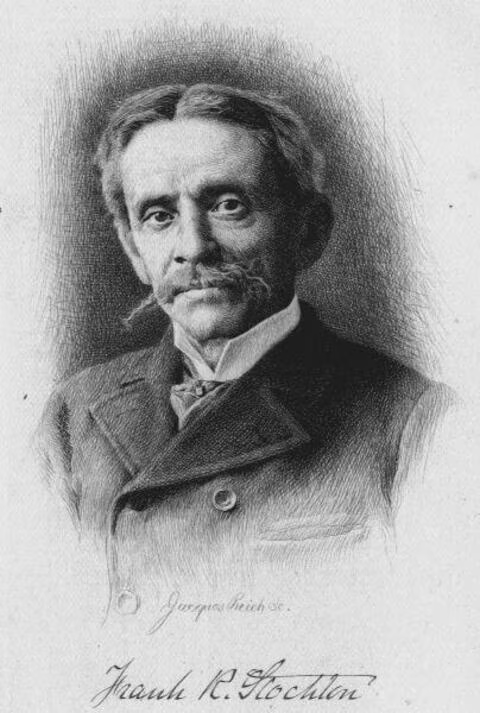
Quick Facts
Frank Richard Stockton
Pen Name: Frank Stockton
Born: April 5, 1834
Died: April 20, 1902
Nationality: American
Genres: Humor, Satire, Fantasy
Frank Stockton (1854 - 1902) was an American writer and humorist, best known for his allegorical fairy tales for all ages. Rather than moralizing, he tended to poke fun at qualities like greed, violence, and abuse of power. The Lady, or the Tiger?, his most famous story (published in 1882), offers a compelling choice for the reader because there is no right answer. It is a fascinating illustration of the conflict between determinism and free-will, an increasingly popular choice for middle school language arts teachers to include in their persuasive writing lessons. His story, The Griffin and the Minor Canon (1885) received renewed interest in 1963, with an edition illustrated by Maurice Sendak. We feature both works on our Fairy Tales Guide.
Stockton also offers a different storytelling style, a more subtle element of surprise, as in The Widow's Cruise, a slow-paced conversation between widows and visiting seafaring men, in which one widow tells the most dramatic sea story of all.
Stockton was raised in Philadelphia, son of a minister who discouraged the young Stockton's writing career (this explains his later tendency to avoid telling overt morality tales). He moved to New Jersey, became an accomplished wood engraver, before beginning his writing career after his father's death. He moved back to Philadelphia to write stories for his brother's newspaper, and published his first fairy tale, Ting-a-ling (1867) in The Riverside Magazine. Stockton's first collection of short stories was published in 1870.
Though Stockton doesn't have the name recognition of many American authors featured at this site, his works are slowly being discovered for their engaging style delivering compelling lessons implicitly, rather than explicitly. No wonder middle school teachers enjoy teaching Stockton!
Frequently Asked Questions about Frank Stockton
Who was Frank Stockton?
Frank Richard Stockton (1834–1902) was an American writer and humorist best known for his innovative fairy tales and witty short stories. Born in Philadelphia to a prominent Methodist minister who discouraged his literary ambitions, Stockton initially worked as a wood engraver before turning to writing after his father’s death. He became assistant editor of St. Nicholas Magazine in 1873, one of the most influential children’s periodicals of the era, and went on to publish dozens of stories that blended fantasy, humor, and social commentary. In his lifetime he was frequently compared to Mark Twain for his ability to entertain readers of all ages while subtly critiquing human nature.
What is Frank Stockton best known for?
Stockton is best known for The Lady, or the Tiger?, published in The Century Magazine in 1882. The story ends with an unresolved dilemma—a young man must open one of two doors, behind which waits either a beautiful lady or a ferocious tiger—and Stockton famously refused to reveal the answer for the rest of his life. The tale became a cultural phenomenon, sparking widespread debate and making the phrase "the lady or the tiger" a lasting idiom for impossible choices. It remains a staple in American middle school and high school English classes, particularly for persuasive writing exercises.
What was Frank Stockton's writing style?
Stockton’s writing style was marked by dry humor, clarity, and a deliberately understated tone that set him apart from the ornate prose fashionable in his era. Rather than moralizing—the standard approach in 19th-century children’s literature—he presented fantastic situations in a matter-of-fact, conversational voice that made the absurd seem perfectly reasonable. His stories often feature ironic reversals, trick endings, and rhetorical questions that invite the reader to participate in the narrative. This technique anticipated the surprise-ending tradition later perfected by O. Henry.
What fairy tales did Frank Stockton write?
Stockton wrote numerous fairy tales that broke from the didactic tradition of his time. His first, Ting-a-Ling, appeared in The Riverside Magazine in 1867, telling the adventures of a mischievous sprite. Major fairy tales include The Griffin and the Minor Canon (1885), which was reissued in 1963 with illustrations by Maurice Sendak, and The Bee Man of Orn (1887), a philosophical fable about identity and contentment. His collections The Floating Prince and Other Fairy Tales and The Bee Man of Orn and Other Fanciful Tales cemented his reputation as one of America’s most original writers of fantasy for young readers.
How did Frank Stockton influence American literature?
Stockton’s influence on American literature extends in several directions. His non-moralizing fairy tales helped pioneer a distinctly American tradition of children’s fantasy—L. Frank Baum explicitly credited Stockton’s The Floating Prince as an inspiration for his own approach in The Wonderful Wizard of Oz. His use of trick endings and unresolved narratives influenced the development of the American short story, anticipating techniques used by O. Henry and other humorists. He was also an early practitioner of what would later be called speculative fiction, with stories that blended science fiction, fantasy, and satire in ways that influenced writers like John Kendrick Bangs.
What is the answer to "The Lady, or the Tiger?"?
There is no definitive answer—and that is precisely the point. Stockton deliberately left the ending of The Lady, or the Tiger? unresolved, and he refused to reveal the princess’s choice for the rest of his life. When pressed at public appearances, he reportedly replied, "If you decide which it was—the lady or the tiger—you find out what kind of person you are yourself." The ambiguity is central to the story’s lasting power: it transforms the reader from a passive audience into an active participant who must weigh jealousy against love, cruelty against mercy. He did write a companion piece, The Discourager of Hesitancy, but it playfully avoids answering the question as well.
When was Frank Stockton born and when did he die?
Frank Richard Stockton was born on April 5, 1834, in Philadelphia, Pennsylvania. He died on April 20, 1902, in Washington, D.C., at the age of 68. He was buried in The Woodlands cemetery in Philadelphia. His most productive period spanned roughly from the late 1870s through the 1890s, during which he published prolifically in leading magazines like The Century, Harper’s, and St. Nicholas.
What was Frank Stockton's role at St. Nicholas Magazine?
In 1873, Stockton became assistant editor of St. Nicholas Magazine, one of the most prestigious and widely read children’s periodicals of the 19th century. Under editor Mary Mapes Dodge, the magazine published work by Mark Twain, Louisa May Alcott, and Rudyard Kipling, among others. Stockton served in this role until 1878, when deteriorating eyesight forced him to resign. The position was formative: it immersed him in children’s literature and gave him a platform for his own fairy tales, shaping the narrative voice and playful tone that would define his career.
Why is Frank Stockton taught in schools?
Stockton’s work—especially The Lady, or the Tiger?—is a favorite in middle school and high school classrooms because its open ending naturally generates persuasive writing and critical thinking exercises. Teachers use the story to teach argumentative essay structure: students must take a position on the princess’s choice and defend it with textual evidence. Beyond that single story, Stockton’s fairy tales like The Griffin and the Minor Canon offer accessible introductions to allegory, irony, and satire without heavy-handed moralizing, making them effective tools for teaching literary analysis at the middle school level.
What other stories by Frank Stockton are worth reading?
Beyond his most famous tale, Stockton wrote a rich body of work well worth exploring. The Griffin and the Minor Canon is a darkly humorous allegory about self-sacrifice and community ingratitude. The Widow’s Cruise is a quietly surprising tale of seafaring widows that showcases his gift for understated humor. A Piece of Red Calico is a comic masterpiece about the absurd difficulty of a simple errand. For readers who enjoy the unresolved ending of "The Lady, or the Tiger?", its companion piece The Discourager of Hesitancy offers another delightfully inconclusive puzzle.