The War Prayer
by Mark Twain
The War Prayer (1905) is Twain's searing antiwar parable, in which a mysterious stranger reveals the unspoken horror beneath a congregation's patriotic prayer for victory. Twain withheld it from publication during his lifetime, saying: "Only dead men can tell the truth in this world."
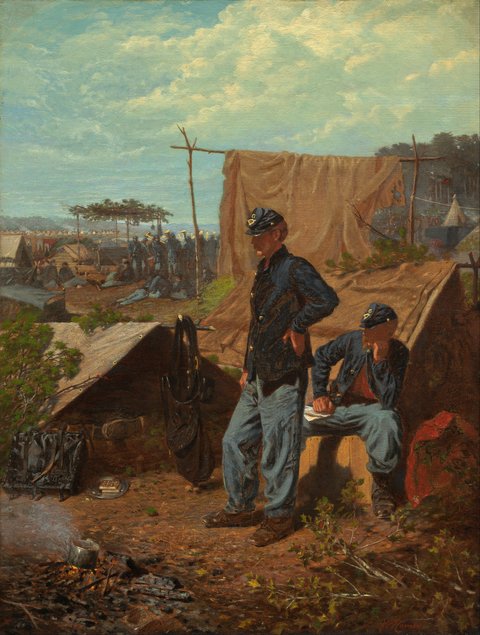
It was a time of great and exalting excitement. The country was up in arms, the war was on, in every breast burned the holy fire of patriotism; the drums were beating, the bands playing, the toy pistols popping, the bunched firecrackers hissing and sputtering; on every hand and far down the receding and fading spreads of roofs and balconies a fluttering wilderness of flags flashed in the sun; daily the young volunteers marched down the wide avenue gay and fine in their new uniforms, the proud fathers and mothers and sisters and sweethearts cheering them with voices choked with happy emotion as they swung by; nightly the packed mass meetings listened, panting, to patriot oratory which stirred the deepest deeps of their hearts and which they interrupted at briefest intervals with cyclones of applause, the tears running down their cheeks the while; in the churches the pastors preached devotion to flag and country and invoked the God of Battles, beseeching His aid in our good cause in outpouring of fervid eloquence which moved every listener.
It was indeed a glad and gracious time, and the half dozen rash spirits that ventured to disapprove of the war and cast a doubt upon its righteousness straightway got such a stern and angry warning that for their personal safety's sake they quickly shrank out of sight and offended no more in that way.
Sunday morning came-next day the battalions would leave for the front; the church was filled; the volunteers were there, their faces alight with material dreams-visions of a stern advance, the gathering momentum, the rushing charge, the flashing sabers, the flight of the foe, the tumult, the enveloping smoke, the fierce pursuit, the surrender!-then home from the war, bronzed heros, welcomed, adored, submerged in golden seas of glory! With the volunteers sat their dear ones, proud, happy, and envied by the neighbors and friends who had no sons and brothers to send forth to the field of honor, there to win for the flag or, failing, die the noblest of noble deaths. The service proceeded; a war chapter from the Old Testament was read; the first prayer was said; it was followed by an organ burst that shook the building, and with one impulse the house rose, with glowing eyes and beating hearts, and poured out that tremendous invocation -- "God the all-terrible! Thou who ordainest, Thunder thy clarion and lightning thy sword!"
Then came the "long" prayer. None could remember the like of it for passionate pleading and moving and beautiful language. The burden of its supplication was that an ever--merciful and benignant Father of us all would watch over our noble young soldiers and aid, comfort, and encourage them in their patriotic work; bless them, shield them in His mighty hand, make them strong and confident, invincible in the bloody onset; help them to crush the foe, grant to them and to their flag and country imperishable honor and glory -
An aged stranger entered and moved with slow and noiseless step up the main aisle, his eyes fixed upon the minister, his long body clothed in a robe that reached to his feet, his head bare, his white hair descending in a frothy cataract to his shoulders, his seamy face unnaturally pale, pale even to ghastliness. With all eyes following him and wondering, he made his silent way; without pausing, he ascended to the preacher's side and stood there, waiting. With shut lids the preacher, unconscious of his presence, continued his moving prayer, and at last finished it with the words, uttered in fervent appeal,"Bless our arms, grant us the victory, O Lord our God, Father and Protector of our land and flag!"
The stranger touched his arm, motioned him to step aside -- which the startled minister did -- and took his place. During some moments he surveyed the spellbound audience with solemn eyes in which burned an uncanny light; then in a deep voice he said
"I come from the Throne-bearing a message from Almighty God!" The words smote the house with a shock; if the stranger perceived it he gave no attention. "He has heard the prayer of His servant your shepherd and grant it if such shall be your desire after I, His messenger, shall have explained to you its import-that is to say, its full import. For it is like unto many of the prayers of men, in that it asks for more than he who utters it is aware of-except he pause and think. "God's servant and yours has prayed his prayer. Has he paused and taken thought? Is it one prayer? No, it is two- one uttered, the other not. Both have reached the ear of His Who hearth all supplications, the spoken and the unspoken. Ponder this-keep it in mind. If you beseech a blessing upon yourself, beware! lest without intent you invoke a curse upon a neighbor at the same time. If you pray for the blessing of rain upon your crop which needs it, by that act you are possibly praying for a curse upon some neighbor's crop which may not need rain and can be injured by it. "You have heard your servant's prayer-the uttered part of it. I am commissioned by God to put into words the other part of it-that part which the pastor, and also you in your hearts, fervently prayed silently. And ignorantly and unthinkingly? God grant that it was so! You heard these words: 'Grant us the victory, O Lord our God!' That is sufficient. The whole of the uttered prayer is compact into those pregnant words. Elaborations were not necessary. When you have prayed for victory you have prayed for many unmentioned results which follow victory-must follow it, cannot help but follow it. Upon the listening spirit of God the Father fell also the unspoken part of the prayer. He commandeth me to put it into words. Listen!
"O Lord our Father, our young patriots, idols of our hearts, go forth to battle-be Thou near them! With them, in spirit, we also go forth from the sweet peace of our beloved firesides to smite the foe. O Lord our God, help us to tear their soldiers to bloody shreds with our shells; help us to cover their smiling fields with the pale forms of their patriot dead; help us to drown the thunder of the guns with the shrieks of their wounded, writhing in pain; help us to lay waste their humble homes with a hurricane of fire; help us to wring the hearts of their unoffending widows with unavailing grief; help us to turn them out roofless with their little children to wander unfriended the wastes of their desolated land in rags and hunger and thirst, sports of the sun flames of summer and the icy winds of winter, broken in spirit, worn with travail, imploring Thee for the refuge of the grave and denied it-for our sakes who adore Thee, Lord, blast their hopes, blight their lives, protract their bitter pilgrimage, make heavy their steps, water their way with their tears, stain the white snow with the blood of their wounded feet! We ask it, in the spirit of love, of Him Who is the Source of Love, and Who is ever-faithful refuge and friend of all that are sore beset and seek His aid with humble and contrite hearts. Amen.
(After a pause)
"Ye have prayed it; if ye still desire it, speak! The messenger of the Most High waits."
It was believed afterward that the man was a lunatic, because there was no sense in what he said.
Frequently Asked Questions about The War Prayer
What is "The War Prayer" by Mark Twain about?
The War Prayer is an antiwar prose piece in which a community gathers in church to send its young soldiers off to battle. The minister delivers a rousing prayer for victory, asking God to protect the troops and crush the enemy. At the climax of the prayer, a mysterious aged stranger appears and announces he has been sent by God to speak aloud the unspoken half of the prayer — a harrowing catalog of the death, suffering, and devastation that "victory" necessarily inflicts on the opposing side. The congregation dismisses him as a lunatic, and the story ends with the chilling line: "It was believed afterward that the man was a lunatic, because there was no sense in what he said."
What is the main theme of "The War Prayer"?
The central theme is the hypocrisy of wartime patriotism and religious fervor. argues that when a nation prays for military victory, it is simultaneously — whether it acknowledges it or not — praying for the destruction of other human beings. The stranger's "unspoken prayer" lays bare this moral contradiction: asking God to "help us to tear their soldiers to bloody shreds" and "help us to lay waste their humble homes." Twain suggests that societies wrap violence in the language of piety and duty to avoid confronting what war actually requires.
Why was "The War Prayer" not published during Mark Twain's lifetime?
wrote The War Prayer around 1904–1905, during the Philippine-American War, but it remained unpublished until after his death in 1910. When he submitted it to Harper's Bazaar, it was rejected as "not quite suited to a woman's magazine." His family — particularly his daughter Jean — also discouraged publication, fearing the piece would be considered sacrilegious. Twain himself reportedly said, "I have told the whole truth in that, and only dead men can tell the truth in this world." The story was finally published in 1923 in the posthumous collection Europe and Elsewhere, edited by his literary executor Albert Bigelow Paine.
Who is the stranger in "The War Prayer"?
The stranger is described as "an aged man" with "long body" and "unnaturally pale" face whose eyes burn with "an uncanny light." He claims to have come directly from God, sent as a divine messenger to articulate what the congregation has truly been praying for. He is not named and his identity is deliberately ambiguous — he could be an angel, a prophet, or simply a man brave enough to speak uncomfortable truths. His function in the story is to serve as the voice of conscience, translating the euphemistic language of the minister's prayer into its brutal reality. The congregation's final verdict — that he was "a lunatic" — underscores Twain's point that societies reject those who force them to confront the true cost of war.
What literary devices does Mark Twain use in "The War Prayer"?
Twain employs several powerful literary devices throughout The War Prayer. Satire is the dominant mode — the entire piece satirizes blind patriotism and religious sanctimony. Irony pervades the story, particularly in the minister asking an "ever-merciful and benignant Father" to help the soldiers "crush the foe" — a deeply oxymoronic pairing. Juxtaposition provides the central structural device: the stranger contrasts the "spoken" prayer of noble purpose with the "unspoken" prayer of carnage and suffering. Twain also uses vivid imagery in the stranger's speech — "help us to wring the hearts of their unoffending widows" and "stain the white snow with the blood of their wounded" — to make abstract concepts viscerally concrete. The final line delivers a devastating stroke of dramatic irony: the reader understands exactly what the stranger said, even as the congregation dismisses it as nonsense.
What is the "unspoken prayer" in "The War Prayer"?
The "unspoken prayer" is the story's central concept. The stranger explains that every prayer for victory is actually two prayers in one: the spoken prayer, which asks for God's blessing and protection for one's own soldiers, and the unspoken prayer, which implicitly asks for the suffering of the enemy. The stranger then delivers the unspoken half aloud: "O Lord our God, help us to tear their soldiers to bloody shreds with our shells... help us to drown the thunder of the guns with the shrieks of their wounded... help us to wring the hearts of their unoffending widows with unavailing grief." By making the implicit explicit, the stranger forces the congregation — and the reader — to acknowledge that you cannot pray for victory without also praying for devastation.
What historical events inspired "The War Prayer"?
The War Prayer was written around 1904–1905 and is widely understood as 's response to the Spanish-American War (1898) and the subsequent Philippine-American War (1899–1902). Twain was a vocal member of the Anti-Imperialist League and deeply opposed American military expansion into the Philippines, where U.S. forces committed atrocities against Filipino civilians. The story's unnamed setting is deliberately universal — Twain avoided specifying a country or conflict so the piece could apply to any war fought under the banner of God and patriotism. His broader anti-imperialist writings from this period include essays like "To the Person Sitting in Darkness" (1901) and "King Leopold's Soliloquy" (1905).
What is the significance of the ending of "The War Prayer"?
The story ends with a single devastating sentence: "It was believed afterward that the man was a lunatic, because there was no sense in what he said." This is the story's most powerful stroke of irony — the stranger has spoken the clearest, most logical truth in the entire piece, yet the congregation rejects it entirely. The ending reveals that the problem is not ignorance but willful refusal to understand. The congregation heard every word; they simply chose to label the messenger insane rather than confront the moral implications of their own prayer. Twain suggests that societies will always prefer comfortable delusion over uncomfortable truth, and that those who speak plainly about the costs of war will be marginalized as lunatics or traitors.
Is "The War Prayer" a short story or a poem?
The War Prayer occupies a hybrid space between genres. It is most commonly classified as a short story or prose poem, though some scholars describe it as a parable or polemic. It has narrative elements — a setting, characters, and a plot arc — but the stranger's speech has a distinctly poetic quality, with rhythmic repetition ("help us to... help us to... help us to") and elevated, incantatory language. At roughly 1,500 words, it is shorter than most traditional short stories and reads more like an extended rhetorical performance. Its brevity and moral directness align it with the parable tradition, while its satirical intent places it firmly within Twain's larger body of social commentary.
Save stories, build your reading list, and access all study tools — completely free.
Save The War Prayer to your library — it's free!Need help with The War Prayer?
Study tools to help with homework, prepare for quizzes, and deepen your understanding.
Flashcards → | Vocabulary → | Study Guide →