Ozymandias


Percy Bysshe's poem, Ozymandias (1818) is a traveler's description of a ruined statue of the Egyptian King Ramses II from the 13th century BCE. Often studied by students in grades 9-10 in conjunction with world history.
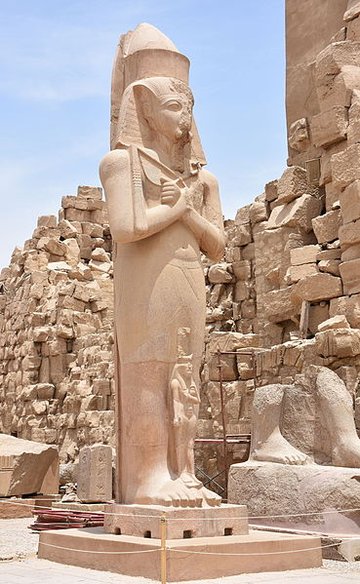
Ozymandias by Percy Bysshe Shelley
I met a traveller from an antique land
Who said: Two vast and trunkless legs of stone
Stand in the desert…Near them, on the sand,
Half sunk, a shattered visage lies, whose frown,
And wrinkled lip, and sneer of cold command, 
Tell that its sculptor well those passions read
Which yet survive, stamped on these lifeless things,
The hand that mocked them, and the heart that fed: 
And on the pedestal these words appear:

'My name is Ozymandias, king of kings:
Look on my works, ye Mighty, and despair!'
Nothing beside remains. Round the decay
Of that colossal wreck, boundless and bare
The lone and level sands stretch far away.

Featured in our selection of Poetry for Students.


Frequently Asked Questions about Ozymandias

What is "Ozymandias" by Percy Bysshe Shelley about?

Ozymandias is a sonnet about a traveller who encounters the ruins of a colossal statue in a vast desert. The shattered sculpture depicts an ancient king whose pedestal bears the boastful inscription, "My name is Ozymandias, king of kings: / Look on my works, ye Mighty, and despair!" Yet nothing of his empire survives — only the broken statue surrounded by endless sand. Through this striking image, Shelley dramatizes the inevitable decline of all tyrants and the civilizations they build, contrasting human arrogance with the indifferent power of time and nature.

What is the theme of "Ozymandias"?

The central theme of Ozymandias is the impermanence of political power. Ozymandias commanded onlookers to "despair" at his greatness, yet his empire has been reduced to rubble and sand. Closely related is the theme of hubris — the king's arrogant inscription becomes deeply ironic when read beside the desolation surrounding it. The poem also explores a subtler counter-theme: the enduring power of art. While the king's political achievements have vanished, the sculptor's craft still communicates his "sneer of cold command" across millennia, suggesting that art outlasts the rulers it depicts.

Who was Ozymandias in real life?

Ozymandias is the Greek name for Ramesses II (also spelled Ramses II), one of the most powerful pharaohs of ancient Egypt. He ruled during the 19th Dynasty (c. 1279–1213 BCE) and was renowned for his military campaigns and monumental building projects, including the temples at Abu Simbel and the Ramesseum at Thebes. The Greek historian Diodorus Siculus recorded an inscription on a statue of Ramesses that read, "King of Kings Ozymandias am I. If any want to know how great I am and where I lie, let him outdo me in my work." This passage directly inspired Shelley's poem.

What literary devices are used in "Ozymandias"?

Shelley employs several powerful literary devices in Ozymandias. Irony is the poem's backbone — the king's boastful command to "despair" becomes bitterly ironic beside the surrounding emptiness. Imagery is vivid and precise: "Two vast and trunkless legs of stone," "a shattered visage lies," and "lone and level sands stretch far away" paint the scene in stark visual detail. Alliteration reinforces the desolation through phrases like "boundless and bare" and "lone and level." Synecdoche appears in "The hand that mocked them, and the heart that fed," where "hand" represents the sculptor and "heart" the king. The poem also makes striking use of enjambment, carrying meaning across line breaks to mirror the fragmented statue itself.

What is the irony in "Ozymandias"?

The poem's central irony is dramatic irony: Ozymandias intended his inscription — "Look on my works, ye Mighty, and despair!" — as a threat to rival kings, boasting that his achievements were unsurpassable. But the reader sees what the king could not foresee: his "works" have completely vanished, and only a broken statue remains in an empty desert. The command to "despair" now takes on an unintended meaning — mighty rulers should despair not at Ozymandias's power, but at the realization that even the greatest empires are impermanent. This ironic reversal is heightened by situational irony: the king erected the statue to immortalize his greatness, but it ultimately immortalizes his downfall instead.

What does "Look on my Works, ye Mighty, and despair" mean?

This famous inscription is the voice of Ozymandias himself, carved on the pedestal of his statue. In its original intent, it was a warning to other powerful rulers: survey my vast empire and its monuments, and despair because you will never match them. The phrase "ye Mighty" addresses fellow kings and conquerors, asserting Ozymandias as the supreme "king of kings." However, Shelley recontextualizes the words so they carry an unintended meaning for modern readers: look upon the total erasure of this ruler's legacy and despair at the futility of all human ambition. The line's power lies in this double reading — arrogant boast and inadvertent memento mori simultaneously.

What does the statue symbolize in "Ozymandias"?

The ruined statue functions as a multilayered symbol. Most directly, it represents the collapse of tyrannical power — a once-mighty ruler reduced to shattered stone. The "shattered visage" with its "sneer of cold command" symbolizes the cruelty and arrogance that characterized Ozymandias's reign, preserved in stone long after his political power disappeared. The surrounding desert — "boundless and bare" with "lone and level sands" — symbolizes time and nature's supremacy over human ambition. Yet the statue also carries a paradox: while it represents ruin, the sculptor's artistry has survived for millennia, making the wreckage itself a symbol of art's endurance beyond the lifespan of empires.

When was "Ozymandias" written and what inspired Shelley to write it?

Shelley composed Ozymandias in late December 1817 or early January 1818. It was first published on January 11, 1818, in The Examiner, a London weekly. The poem originated from a friendly writing competition with fellow poet Horace Smith — both men agreed to write a sonnet on the same subject. Smith's competing sonnet, also titled "Ozymandias," was published in The Examiner the following month. Both poets drew inspiration from a passage in the Bibliotheca historica by the Greek historian Diodorus Siculus describing a massive statue of Ramesses II. The arrival of fragments of a colossal statue of Ramesses at the British Museum around the same time may have also sparked their interest.

What is the structure and rhyme scheme of "Ozymandias"?

Ozymandias is a fourteen-line sonnet written in loose iambic pentameter. Its rhyme scheme — ABAB ACDC EDE FEF — departs from both the Petrarchan (ABBAABBA CDECDE) and Shakespearean (ABAB CDCD EFEF GG) conventions. This unconventional structure mirrors the poem's subject: just as Ozymandias's empire has crumbled, the sonnet form itself is partially broken. The poem also features a nested narrative structure — the speaker recounts a traveller's account of the statue, creating two layers of distance between the reader and Ozymandias that emphasize how far removed the king is from the present day.

Why is "Ozymandias" considered one of the greatest English poems?

Ozymandias is widely regarded as one of the finest poems in the English language for several reasons. In just fourteen lines, Shelley achieves an extraordinary compression of meaning — a meditation on power, art, time, and human vanity that has remained relevant for over two centuries. The poem's central image — a broken colossus in an empty desert — is so vivid and universal that it has entered popular culture, referenced in works from Yeats to the television series Breaking Bad. Its dramatic irony requires no footnotes, making it accessible to first-time readers while still rewarding close analysis. Fellow Romantic poets like John Keats and Lord Byron were among Shelley's contemporaries, but few poems from the era match the concise force of Ozymandias.

Save stories, build your reading list, and access all study tools — completely free.

Save Ozymandias to your library — it's free!

Need help with Ozymandias?

Study tools to help with homework, prepare for quizzes, and deepen your understanding.

Flashcards → | Vocabulary → | Study Guide →