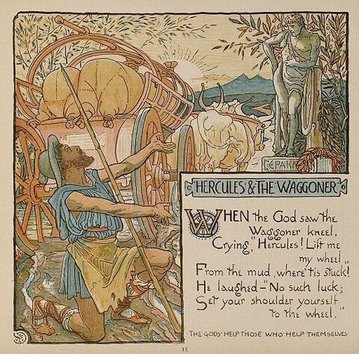
This fable is also known as "Hercules and the Carter." It is Perry Index 291 and the origin of two famous proverbs: "Heaven helps those who help themselves" and "put your shoulder to the wheel."
A Farmer was driving his wagon along a miry country road after a
heavy rain. The horses could hardly drag the load through the
deep mud, and at last came to a standstill when one of the wheels
sank to the hub in a rut.
The farmer climbed down from his seat and stood beside the wagon
looking at it but without making the least effort to get it out
of the rut. All he did was to curse his bad luck and call loudly
on Hercules to come to his aid. Then, it is said, Hercules really
did appear, saying:
"Put your shoulder to the wheel, man, and urge on your horses. Do
you think you can move the wagon by simply looking at it and
whining about it? Hercules will not help unless you make some
effort to help yourself."
And when the farmer put his shoulder to the wheel and urged on
the horses, the wagon moved very readily, and soon the Farmer was
riding along in great content and with a good lesson learned.
Self help is the best help.
Heaven helps those who help themselves.
Frequently Asked Questions
What is the moral of "Hercules and the Wagoner"?
The moral is "Self-help is the best help" and "Heaven helps those who help themselves." The wagoner prayed to Hercules for help, but Hercules appeared only to tell him to make an effort first. The fable teaches that prayer, wishing, and complaining are no substitute for action. Help — whether divine or otherwise — comes to those who are already working to solve their own problems.
What does "put your shoulder to the wheel" mean?
The phrase "put your shoulder to the wheel" means to apply yourself with effort and determination. It comes directly from this Aesop fable, where Hercules tells the wagoner to physically push the wheel rather than just staring at the stuck wagon. The expression was first recorded in English by Robert Burton in 1621 and remains in common use today. It means: stop waiting for help and start working on the problem yourself.
Is "God helps those who help themselves" from the Bible?
No. Despite being widely attributed to the Bible, this proverb actually traces back to Aesop and this fable (Perry Index 291, circa 550 BCE). The modern English phrasing was coined by Algernon Sidney in the 17th century and later popularized by Benjamin Franklin in Poor Richard’s Almanack (1736). The phrase does not appear anywhere in the Bible — in fact, many theologians argue it contradicts core biblical teachings about grace and divine assistance.
Would you like to read more of Aesop’s Fables?
Here are some of our favorite Aesop fables to read next:
The Ant and the Grasshopper — Another fable about the value of hard work: the ant prepares for winter while the grasshopper plays, with predictable results.
The Crow and the Pitcher — A thirsty crow solves an impossible problem through clever thinking and persistent effort.
The Tortoise and the Hare — Slow and steady wins the race: effort and persistence triumph over natural talent.
The Boy and the Filberts — A boy learns that greed defeats itself when he gets his hand stuck in a jar of nuts.
"Self-help is the best help" sounds simple, but the fable makes a subtle and important point. Hercules does not refuse to help — he refuses to help someone who has …
...
Advertisement
Understanding Hercules And The Wagoner
A short summary of the story
The Real Moral
"Self-help is the best help" sounds simple, but the fable makes a subtle and important point. Hercules does not refuse to help — he refuses to help someone who has not tried. The wagoner’s sin is not asking for help; it is asking for help while standing idle beside his stuck wagon "without making the least effort to get it out."
The distinction matters. The fable does not say you should never ask for help. It says that effort is a prerequisite for assistance, not an alternative to it. When the farmer finally puts his shoulder to the wheel and urges on his horses, the wagon moves "very readily" — suggesting that the obstacle was never as insurmountable as his inaction made it seem.
What This Fable Teaches
This fable has generated two of the most widely used proverbs in the English language, both of which are frequently misattributed:
"Heaven helps those who help themselves" — Often mistakenly attributed to the Bible, this proverb actually comes from Aesop. Benjamin Franklin popularized the English phrasing in Poor Richard’s Almanack (1736).
"Put your shoulder to the wheel" — Meaning to apply yourself with effort and determination. The phrase comes directly from Hercules’ instruction to the wagoner in this fable.
The fable’s lesson extends far beyond stuck wagons. It speaks to anyone who prays for a better job without updating their resume, who wishes for better health without exercising, or who complains about a problem without taking even the first step to solve it. The message is not that divine help is impossible — it is that help flows toward effort, not inertia.
Historical Context
"Hercules and the Wagoner" is Perry Index 291, attributed to Aesop (circa 620–564 BCE). The earliest surviving written version is by the Greek fabulist Babrius (late 1st century CE, as Babrius 20). The fable was later retold by Jean de La Fontaine in French as "Le Chartier embourbé" (Book VI, Fable 18, published 1668).
The fable’s influence on Western proverbs is remarkable. The phrase "God helps those who help themselves" became so widespread that surveys consistently find a majority of Americans believe it comes from the Bible. It does not. The sentiment is Aesop’s, filtered through centuries of classical, Renaissance, and Enlightenment thought. Its attribution to Ben Franklin, while closer to correct, still understates its ancient Greek origins by about 2,200 years.
Advertisement
Find this helpful? Create a free account to bookmark stories and save explanations for quick reference.