The Open Window
by H.H. Munro (SAKI)
"Out through that window, three years ago to a day, her husband and her two young brothers went off for their day's shooting. They never came back."
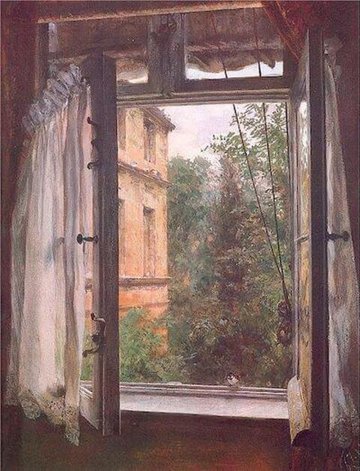
"My aunt will be down presently, Mr. Nuttel," said a very self-possessed young lady of fifteen; "in the meantime you must try and put up with me."
Framton Nuttel endeavored to say the correct something which should duly flatter the niece of the moment without unduly discounting the aunt that was to come. Privately he doubted more than ever whether these formal visits on a succession of total strangers would do much towards helping the nerve cure which he was supposed to be undergoing
"I know how it will be," his sister had said when he was preparing to migrate to this rural retreat; "you will bury yourself down there and not speak to a living soul, and your nerves will be worse than ever from moping. I shall just give you letters of introduction to all the people I know there. Some of them, as far as I can remember, were quite nice."
Framton wondered whether Mrs. Sappleton, the lady to whom he was presenting one of the letters of introduction came into the nice division.
"Do you know many of the people round here?" asked the niece, when she judged that they had had sufficient silent communion.
"Hardly a soul," said Framton. "My sister was staying here, at the rectory, you know, some four years ago, and she gave me letters of introduction to some of the people here."
He made the last statement in a tone of distinct regret.
"Then you know practically nothing about my aunt?" pursued the self-possessed young lady.
"Only her name and address," admitted the caller. He was wondering whether Mrs. Sappleton was in the married or widowed state. An undefinable something about the room seemed to suggest masculine habitation.
"Her great tragedy happened just three years ago," said the child; "that would be since your sister's time."
"Her tragedy?" asked Framton; somehow in this restful country spot tragedies seemed out of place.
"You may wonder why we keep that window wide open on an October afternoon," said the niece, indicating a large French window that opened on to a lawn.
"It is quite warm for the time of the year," said Framton; "but has that window got anything to do with the tragedy?"
"Out through that window, three years ago to a day, her husband and her two young brothers went off for their day's shooting. They never came back. In crossing the moor to their favorite snipe-shooting ground they were all three engulfed in a treacherous piece of bog. It had been that dreadful wet summer, you know, and places that were safe in other years gave way suddenly without warning. Their bodies were never recovered. That was the dreadful part of it." Here the child's voice lost its self-possessed note and became falteringly human. "Poor aunt always thinks that they will come back someday, they and the little brown spaniel that was lost with them, and walk in at that window just as they used to do. That is why the window is kept open every evening till it is quite dusk. Poor dear aunt, she has often told me how they went out, her husband with his white waterproof coat over his arm, and Ronnie, her youngest brother, singing 'Bertie, why do you bound?' as he always did to tease her, because she said it got on her nerves. Do you know, sometimes on still, quiet evenings like this, I almost get a creepy feeling that they will all walk in through that window--"
She broke off with a little shudder. It was a relief to Framton when the aunt bustled into the room with a whirl of apologies for being late in making her appearance.
"I hope Vera has been amusing you?" she said.
"She has been very interesting," said Framton.
"I hope you don't mind the open window," said Mrs. Sappleton briskly; "my husband and brothers will be home directly from shooting, and they always come in this way. They've been out for snipe in the marshes today, so they'll make a fine mess over my poor carpets. So like you menfolk, isn't it?"
She rattled on cheerfully about the shooting and the scarcity of birds, and the prospects for duck in the winter. To Framton it was all purely horrible. He made a desperate but only partially successful effort to turn the talk on to a less ghastly topic, he was conscious that his hostess was giving him only a fragment of her attention, and her eyes were constantly straying past him to the open window and the lawn beyond. It was certainly an unfortunate coincidence that he should have paid his visit on this tragic anniversary.
"The doctors agree in ordering me complete rest, an absence of mental excitement, and avoidance of anything in the nature of violent physical exercise," announced Framton, who labored under the tolerably widespread delusion that total strangers and chance acquaintances are hungry for the least detail of one's ailments and infirmities, their cause and cure. "On the matter of diet they are not so much in agreement," he continued.
"No?" said Mrs. Sappleton, in a voice which only replaced a yawn at the last moment. Then she suddenly brightened into alert attention--but not to what Framton was saying.
"Here they are at last!" she cried. "Just in time for tea, and don't they look as if they were muddy up to the eyes!"
Framton shivered slightly and turned towards the niece with a look intended to convey sympathetic comprehension. The child was staring out through the open window with a dazed horror in her eyes. In a chill shock of nameless fear Framton swung round in his seat and looked in the same direction.
In the deepening twilight three figures were walking across the lawn towards the window, they all carried guns under their arms, and one of them was additionally burdened with a white coat hung over his shoulders. A tired brown spaniel kept close at their heels. Noiselessly they neared the house, and then a hoarse young voice chanted out of the dusk: "I said, Bertie, why do you bound?"
Framton grabbed wildly at his stick and hat; the hall door, the gravel drive, and the front gate were dimly noted stages in his headlong retreat. A cyclist coming along the road had to run into the hedge to avoid imminent collision.
"Here we are, my dear," said the bearer of the white mackintosh, coming in through the window, "fairly muddy, but most of it's dry. Who was that who bolted out as we came up?"
"A most extraordinary man, a Mr. Nuttel," said Mrs. Sappleton; "could only talk about his illnesses, and dashed off without a word of goodby or apology when you arrived. One would think he had seen a ghost."
"I expect it was the spaniel," said the niece calmly; "he told me he had a horror of dogs. He was once hunted into a cemetery somewhere on the banks of the Ganges by a pack of pariah dogs, and had to spend the night in a newly dug grave with the creatures snarling and grinning and foaming just above him. Enough to make anyone lose their nerve."
Romance at short notice was her speciality.
Featured in our collection of Short Stories for Middle School I
Frequently Asked Questions about The Open Window
What is "The Open Window" by Saki about?
"The Open Window" tells the story of Framton Nuttel, a nervous man who visits the countryside for a rest cure and calls on Mrs. Sappleton armed with a letter of introduction. While he waits, Mrs. Sappleton's fifteen-year-old niece Vera tells him a tragic tale: three years ago, Mrs. Sappleton's husband and two young brothers went out hunting through the French window and never returned, swallowed by a treacherous bog. Vera explains that her aunt keeps the window open every evening, convinced they will one day walk back in. When the men actually appear on the lawn — alive and well, returning from a perfectly ordinary day of snipe shooting — Framton believes he is seeing ghosts and flees in terror. The story ends with Vera calmly inventing yet another lie to explain his departure.
What is the twist ending of "The Open Window"?
The twist is a double revelation. First, the reader discovers that Vera's tragic story about the three men drowning in a bog was entirely fabricated — Mr. Sappleton and the brothers are alive and simply out hunting for the day. The open window is not a shrine to the dead but a perfectly ordinary entrance the men always use. Second, when Mrs. Sappleton wonders why Framton bolted, Vera instantly invents another lie — that he has a morbid terror of dogs after being chased into an open grave by pariah dogs on the banks of the Ganges. The famous final line, "Romance at short notice was her speciality," confirms that Vera is a habitual and gifted storyteller, and the entire episode was her impromptu entertainment.
What are the main themes of "The Open Window" by Saki?
The central theme is deception and the power of storytelling. Vera demonstrates how a well-crafted narrative can completely control another person's perception of reality — she turns an ordinary open window into evidence of tragedy with nothing more than words. A related theme is appearance versus reality: everything Framton sees in the Sappleton household is filtered through Vera's false story, so the perfectly normal scene of men returning from hunting becomes a supernatural horror. The story also satirizes social convention and gullibility — Framton is so eager to be polite and so wrapped up in his own neuroses that he never questions Vera's tale. Finally, explores the theme of youth outwitting age: the fifteen-year-old Vera effortlessly manipulates every adult in the room.
What types of irony does Saki use in "The Open Window"?
employs all three major types of irony. Situational irony drives the central joke: Framton has come to the countryside specifically to calm his nerves, yet Vera's prank terrifies him far worse than anything in London. Dramatic irony operates once the twist is revealed — on rereading, the audience knows Vera is lying while Framton does not, making details like Mrs. Sappleton's cheerful talk about the shooting and the scarcity of birds darkly comic rather than tragic. Verbal irony appears in Vera's very name, which derives from the Latin word for "truth" — yet truth is the one thing she never tells. Mrs. Sappleton's remark that Framton left as though "he had seen a ghost" is also verbally ironic, since from his perspective that is exactly what happened.
Who is Vera in "The Open Window" and why does she lie?
Vera is Mrs. Sappleton's fifteen-year-old niece — poised, articulate, and described as "a very self-possessed young lady." She is the story's true protagonist and its most sophisticated character. Vera lies not out of malice but out of creative impulse and mischief. She quickly assesses that Framton knows nothing about the family, giving her a blank canvas. She crafts a convincing ghost story complete with specific sensory details — the white waterproof coat, the brown spaniel, the song "Bertie, why do you bound?" — all drawn from real details she knows will soon appear when the hunters return. Her ability to improvise a second lie on the spot (the Ganges cemetery story) confirms she is a habitual and gifted storyteller. The closing line — "Romance at short notice was her speciality" — frames her not as a villain but as an artist of fiction.
What does the open window symbolize in the story?
The open window functions as a symbol with shifting meaning. In Vera's fabricated story, it symbolizes grief and denial — a widow's refusal to accept death, kept open as a vigil for the lost. Once the truth is revealed, it becomes a symbol of deception itself: an ordinary domestic detail transformed into something haunted by the power of narrative. There is also irony in the conventional symbolism of an open window as transparency and honesty — the very opposite of what Vera uses it for. On a deeper level, the window represents the threshold between fiction and reality, the boundary that Vera collapses so effectively that Framton can no longer distinguish a returning hunter from a ghost.
What literary devices does Saki use in "The Open Window"?
Beyond irony, employs several notable literary devices. The story uses a frame narrative — a story within a story — as Vera's fabricated tale is embedded inside the main narrative, mirroring how fiction can nest inside reality. Foreshadowing operates subtly: Vera's careful question "Then you know practically nothing about my aunt?" is her way of confirming she has a blank canvas for her lie. The unreliable narrator technique applies to Vera, whose convincing performance leads both Framton and the first-time reader astray. Saki also uses juxtaposition, contrasting Framton's neurotic self-absorption with Vera's cool composure, and the horror of the "ghost" scene with its perfectly mundane reality. The third-person limited point of view, filtered mostly through Framton's anxious perspective, ensures the reader shares his credulity.
Who is Framton Nuttel in "The Open Window"?
Framton Nuttel is a nervous, hypochondriac Londoner sent to the countryside by his sister for a "nerve cure." He arrives at the Sappleton home armed with a letter of introduction but knowing nothing about the family — a vulnerability Vera immediately exploits. Framton is self-absorbed to the point of comic obliviousness: he drones on about his doctors' dietary disagreements while Mrs. Sappleton barely stifles a yawn. His name itself is gently mocking — "Nuttel" suggests someone slightly unhinged. He serves as the perfect dupe for Vera's story because his anxiety makes him predisposed to believe the worst, and his rigid adherence to social convention prevents him from questioning a young girl's account. His panicked flight at the story's climax — grabbing "wildly at his stick and hat" and nearly colliding with a cyclist — is pure slapstick rooted in genuine terror.
What does "Romance at short notice was her speciality" mean?
This famous closing line is 's final, devastating twist. "Romance" here does not mean love — it means a fanciful, invented story, in the older literary sense of the word. "At short notice" emphasizes that Vera fabricates her tales instantly and improvisationally, without preparation. The line reframes everything: it confirms that Vera's ghost story was a spontaneous invention, that her second lie about Framton's fear of dogs was equally improvised, and that this kind of performance is habitual for her — her "speciality." It is also Saki's wink to the reader, acknowledging the parallels between Vera's artistry and his own: both are masters of the short, devastating fiction that upends expectations in a final line.
When was "The Open Window" by Saki published?
"The Open Window" was first published in 1914 in 's collection Beasts and Super-Beasts. Saki was the pen name of Hector Hugh Munro, a British writer known for his witty, darkly comic short fiction satirizing Edwardian society. He is often compared to Oscar Wilde for his epigrammatic style and to O. Henry for his mastery of the surprise ending. "The Open Window" is Saki's most widely anthologized story and a staple of English literature curricula around the world. Munro was killed in action during World War I in 1916, just two years after the collection's publication, cutting short one of the sharpest careers in English short fiction.
Save stories, build your reading list, and access all study tools — completely free.
Save The Open Window to your library — it's free!Need help with The Open Window?
Study tools to help with homework, prepare for quizzes, and deepen your understanding.
Flashcards → | Vocabulary → | Study Guide →