The Two Goats


The Two Goats is a fable without an ancient Greek or Latin source in the Aesopic tradition, and it is not catalogued in the Perry Index. Its earliest known origin is Pliny the Elder's Natural History (VIII, 50), where, notably, the goats reach a sensible agreement. The tale was popularized by Jean de La Fontaine as Les deux Chèvres (Book XII, Fable 4, 1694), which gave it the tragic ending familiar today. The English version presented here follows the La Fontaine tradition and appears in most 19th-century collections attributed to Aesop.
The Two Goats by Aesop

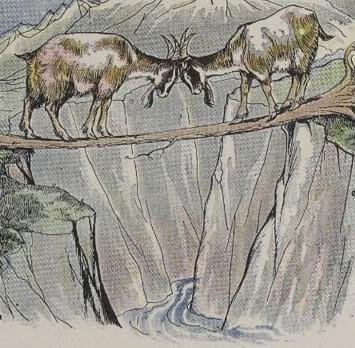
Two goats, frolicking happily on the rocky slopes of a mountain valley, happened to meet, one on each side of a deep chasm through which poured a mighty mountain torrent. The trunk of a fallen tree formed the only way to cross the chasm, and on this not even two squirrels could have passed each other safely. The narrow path would have made the bravest tremble. Not so our goats. Their pride would not allow either to stand aside for the other.

One set her foot on the log. The other did the same. In the middle they met horn to horn. Neither would give way, and so they both fell, to be swept away by the roaring torrent below.

It is better to yield than to come to misfortune through stubbornness.

Two Goats, frisking gayly on the rocky steeps of a mountain valley, chanced to meet, one on each side of a deep chasm through which poured a mighty mountain torrent. The trunk of a fallen tree formed the only means of crossing the chasm, and on this not even two squirrels could have passed each other in safety. The narrow path would have made the bravest tremble. Not so our Goats. Their pride would not permit either to stand aside for the other.

One set her foot on the log. The other did likewise. In the middle they met horn to horn. Neither would give way, and so they both fell, to be swept away by the roaring torrent below.

It is better to yield than to come to misfortune through stubbornness.


Frequently Asked Questions about The Two Goats

What is the moral of The Two Goats?

The moral of The Two Goats is "It is better to yield than to come to misfortune through stubbornness." The fable teaches that insisting on having your way when compromise is possible can lead to disaster for everyone involved. Both goats refused to step aside on the narrow log, and as a result, both fell into the torrent and perished. The lesson is that yielding is not weakness—it is wisdom, especially when the alternative is mutual destruction.

What is the theme of The Two Goats?

The central themes of The Two Goats are pride, stubbornness, and the importance of compromise. The fable illustrates how unchecked pride can turn a simple, solvable problem into a fatal one. Neither goat has a better claim to the right of way, yet both would rather risk death than appear to back down. A secondary theme is the difference between real courage and mere vanity—the goats show no fear on the narrow log, but their fearlessness comes from pride rather than bravery.

Why did both goats fall off the log?

Both goats fell because neither would give way to the other. When they met horn to horn in the middle of the narrow log, each goat refused to step back and let the other pass first. The log was so narrow that "not even two squirrels could have passed each other in safety," so there was physically no room for both to stand their ground. Their stubbornness made the outcome inevitable: locked together and unable to move forward or backward, they both tumbled into the roaring mountain torrent below.

What does The Two Goats teach about compromise?

The Two Goats teaches that compromise is not a sign of weakness but a practical necessity. If either goat had simply stepped back and allowed the other to cross first, both would have survived. The fable shows that when two parties refuse to compromise, the result is often worse for both than if either had yielded. Interestingly, in Pliny the Elder's earlier version of this story, the goats do reach an agreement—one lies down and lets the other walk over it—proving that cooperation was always the obvious solution.

What is the story of The Two Goats about?

The Two Goats is about two goats who meet on opposite sides of a deep mountain chasm. The only way across is a fallen tree trunk so narrow that not even two squirrels could pass each other on it. Both goats step onto the log from opposite ends, and when they meet in the middle, neither will step aside to let the other pass. Locked horn to horn, they struggle until both fall into the rushing torrent below. The story is a brief but powerful warning about the consequences of stubborn pride.

Who wrote The Two Goats and where does it come from?

The Two Goats is traditionally attributed to Aesop, though it does not appear in the ancient Greek or Latin Aesopic collections and is not catalogued in the Perry Index. The earliest known version comes from Pliny the Elder's Natural History (Book VIII), where the goats actually cooperate. The tragic version familiar today was popularized by Jean de La Fontaine in his Fables (Book XII, Fable 4, published 1694) as Les deux Chèvres. Most English-language editions follow La Fontaine's version.

How is The Two Goats related to game theory?

The scenario in The Two Goats is a classic example of what game theorists call a "game of chicken"—a standoff where two parties rush toward mutual destruction, each expecting the other to yield first. When neither swerves, both lose. The fable illustrates this concept centuries before it was formally described: both goats calculate that the other should back down, and because both run the same calculation, the result is catastrophe. The fable remains widely used in introductory discussions of conflict theory and negotiation strategy.

What are the best Aesop fables to read next?

If you enjoyed The Two Goats, these Aesop fables explore related themes of pride, misplaced trust, and the consequences of foolish choices:

  • The Old Lion — A once-mighty lion discovers how quickly the powerful are scorned when their strength fades.
  • The Rose And The Butterfly — A butterfly's fickle nature teaches a lesson about loyalty and broken promises.
  • The Two Pots — Two pots of unequal strength float down a river, showing that unequal partnerships often end badly for the weaker party.
  • The Wolf And The Crane — A crane risks its life to help a wolf and learns a harsh lesson about expecting gratitude from the ungrateful.

Save stories, build your reading list, and access all study tools — completely free.

Save The Two Goats to your library — it's free!

Need help with The Two Goats?

Study tools to help with homework, prepare for quizzes, and deepen your understanding.

Flashcards →