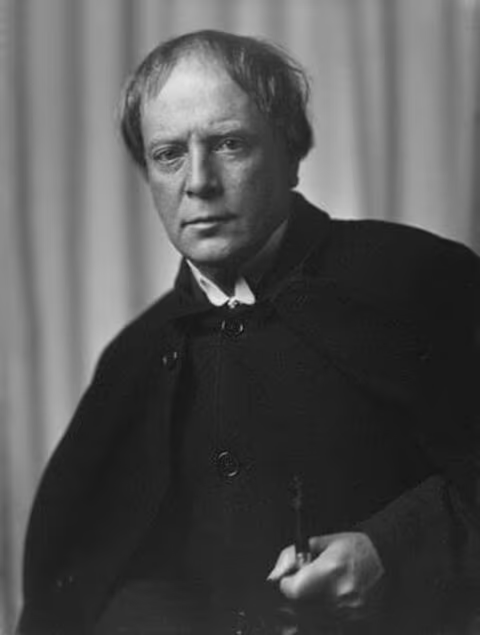
Quick Facts
Arthur Llewellyn Jones
Pen Name: Arthur Machen
Born: 3 March 1863
Died: 15 December 1947
Nationality: Welsh
Genres: Gothic, Horror, Fantasy
Notable Works: The Great God Pan, The Hill of Dreams, The White People, The Three Impostors, The Bowmen
👶 Early Life and Education
Arthur Llewellyn Jones was born on 3 March 1863 in Caerleon, Monmouthshire, Wales — a town steeped in Arthurian legend and Roman history that would profoundly shape his imagination. His father, John Edward Jones, was an Anglican clergyman who served as rector of the parish of Llanddewi Fach. The family later adopted the surname Machen (his mother's maiden name) to inherit a legacy, and Arthur would use the shortened form as his pen name throughout his career.
The ancient landscape of Gwent, with its Roman ruins and misty hills, imprinted itself on the young Machen's psyche. He attended Hereford Cathedral School, where he received a classical education steeped in Latin and Greek. Though academically capable, his family lacked the means to send him to university. At age seventeen, he moved to London to pursue a literary career, surviving on freelance translation work — including a notable rendition of Casanova's Memoirs.
📖 Literary Career and Breakthrough
Machen found his distinctive voice in the 1890s with a burst of supernatural fiction that would cement his reputation. His novella The Great God Pan (1890, revised 1894) scandalised critics with its blend of sexual content and cosmic horror, but it has since been recognised as one of the greatest horror stories ever written. H.P. Lovecraft praised it extravagantly: "No one could begin to describe the cumulative suspense and ultimate horror with which every paragraph abounds." Stephen King later called it "maybe the best [horror story] in the English language."
This productive decade also yielded The Three Impostors (1895), an episodic novel weaving together several chilling tales including The Novel of the White Powder and the celebrated The Novel of the Black Seal. The White People (1904) — a haunting first-person account of a young girl's encounters with ancient, pagan forces — is often ranked alongside The Great God Pan as one of the finest horror stories ever written.
Later works continued to explore new dimensions of Machen's vision. The Hill of Dreams (1907) is a hallucinatory portrait of a young writer consumed by visions of Roman Britain. The Terror (1917), written during World War I, imagines nature itself turning against humanity in a chilling allegory of the era's anxieties. The Secret Glory (1922), his most personal novel, channels his own schoolboy sufferings and mystical longings into a fierce indictment of institutional education.
🌿 Themes and Writing Style
Machen described himself as "a literary medium" who rejected realism in favour of revealing what he called "reality invisible." His fiction operates along two complementary axes: the mystical beauty of the Welsh landscape, offering spiritual transcendence; and the eruption of ancient, pre-human evil into the modern world. His prose moves between lyrical, visionary passages evoking the hills and valleys of Gwent and passages of mounting dread as his characters confront forces that shatter their understanding of reality.
His work shares thematic territory with contemporaries like Robert Louis Stevenson (Strange Case of Dr Jekyll and Mr Hyde), Bram Stoker (Dracula), and Oscar Wilde (The Picture of Dorian Gray) — all exploring the anxieties of late Victorian England about degeneration, the primitive, and the boundaries of human identity.
⚔️ The Bowmen and the Angels of Mons
In September 1914, weeks after the devastating British retreat from Mons, Machen published The Bowmen in The Evening News. The story depicted ghostly medieval archers, summoned by St. George, coming to the aid of beleaguered British soldiers. Readers took the fiction as fact, and the tale mutated into the legend of the "Angels of Mons" — one of the most enduring myths of World War I. Despite Machen's repeated insistence that the story was pure invention, the legend persisted. He later reflected ruefully: "If I had failed in the art of letters, I had succeeded, unwittingly, in the art of deceit."
The success of The Bowmen prompted Machen to write several more wartime supernatural tales, collected as The Bowmen and Other Legends of the War. These include The Soldiers' Rest, in which a wounded soldier finds divine comfort at a mysterious inn; The Monstrance, a vision of supernatural radiance in a village church; and The Dazzling Light, a tale of inexplicable lights over the battlefields of France.
✒️ Notable Works
- The Great God Pan (1894) — his most famous novella, a masterpiece of cosmic horror
- The Hill of Dreams (1907) — often considered his finest novel, a hallucinatory portrait of a young writer consumed by visions
- The White People (1904) — a haunting tale of innocence confronting ancient pagan forces
- The Three Impostors (1895) — an episodic horror novel containing some of his best short fiction
- The Bowmen (1914) — the story that spawned the Angels of Mons legend
- The Inmost Light (1894) — a dark tale of a scientist who captures his wife's soul in a jewel
- The Terror (1917) — a wartime supernatural mystery about nature's revolt against humanity
- The Secret Glory (1922) — a semi-autobiographical novel of mystical awakening against institutional cruelty
- The Novel of the Black Seal (1895) — a chilling tale of pre-human races surviving in the Welsh hills
❤️ Personal Life
In 1887, Machen married Amy Hogg, an independent woman deeply embedded in London's literary scene. Her death from cancer in 1899 devastated him. His recovery was aided by a dramatic change of career: in 1901, he joined Frank Benson's touring theatrical company as an actor, spending several years on the stage. He also briefly joined the Hermetic Order of the Golden Dawn through his friend A.E. Waite, though his involvement remained peripheral.
In 1903, he married Dorothie Purefoy Hudleston, a singer, and the couple had two children, Hilary and Janet. From 1910 to 1921, he worked as a journalist for The Evening News, where he published The Bowmen. In later years, financial struggles were eased somewhat by a Civil List pension granted in 1932. He died on 15 December 1947 in Amersham, Buckinghamshire, shortly after his second wife.
✨ Legacy and Influence
H.P. Lovecraft named Machen one of the four "modern masters" of supernatural horror in his essay Supernatural Horror in Literature, alongside Algernon Blackwood, Lord Dunsany, and M.R. James. His psycho-geographical approach to horror — rooting the supernatural in specific, evocative landscapes — influenced generations of writers from Lovecraft himself to modern authors like Ramsey Campbell and filmmakers like Guillermo del Toro, who has cited Machen as an influence on Pan's Labyrinth.
Oscar Wilde, William Butler Yeats, and Arthur Conan Doyle were all admirers of his work. Machen is featured in our Gothic Literature Study Guide and many of his stories appear in our Gothic, Ghost, Horror & Weird Library and Halloween Stories collections.
Frequently Asked Questions about Arthur Machen
Where can I find study guides for Arthur Machen's stories?
We offer free interactive study guides for the following Arthur Machen stories:
- The Bowmen — comprehension questions, vocabulary review, and discussion prompts
- The Inmost Light — comprehension questions, vocabulary review, and discussion prompts
- The Novel of the White Powder — comprehension questions, vocabulary review, and discussion prompts
What is Arthur Machen best known for?
Arthur Machen is best known for his supernatural horror fiction, particularly his novella The Great God Pan (1894), which Stephen King called "maybe the best [horror story] in the English language." He is also famous for The Bowmen (1914), a short story that readers mistook for fact, spawning the enduring World War I legend of the Angels of Mons.
How did Arthur Machen influence H.P. Lovecraft?
H.P. Lovecraft named Machen one of four "modern masters" of supernatural horror in his essay Supernatural Horror in Literature. Machen's technique of rooting cosmic terror in specific landscapes and his themes of ancient, pre-human evil directly shaped Lovecraft's own Cthulhu Mythos. Lovecraft described The Great God Pan as a work whose "cumulative suspense and ultimate horror" defied description.
What is the Angels of Mons legend?
The Angels of Mons legend originated from Machen's short story The Bowmen, published in The Evening News on 29 September 1914. The story depicted ghostly medieval archers aiding retreating British soldiers at the Battle of Mons. Readers believed it was a true account, and the tale evolved into reports of angelic beings on the battlefield — one of the most persistent myths of World War I.
What was Arthur Machen's writing style?
Machen described himself as "a literary medium" who rejected realism in favour of revealing an invisible reality behind the surface of the everyday world. His prose alternates between lyrical, visionary passages evoking the Welsh landscape and passages of escalating dread as characters confront ancient, inhuman forces. His work belongs to the late Victorian Gothic tradition alongside Robert Louis Stevenson and Bram Stoker.
When did Arthur Machen die and what was his cause of death?
Arthur Machen died on 15 December 1947 in Amersham, Buckinghamshire, at the age of 84. He had spent his final years in modest circumstances, though a Civil List pension granted in 1932 provided some financial relief. He died shortly after his second wife, Dorothie Purefoy Hudleston.
Was Arthur Machen a member of the Golden Dawn?
Yes, Machen briefly joined the Hermetic Order of the Golden Dawn around 1899 through the influence of his friend A.E. Waite. However, his involvement was peripheral and short-lived. His interest in mysticism and the occult informed his fiction — particularly the themes of hidden realities and ancient rituals — but he was not deeply committed to the order's practices.
What is "The Hill of Dreams" about?
The Hill of Dreams (1907) is often considered Machen's masterpiece. It follows Lucian Taylor, a young aspiring writer in rural Wales, who becomes consumed by ecstatic visions of the Roman past after falling asleep on an ancient hilltop fort. As he moves to London to pursue his literary ambitions, his visionary experiences intensify into hallucinatory obsession, blurring the boundary between creativity and madness.