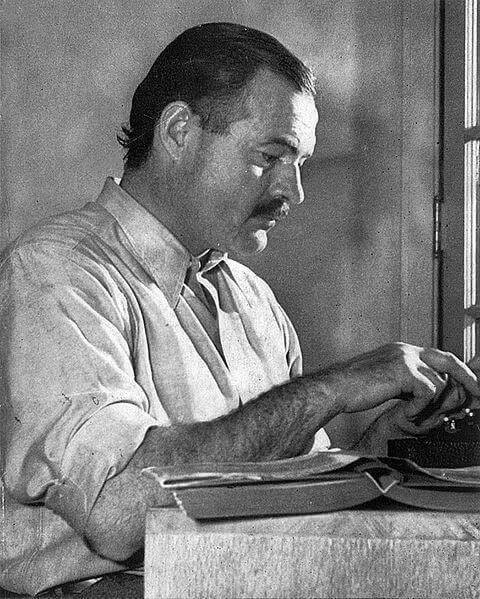
👶 Early Life and Education
Ernest Miller Hemingway was born on July 21, 1899, in Oak Park, Illinois, an affluent suburb of Chicago. His father, Clarence Hemingway, was a physician who instilled in young Ernest a love of the outdoors — hunting, fishing, and camping in northern Michigan — experiences that would deeply shape his fiction. His mother, Grace Hall-Hemingway, was a musician who pushed her son toward the arts. Hemingway attended Oak Park and River Forest High School, where he wrote for the school newspaper and literary magazine, showing early promise as a writer.
After graduating in 1917, Hemingway bypassed college and took a job as a cub reporter at the Kansas City Star. The paper's style guide — favoring short sentences, vigorous English, and the avoidance of adjectives — became the foundation of Hemingway's lean prose style. When the United States entered World War I, he volunteered as an ambulance driver for the American Red Cross in Italy. In July 1918, just weeks after arriving, he was severely wounded by mortar fire near Fossalta di Piave. He was only eighteen years old.
📖 Career and Literary Breakthrough
After the war, Hemingway returned to journalism and married Hadley Richardson in 1921. The couple moved to Paris, where Hemingway joined the expatriate literary community that Gertrude Stein famously dubbed "the Lost Generation." In the cafes and salons of 1920s Paris, he was mentored by Stein and Ezra Pound, befriended F. Scott Fitzgerald and John Dos Passos, and was encouraged by Ford Madox Ford and Sherwood Anderson.
His first major publication, Three Stories and Ten Poems (1923), was followed by In Our Time (1925), a groundbreaking story collection featuring the Nick Adams stories that announced a bold new voice in American fiction. Legend has it that Hemingway once bet a group of fellow writers he could write a meaningful story in just six words, and he won with: "For sale: baby shoes, never worn."
His first novel, The Sun Also Rises (1926), captured the disillusionment of the postwar generation through expatriates adrift in Paris and Pamplona. A Farewell to Arms (1929), a love story set against the Italian front in World War I, cemented his reputation as one of America's defining literary voices.
🌊 Writing Style and the Iceberg Theory
Hemingway's prose is among the most recognizable in the English language. His "Iceberg Theory" — also called the theory of omission — holds that the deeper meaning of a story should not be evident on the surface but should shine through implicitly. His experiences in war led him to abandon abstract language as empty, in favor of simplified, concrete actions. Short declarative sentences. Precise nouns. Unadorned verbs. As he put it: "There is nothing to writing. All you do is sit down at a typewriter and bleed."
This stripped-down style proved enormously influential, shaping generations of writers including William Faulkner's rival Mark Twain-influenced contemporaries and later writers like Raymond Carver and Cormac McCarthy. Hemingway himself acknowledged his debt to American tradition: "All modern American literature comes from one book by Mark Twain called Huckleberry Finn. There was nothing before. There has been nothing as good since."
✏️ Notable Works
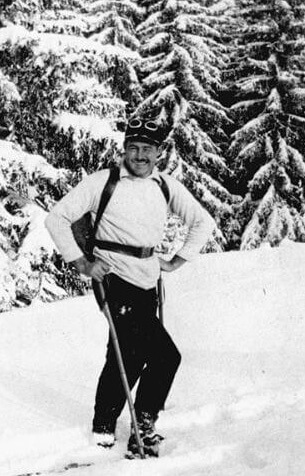
Hemingway's major novels include The Sun Also Rises (1926), A Farewell to Arms (1929), For Whom the Bell Tolls (1940), and The Old Man and the Sea (1952). Among his short story collections, In Our Time (1925), Men Without Women (1927), and Winner Take Nothing (1933) contain some of the finest short fiction ever written in English.
His most celebrated stories include Hills Like White Elephants, a masterclass in subtext and omission; The Killers, a taut crime story that influenced an entire genre; The Snows of Kilimanjaro, a meditation on regret and mortality; Indian Camp, a stark initiation into violence; and the two-part Big Two-Hearted River, in which what is not said carries more weight than what is. He received the Pulitzer Prize in 1953 and the Nobel Prize in Literature in 1954.
❤️ Personal Life
Hemingway participated in World War I as an ambulance driver until he was injured; served as a war correspondent during the Spanish Civil War; survived car accidents and plane crashes as well as mishaps on hunting and fishing expeditions. And if that wasn't enough danger for one man, he crowned it with an exclamation point by marrying four times: Hadley Richardson (1921–1927), Pauline Pfeiffer (1927–1940), Martha Gellhorn (1940–1945), and Mary Welsh (1946–1961).
With Hadley, he lived the bohemian Paris life later captured in his memoir A Moveable Feast. Pauline Pfeiffer, a fashion journalist, brought him to Key West, Florida, where he wrote prolifically and developed his passion for deep-sea fishing. His third wife, Martha Gellhorn, was one of the great war correspondents of the twentieth century; their marriage, characterized by competing ambitions, lasted only five years. He settled finally with Mary Welsh in Cuba and later Ketchum, Idaho.
✨ Death and Legacy
Hemingway's later years were marked by declining health, severe depression, and paranoid delusions exacerbated by alcoholism, traumatic brain injuries from his plane crashes, and hereditary hemochromatosis (iron overload). After two hospitalizations and electroshock treatments at the Mayo Clinic, he found he could no longer write. On July 2, 1961, at the age of 61, Hemingway died by suicide at his home in Ketchum, Idaho. The tragedy of suicide ran in the Hemingway family — his father, a brother, a sister, and later his granddaughter Margaux Hemingway also took their own lives.
Despite the darkness of his final years, Hemingway's literary legacy is towering. His economical prose style revolutionized modern fiction. His exploration of courage, loss, grace under pressure, and the human capacity for endurance resonates as powerfully today as when he first committed it to paper. We feature Hemingway in Pulitzer Prize Winners.