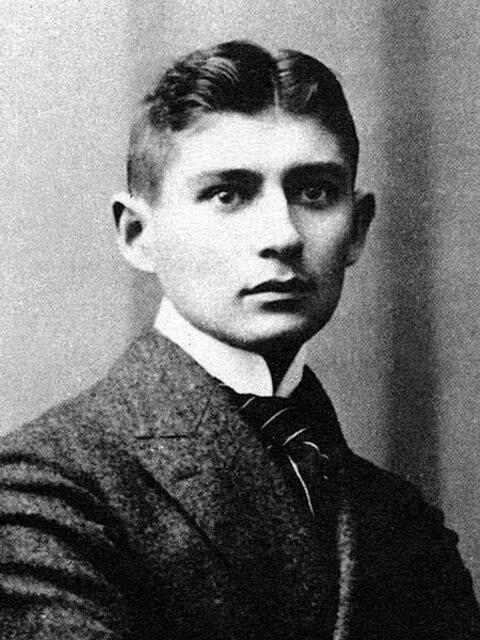
Quick Facts
Franz Kafka
Born: 3 July 1883
Died: 3 June 1924
Nationality: Czech
Genres: Modernism, Existentialism, Absurdism
Notable Works: The Metamorphosis, The Trial, The Castle, A Hunger Artist, In the Penal Colony
👶 Early Life and Education
Franz Kafka was born on July 3, 1883, in Prague, then part of the Austro-Hungarian Empire. He was the eldest surviving child of Hermann Kafka, a successful Czech-Jewish merchant, and Julie Kafka (née Löwy). Kafka’s fraught relationship with his domineering father would profoundly shape his writing — most directly in the autobiographical Letter to His Father (1919), a hundred-page indictment that was never delivered.
Kafka grew up speaking both German and Czech in a multilingual Prague. He studied law at the German Charles-Ferdinand University, earning his doctorate in 1906. His literary influences included Flaubert, Dostoevsky, Dickens, and Nietzsche — writers who explored guilt, alienation, and the absurdity of human institutions.
📖 Career and Literary Breakthrough
After completing his studies, Kafka took a position at the Workers’ Accident Insurance Institute for the Kingdom of Bohemia, where he investigated industrial injuries. He resented the job for consuming the time he needed for his true passion — writing — but the bureaucratic world he inhabited seeped into his fiction in unmistakable ways.
Kafka’s literary breakthrough came with The Judgment (1912), written in a single overnight session. That same year he began The Metamorphosis (German: Die Verwandlung), in which a man named Gregor Samsa wakes one morning to find himself transformed into a giant insect. Published in 1915, it remains one of the most read and analyzed works of twentieth-century literature.
✏️ Notable Works
The Trial (German: Der Process, published posthumously 1925) follows a bank clerk named Josef K. who is arrested and prosecuted by a mysterious authority for an unspecified crime. The novel gave the world the term “Kafkaesque” — now used to describe nightmarish, illogical bureaucratic situations where individuals are powerless against opaque systems.
The Castle (German: Das Schloss, published posthumously 1926) tells of a land surveyor who arrives in a village governed by an impenetrable castle bureaucracy and can never gain access to the authorities who summoned him.
Among his finest short stories are In the Penal Colony (1919), a harrowing tale of an elaborate execution machine; A Hunger Artist (1922), about a professional faster whose art is forgotten by the public; and Before the Law (1915), a parable about a man who waits a lifetime for admission to the Law through a door that was meant only for him.
🎭 Writing Style
Kafka wrote in a precise, matter-of-fact German prose that makes the impossible seem grimly plausible. His stories typically place ordinary people in surreal, threatening situations — inexplicable transformations, impenetrable bureaucracies, arbitrary punishments — and describe their struggles with an almost clinical detachment. The effect is simultaneously horrifying and darkly comic, capturing a sense of modern alienation that feels as urgent today as it did a century ago.
❤️ Personal Life and Death
Kafka’s personal life was marked by intense but often tormented relationships. He was twice engaged to Felice Bauer, a Berlin businesswoman, but broke off both engagements. He later had a passionate correspondence with Czech journalist and translator Milena Jesenská. In his final year, he found happiness with Dora Diamant, a young Polish-Jewish woman with whom he lived in Berlin.
Kafka was diagnosed with tuberculosis in 1917. The disease eventually spread to his larynx, making it excruciatingly painful to eat or speak. He died on June 3, 1924, at a sanatorium near Vienna, at the age of forty.
✨ Legacy
Before his death, Kafka asked his closest friend, Max Brod, to burn all his unpublished manuscripts. Brod refused, and instead edited and published The Trial, The Castle, and Amerika, ensuring that works Kafka considered unfinished reached the world. Today Kafka is recognized as one of the most important writers of the twentieth century, and the word “Kafkaesque” has entered dozens of languages as shorthand for the absurd, alienating, and nightmarishly bureaucratic.
“A book must be the axe for the frozen sea within us.”
Frequently Asked Questions about Franz Kafka
Where can I find study guides for Franz Kafka's stories?
We offer free interactive study guides for the following Franz Kafka stories:
- A Hunger Artist — comprehension questions, vocabulary review, and discussion prompts
- Before the Law — comprehension questions, vocabulary review, and discussion prompts
- In the Penal Colony — comprehension questions, vocabulary review, and discussion prompts