The Hand
by Guy de Maupassant
The Hand (1883) is a gruesome and creepy story about the mystery surrounding the death of an enigmatic Englishman named Sir John Rowell. The good sir, it seems, was fond of hunting. Quite fond. And Maupassant drops a solitary creepy line on the reader to emphasize the point, 'I have also frequently been man-hunting.' I find this story rather unnerving. If scary campfire stories are your thing, you are going to enjoy this popular horror story.
This story is featured in our collection of Halloween Stories and our Gothic Literature Study Guide.
All were crowding around M. Bermutier, the judge, who was giving his opinion about the Saint-Cloud mystery. For a month this inexplicable crime had been the talk of Paris. Nobody could make head or tail of it.
M. Bermutier, standing with his back to the fireplace, was talking, citing the evidence, discussing the various theories, but arriving at no conclusion.
Some women had risen, in order to get nearer to him, and were standing with their eyes fastened on the clean-shaven face of the judge, who was saying such weighty things. They, were shaking and trembling, moved by fear and curiosity, and by the eager and insatiable desire for the horrible, which haunts the soul of every woman. One of them, paler than the others, said during a pause:
"It's terrible. It verges on the supernatural. The truth will never be known."
The judge turned to her:
"True, madame, it is likely that the actual facts will never be discovered. As for the word 'supernatural' which you have just used, it has nothing to do with the matter. We are in the presence of a very cleverly conceived and executed crime, so well enshrouded in mystery that we cannot disentangle it from the involved circumstances which surround it. But once I had to take charge of an affair in which the uncanny seemed to play a part. In fact, the case became so confused that it had to be given up."
Several women exclaimed at once:
"Oh! Tell us about it!"
M. Bermutier smiled in a dignified manner, as a judge should, and went on:
"Do not think, however, that I, for one minute, ascribed anything in the case to supernatural influences. I believe only in normal causes. But if, instead of using the word 'supernatural' to express what we do not understand, we were simply to make use of the word 'inexplicable,' it would be much better. At any rate, in the affair of which I am about to tell you, it is especially the surrounding, preliminary circumstances which impressed me. Here are the facts:
"I was, at that time, a judge at Ajaccio, a little white city on the edge of a bay which is surrounded by high mountains.
"The majority of the cases which came up before me concerned vendettas. There are some that are superb, dramatic, ferocious, heroic. We find there the most beautiful causes for revenge of which one could dream, enmities hundreds of years old, quieted for a time but never extinguished; abominable stratagems, murders becoming massacres and almost deeds of glory. For two years I heard of nothing but the price of blood, of this terrible Corsican prejudice which compels revenge for insults meted out to the offending person and all his descendants and relatives. I had seen old men, children, cousins murdered; my head was full of these stories.
"One day I learned that an Englishman had just hired a little villa at the end of the bay for several years. He had brought with him a French servant, whom he had engaged on the way at Marseilles.
"Soon this peculiar person, living alone, only going out to hunt and fish, aroused a widespread interest. He never spoke to any one, never went to the town, and every morning he would practice for an hour or so with his revolver and rifle.
"Legends were built up around him. It was said that he was some high personage, fleeing from his fatherland for political reasons; then it was affirmed that he was in hiding after having committed some abominable crime. Some particularly horrible circumstances were even mentioned.
"In my judicial position I thought it necessary to get some information about this man, but it was impossible to learn anything. He called himself Sir John Rowell.
"I therefore had to be satisfied with watching him as closely as I could, but I could see nothing suspicious about his actions.
"However, as rumors about him were growing and becoming more widespread, I decided to try to see this stranger myself, and I began to hunt regularly in the neighborhood of his grounds.
"For a long time I watched without finding an opportunity. At last it came to me in the shape of a partridge which I shot and killed right in front of the Englishman. My dog fetched it for me, but, taking the bird, I went at once to Sir John Rowell and, begging his pardon, asked him to accept it.
"He was a big man, with red hair and beard, very tall, very broad, a kind of calm and polite Hercules. He had nothing of the so-called British stiffness, and in a broad English accent he thanked me warmly for my attention. At the end of a month we had had five or six conversations.
"One night, at last, as I was passing before his door, I saw him in the garden, seated astride a chair, smoking his pipe. I bowed and he invited me to come in and have a glass of beer. I needed no urging.
"He received me with the most punctilious English courtesy, sang the praises of France and of Corsica, and declared that he was quite in love with this country.
"Then, with great caution and under the guise of a vivid interest, I asked him a few questions about his life and his plans. He answered without embarrassment, telling me that he had travelled a great deal in Africa, in the Indies, in America. He added, laughing:
"'I have had many adventures.'
"Then I turned the conversation on hunting, and he gave me the most curious details on hunting the hippopotamus, the tiger, the elephant and even the gorilla.
"I said:
"'Are all these animals dangerous?'
"He smiled:
"'Oh, no! Man is the worst.'
"And he laughed a good broad laugh, the wholesome laugh of a contented Englishman.
"'I have also frequently been man-hunting.'
"Then he began to talk about weapons, and he invited me to come in and see different makes of guns.
"His parlor was draped in black, black silk embroidered in gold. Big yellow flowers, as brilliant as fire, were worked on the dark material.
"He said:
"'It is a Japanese material.'
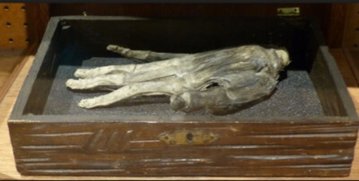
"But in the middle of the widest panel a strange thing attracted my attention. A black object stood out against a square of red velvet. I went up to it; it was a hand, a human hand. Not the clean white hand of a skeleton, but a dried black hand, with yellow nails, the muscles exposed and traces of old blood on the bones, which were cut off as clean as though it had been chopped off with an axe, near the middle of the forearm.
"Around the wrist, an enormous iron chain, riveted and soldered to this unclean member, fastened it to the wall by a ring, strong enough to hold an elephant in leash.
"I asked:
"'What is that?'
"The Englishman answered quietly:
"'That is my best enemy. It comes from America, too. The bones were severed by a sword and the skin cut off with a sharp stone and dried in the sun for a week.'
"I touched these human remains, which must have belonged to a giant. The uncommonly long fingers were attached by enormous tendons which still had pieces of skin hanging to them in places. This hand was terrible to see; it made one think of some savage vengeance.
"I said:
"'This man must have been very strong.'
"The Englishman answered quietly:
"'Yes, but I was stronger than he. I put on this chain to hold him.'
"I thought that he was joking. I said:
"'This chain is useless now, the hand won't run away.'
"Sir John Rowell answered seriously:
"'It always wants to go away. This chain is needed.'
"I glanced at him quickly, questioning his face, and I asked myself:
"'Is he an insane man or a practical joker?'
"But his face remained inscrutable, calm and friendly. I turned to other subjects, and admired his rifles.
"However, I noticed that he kept three loaded revolvers in the room, as though constantly in fear of some attack.
"I paid him several calls. Then I did not go any more. People had become used to his presence; everybody had lost interest in him.
"A whole year rolled by. One morning, toward the end of November, my servant awoke me and announced that Sir John Rowell had been murdered during the night.
"Half an hour later I entered the Englishman's house, together with the police commissioner and the captain of the gendarmes. The servant, bewildered and in despair, was crying before the door. At first I suspected this man, but he was innocent.
"The guilty party could never be found.
"On entering Sir John's parlor, I noticed the body, stretched out on its back, in the middle of the room.
"His vest was torn, the sleeve of his jacket had been pulled off, everything pointed to, a violent struggle.
"The Englishman had been strangled! His face was black, swollen and frightful, and seemed to express a terrible fear. He held something between his teeth, and his neck, pierced by five or six holes which looked as though they had been made by some iron instrument, was covered with blood.
"A physician joined us. He examined the finger marks on the neck for a long time and then made this strange announcement:
"'It looks as though he had been strangled by a skeleton.'
"A cold chill seemed to run down my back, and I looked over to where I had formerly seen the terrible hand. It was no longer there. The chain was hanging down, broken.
"I bent over the dead man and, in his contracted mouth, I found one of the fingers of this vanished hand, cut--or rather sawed off by the teeth down to the second knuckle.
"Then the investigation began. Nothing could be discovered. No door, window or piece of furniture had been forced. The two watch dogs had not been aroused from their sleep.
"Here, in a few words, is the testimony of the servant:
"For a month his master had seemed excited. He had received many letters, which he would immediately burn.
"Often, in a fit of passion which approached madness, he had taken a switch and struck wildly at this dried hand riveted to the wall, and which had disappeared, no one knows how, at the very hour of the crime.
"He would go to bed very late and carefully lock himself in. He always kept weapons within reach. Often at night he would talk loudly, as though he were quarrelling with some one.
"That night, somehow, he had made no noise, and it was only on going to open the windows that the servant had found Sir John murdered. He suspected no one.
"I communicated what I knew of the dead man to the judges and public officials. Throughout the whole island a minute investigation was carried on. Nothing could be found out.
"One night, about three months after the crime, I had a terrible nightmare. I seemed to see the horrible hand running over my curtains and walls like an immense scorpion or spider. Three times I awoke, three times I went to sleep again; three times I saw the hideous object galloping round my room and moving its fingers like legs.
"The following day the hand was brought me, found in the cemetery, on the grave of Sir John Rowell, who had been buried there because we had been unable to find his family. The first finger was missing.
"Ladies, there is my story. I know nothing more."
The women, deeply stirred, were pale and trembling. One of them exclaimed:
"But that is neither a climax nor an explanation! We will be unable to sleep unless you give us your opinion of what had occurred."
The judge smiled severely:
"Oh! Ladies, I shall certainly spoil your terrible dreams. I simply believe that the legitimate owner of the hand was not dead, that he came to get it with his remaining one. But I don't know how. It was a kind of vendetta."
One of the women murmured:
"No, it can't be that."
And the judge, still smiling, said:
"Didn't I tell you that my explanation would not satisfy you?"
Frequently Asked Questions
What is "The Hand" by Guy de Maupassant about?
"The Hand" (1883) is a Gothic horror tale told through a frame narrative. At a Parisian gathering, Judge Bermutier recounts a mysterious case from his days as a magistrate in Corsica. He befriended a reclusive Englishman named Sir John Rowell who kept a severed, dried human hand chained to the wall of his parlor—a trophy from an unnamed enemy. A year later, Sir John was found strangled in his locked home, the hand and its broken chain missing. The hand was eventually discovered on Sir John’s grave with one finger gone—the same finger found bitten off in the dead man’s mouth. Bermutier offers a rational explanation (the hand’s original owner came for revenge), but the listeners remain unsatisfied, and the truth is left deliberately ambiguous.
What are the main themes of "The Hand"?
The story explores several interlocking themes. The supernatural versus the rational is the central tension—Judge Bermutier insists on a logical explanation, but every detail points toward something inexplicable. Revenge and vendetta permeate the setting, from the Corsican blood feuds that surround the narrator to Sir John’s own trophy and its implied backstory. Obsession and guilt surface in Sir John’s behavior: he keeps loaded revolvers nearby, argues with unseen presences at night, and strikes the hand in fits of rage. The unknowable ties everything together—Maupassant deliberately refuses closure, forcing readers to sit with uncertainty.
What is the significance of the severed hand in the story?
The severed hand operates on multiple symbolic levels. As a physical trophy, it represents Sir John’s violent past and his domination over a defeated enemy. The iron chain binding it to the wall suggests that Sir John fears the hand—or what it represents—may return, transforming a hunting trophy into a symbol of unresolved guilt. When Sir John tells Bermutier "It always wants to go away," the hand becomes an emblem of revenge that cannot be contained. Its disappearance during the murder and reappearance on Sir John’s grave completes its role as an instrument of poetic justice, whether supernatural or human in origin.
Who is Sir John Rowell in "The Hand"?
Sir John Rowell is a mysterious Englishman who has settled in a remote villa near Ajaccio, Corsica. He is described as a tall, broad, red-haired man—"a calm and polite Hercules"—who lives alone with a French servant, practices daily with firearms, and never visits town. He claims to have traveled extensively in Africa, India, and America, and hints that he has hunted men as well as animals. His parlor is decorated in black Japanese silk, and on one wall he displays a dried human hand chained in place. Over time Sir John grows increasingly agitated, burning letters and arguing with invisible presences, until he is found strangled in his locked room. His true identity and the full story of how he obtained the hand are never revealed.
What literary devices does Maupassant use in "The Hand"?
Maupassant employs a rich array of literary techniques. The frame narrative—a story within a story told at a social gathering—creates distance and unreliability, since readers only have Bermutier’s account. Foreshadowing appears in Sir John’s loaded revolvers, his declaration that "man is the worst" prey, and his insistence that the chain is necessary. Gothic atmosphere is built through the black silk parlor, the dried hand on red velvet, and the Corsican setting known for vendettas. Irony pervades the ending: the rational judge cannot actually explain the crime, and his "rational" theory is no less bizarre than a supernatural one. Maupassant also uses simile to disturbing effect, comparing the hand in Bermutier’s nightmare to "an immense scorpion or spider."
How does Sir John Rowell die in "The Hand"?
Sir John is found strangled to death in his locked parlor. His vest is torn, his jacket sleeve ripped off, and his black, swollen face bears an expression of terrible fear. His neck is pierced by five or six holes "which looked as though they had been made by some iron instrument," and a physician concludes it looks as though he was strangled by a skeleton. The chain that held the severed hand to the wall is broken, and the hand itself is gone. Clenched between Sir John’s teeth is a single finger, bitten clean through to the second knuckle. No door, window, or piece of furniture shows signs of forced entry, and the watchdogs slept through the night undisturbed.
What is the ending of "The Hand" by Maupassant?
The ending operates on two levels. Within the inner story, the severed hand is found three months after the murder on Sir John’s grave, with one finger missing—matching the finger found in his mouth. In the frame narrative, Judge Bermutier offers a rational explanation: the hand’s original owner was not truly dead and came to reclaim it, making the murder "a kind of vendetta." The women listening reject this explanation as inadequate, and Bermutier smiles and says, "Didn’t I tell you that my explanation would not satisfy you?" The story ends without resolution, leaving the reader to decide whether the hand acted on its own or whether a living avenger carried out the killing.
What is the role of the frame narrative in "The Hand"?
The frame narrative serves multiple purposes. By having Judge Bermutier tell his story at a Parisian salon, Maupassant creates a social context of performance—the judge is entertaining an audience, which raises questions about embellishment and reliability. The frame also establishes a tension between rational authority and supernatural possibility: Bermutier is a man of law and logic, yet his own story defies explanation. The listeners’ dissatisfied reaction at the end mirrors the reader’s own frustration, and Bermutier’s knowing smile suggests he recognizes that some events resist tidy explanations. The device also allows Maupassant to comment meta-fictionally on horror storytelling itself—the audience craves supernatural terror, just as readers of Gothic fiction do.
How is "The Hand" related to Maupassant’s earlier story "The Flayed Hand"?
"The Hand" (1883) is a more mature reworking of Maupassant’s earlier tale "The Flayed Hand" (La Main d’écorché, 1875), written when he was only twenty-five. Both stories center on a severed hand that seems to take supernatural revenge. However, the later version is significantly more sophisticated: it replaces the student setting with Corsica and its vendetta culture, adds the frame narrative structure, and introduces the deliberate ambiguity between rational and supernatural explanations that makes "The Hand" a more complex and enduring work. The revision demonstrates Maupassant’s artistic growth from a promising young writer into a master craftsman of the short story form.
What is the setting of "The Hand" and why does it matter?
The story has two settings that work in contrast. The outer frame takes place in a comfortable Parisian salon, where well-dressed guests discuss a recent crime—a civilized, rational world. The inner story unfolds in Ajaccio, Corsica, a place Bermutier describes as dominated by vendettas, blood feuds, and centuries-old cycles of revenge. This Corsican setting is essential: it provides a cultural context where violent retribution is normalized, making the idea of a supernatural vendetta feel almost plausible. Sir John’s isolated villa at the edge of the bay, surrounded by mountains, reinforces his role as an outsider harboring dark secrets. The contrast between Parisian rationality and Corsican wildness mirrors the story’s central tension between logic and the inexplicable.
Save stories, build your reading list, and access all study tools — completely free.
Save The Hand to your library — it's free!Need help with The Hand?
Study tools to help with homework, prepare for quizzes, and deepen your understanding.
Flashcards →