The Outsider
by H. P. Lovecraft
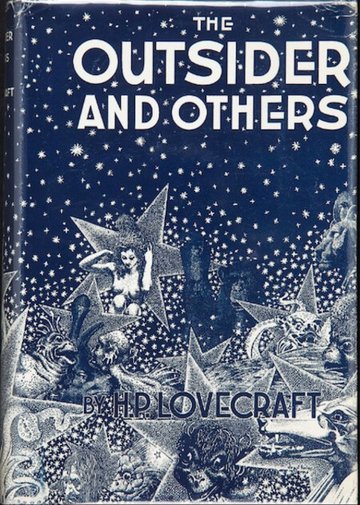
H.P. Lovecraft wrote The Outsider in 1921, first published in Weird Tales magazine, April 1926.
Unhappy is he to whom the memories of childhood bring only fear and sadness. Wretched is he who looks back upon lone hours in vast and dismal chambers with brown hangings and maddening rows of antique books, or upon awed watches in twilight groves of grotesque, gigantic, and vine-encumbered trees that silently wave twisted branches far aloft. Such a lot the gods gave to me—to me, the dazed, the disappointed; the barren, the broken. And yet I am strangely content and cling desperately to those sere memories, when my mind momentarily threatens to reach beyond to the other.
I know not where I was born, save that the castle was infinitely old and infinitely horrible, full of dark passages and having high ceilings where the eye could find only cobwebs and shadows. The stones in the crumbling corridors seemed always hideously damp, and there was an accursed smell everywhere, as of the piled-up corpses of dead generations. It was never light, so that I used sometimes to light candles and gaze steadily at them for relief, nor was there any sun outdoors, since the terrible trees grew high above the topmost accessible tower. There was one black tower which reached above the trees into the unknown outer sky, but that was partly ruined and could not be ascended save by a well-nigh impossible climb up the sheer wall, stone by stone.
I must have lived years in this place, but I cannot measure the time. Beings must have cared for my needs, yet I cannot recall any person except myself, or anything alive but the noiseless rats and bats and spiders. I think that whoever nursed me must have been shockingly aged, since my first conception of a living person was that of somebody mockingly like myself, yet distorted, shrivelled, and decaying like the castle. To me there was nothing grotesque in the bones and skeletons that strewed some of the stone crypts deep down among the foundations. I fantastically associated these things with everyday events, and thought them more natural than the coloured pictures of living beings which I found in many of the mouldy books. From such books I learned all that I know. No teacher urged or guided me, and I do not recall hearing any human voice in all those years—not even my own; for although I had read of speech, I had never thought to try to speak aloud. My aspect was a matter equally unthought of, for there were no mirrors in the castle, and I merely regarded myself by instinct as akin to the youthful figures I saw drawn and painted in the books. I felt conscious of youth because I remembered so little.
Outside, across the putrid moat and under the dark mute trees, I would often lie and dream for hours about what I read in the books; and would longingly picture myself amidst gay crowds in the sunny world beyond the endless forests. Once I tried to escape from the forest, but as I went farther from the castle the shade grew denser and the air more filled with brooding fear; so that I ran frantically back lest I lose my way in a labyrinth of nighted silence.
So through endless twilights I dreamed and waited, though I knew not what I waited for. Then in the shadowy solitude my longing for light grew so frantic that I could rest no more, and I lifted entreating hands to the single black ruined tower that reached above the forest into the unknown outer sky. And at last I resolved to scale that tower, fall though I might; since it were better to glimpse the sky and perish, than to live without ever beholding day.
In the dank twilight I climbed the worn and aged stone stairs till I reached the level where they ceased, and thereafter clung perilously to small footholds leading upward. Ghastly and terrible was that dead, stairless cylinder of rock; black, ruined, and deserted, and sinister with startled bats whose wings made no noise. But more ghastly and terrible still was the slowness of my progress; for climb as I might, the darkness overhead grew no thinner, and a new chill as of haunted and venerable mould assailed me. I shivered as I wondered why I did not reach the light, and would have looked down had I dared. I fancied that night had come suddenly upon me, and vainly groped with one free hand for a window embrasure, that I might peer out and above, and try to judge the height I had once attained.
All at once, after an infinity of awesome, sightless, crawling up that concave and desperate precipice, I felt my head touch a solid thing, and I knew I must have gained the roof, or at least some kind of floor. In the darkness I raised my free hand and tested the barrier, finding it stone and immovable. Then came a deadly circuit of the tower, clinging to whatever holds the slimy wall could give; till finally my testing hand found the barrier yielding, and I turned upward again, pushing the slab or door with my head as I used both hands in my fearful ascent. There was no light revealed above, and as my hands went higher I knew that my climb was for the nonce ended; since the slab was the trapdoor of an aperture leading to a level stone surface of greater circumference than the lower tower, no doubt the floor of some lofty and capacious observation chamber. I crawled through carefully, and tried to prevent the heavy slab from falling back into place, but failed in the latter attempt. As I lay exhausted on the stone floor I heard the eerie echoes of its fall, hoped when necessary to pry it up again.
Believing I was now at prodigious height, far above the accursed branches of the wood, I dragged myself up from the floor and fumbled about for windows, that I might look for the first time upon the sky, and the moon and stars of which I had read. But on every hand I was disappointed; since all that I found were vast shelves of marble, bearing odious oblong boxes of disturbing size. More and more I reflected, and wondered what hoary secrets might abide in this high apartment so many aeons cut off from the castle below. Then unexpectedly my hands came upon a doorway, where hung a portal of stone, rough with strange chiselling. Trying it, I found it locked; but with a supreme burst of strength I overcame all obstacles and dragged it open inward. As I did so there came to me the purest ecstasy I have ever known; for shining tranquilly through an ornate grating of iron, and down a short stone passageway of steps that ascended from the newly found doorway, was the radiant full moon, which I had never before seen save in dreams and in vague visions I dared not call memories.
Fancying now that I had attained the very pinnacle of the castle, I commenced to rush up the few steps beyond the door; but the sudden veiling of the moon by a cloud caused me to stumble, and I felt my way more slowly in the dark. It was still very dark when I reached the grating—which I tried carefully and found unlocked, but which I did not open for fear of falling from the amazing height to which I had climbed. Then the moon came out.
Most demoniacal of all shocks is that of the abysmally unexpected and grotesquely unbelievable. Nothing I had before undergone could compare in terror with what I now saw; with the bizarre marvels that sight implied. The sight itself was as simple as it was stupefying, for it was merely this: instead of a dizzying prospect of treetops seen from a lofty eminence, there stretched around me on the level through the grating nothing less than the solid ground, decked and diversified by marble slabs and columns, and overshadowed by an ancient stone church, whose ruined spire gleamed spectrally in the moonlight.
Half unconscious, I opened the grating and staggered out upon the white gravel path that stretched away in two directions. My mind, stunned and chaotic as it was, still held the frantic craving for light; and not even the fantastic wonder which had happened could stay my course. I neither knew nor cared whether my experience was insanity, dreaming, or magic; but was determined to gaze on brilliance and gaiety at any cost. I knew not who I was or what I was, or what my surroundings might be; though as I continued to stumble along I became conscious of a kind of fearsome latent memory that made my progress not wholly fortuitous. I passed under an arch out of that region of slabs and columns, and wandered through the open country; sometimes following the visible road, but sometimes leaving it curiously to tread across meadows where only occasional ruins bespoke the ancient presence of a forgotten road. Once I swam across a swift river where crumbling, mossy masonry told of a bridge long vanished.
Over two hours must have passed before I reached what seemed to be my goal, a venerable ivied castle in a thickly wooded park, maddeningly familiar, yet full of perplexing strangeness to me. I saw that the moat was filled in, and that some of the well-known towers were demolished, whilst new wings existed to confuse the beholder. But what I observed with chief interest and delight were the open windows—gorgeously ablaze with light and sending forth sound of the gayest revelry. Advancing to one of these I looked in and saw an oddly dressed company indeed; making merry, and speaking brightly to one another. I had never, seemingly, heard human speech before and could guess only vaguely what was said. Some of the faces seemed to hold expressions that brought up incredibly remote recollections, others were utterly alien.
I now stepped through the low window into the brilliantly lighted room, stepping as I did so from my single bright moment of hope to my blackest convulsion of despair and realization. The nightmare was quick to come, for as I entered, there occurred immediately one of the most terrifying demonstrations I had ever conceived. Scarcely had I crossed the sill when there descended upon the whole company a sudden and unheralded fear of hideous intensity, distorting every face and evoking the most horrible screams from nearly every throat. Flight was universal, and in the clamour and panic several fell in a swoon and were dragged away by their madly fleeing companions. Many covered their eyes with their hands, and plunged blindly and awkwardly in their race to escape, overturning furniture and stumbling against the walls before they managed to reach one of the many doors.
The cries were shocking; and as I stood in the brilliant apartment alone and dazed, listening to their vanishing echoes, I trembled at the thought of what might be lurking near me unseen. At a casual inspection the room seemed deserted, but when I moved towards one of the alcoves I thought I detected a presence there—a hint of motion beyond the golden-arched doorway leading to another and somewhat similar room. As I approached the arch I began to perceive the presence more clearly; and then, with the first and last sound I ever uttered—a ghastly ululation that revolted me almost as poignantly as its noxious cause—I beheld in full, frightful vividness the inconceivable, indescribable, and unmentionable monstrosity which had by its simple appearance changed a merry company to a herd of delirious fugitives.
I cannot even hint what it was like, for it was a compound of all that is unclean, uncanny, unwelcome, abnormal, and detestable. It was the ghoulish shade of decay, antiquity, and dissolution; the putrid, dripping eidolon of unwholesome revelation, the awful baring of that which the merciful earth should always hide. God knows it was not of this world—or no longer of this world—yet to my horror I saw in its eaten-away and bone-revealing outlines a leering, abhorrent travesty on the human shape; and in its mouldy, disintegrating apparel an unspeakable quality that chilled me even more.
I was almost paralysed, but not too much so to make a feeble effort towards flight; a backward stumble which failed to break the spell in which the nameless, voiceless monster held me. My eyes bewitched by the glassy orbs which stared loathsomely into them, refused to close; though they were mercifully blurred, and showed the terrible object but indistinctly after the first shock. I tried to raise my hand to shut out the sight, yet so stunned were my nerves that my arm could not fully obey my will. The attempt, however, was enough to disturb my balance; so that I had to stagger forward several steps to avoid falling. As I did so I became suddenly and agonizingly aware of the nearness of the carrion thing, whose hideous hollow breathing I half fancied I could hear. Nearly mad, I found myself yet able to throw out a hand to ward off the foetid apparition which pressed so close; when in one cataclysmic second of cosmic nightmarishness and hellish accident my fingers touched the rotting outstretched paw of the monster beneath the golden arch.
I did not shriek, but all the fiendish ghouls that ride the nightwind shrieked for me as in that same second there crashed down upon my mind a single fleeting avalanche of soul-annihilating memory. I knew in that second all that had been; I remembered beyond the frightful castle and the trees, and recognized the altered edifice in which I now stood; I recognized, most terrible of all, the unholy abomination that stood leering before me as I withdrew my sullied fingers from its own.
But in the cosmos there is balm as well as bitterness, and that balm is nepenthe. In the supreme horror of that second I forgot what had horrified me, and the burst of black memory vanished in a chaos of echoing images. In a dream I fled from that haunted and accursed pile, and ran swiftly and silently in the moonlight. When I returned to the churchyard place of marble and went down the steps I found the stone trap-door immovable; but I was not sorry, for I had hated the antique castle and the trees. Now I ride with the mocking and friendly ghouls on the night-wind, and play by day amongst the catacombs of Nephren-Ka in the sealed and unknown valley of Hadoth by the Nile. I know that light is not for me, save that of the moon over the rock tombs of Neb, nor any gaiety save the unnamed feasts of Nitokris beneath the Great Pyramid; yet in my new wildness and freedom I almost welcome the bitterness of alienage.
For although nepenthe has calmed me, I know always that I am an outsider; a stranger in this century and among those who are still men. This I have known ever since I stretched out my fingers to the abomination within that great gilded frame; stretched out my fingers and touched a cold and unyielding surface of polished glass.
Frequently Asked Questions
What is "The Outsider" by H.P. Lovecraft about?
The Outsider by follows an unnamed narrator who has spent his entire life alone in a dark, decaying castle surrounded by impenetrable forests. Desperate for light and human contact, he climbs a seemingly endless black tower, only to emerge not at a great height but at ground level in a churchyard. He wanders to a nearby castle where a lively gathering is taking place, but when he enters, the partygoers flee in absolute terror. The narrator then encounters what he believes is a hideous monster—only to realize, when his fingers touch cold polished glass, that he has been looking at his own reflection in a mirror. The story is a masterful Gothic tale about identity, isolation, and the horror of self-discovery.
What is the twist ending of "The Outsider" by Lovecraft?
The twist ending of The Outsider is one of the most celebrated reveals in horror fiction. After the narrator enters a party and causes everyone to flee in terror, he sees a monstrous, decaying figure standing in an archway. When he reaches out to touch the creature, his fingers meet "a cold and unyielding surface of polished glass"—he has been looking into a mirror the entire time. The horrifying monster that scattered the partygoers was the narrator himself, a ghoulish, undead being who never knew his own appearance because there were no mirrors in the castle where he grew up. This revelation recontextualizes the entire story, suggesting the narrator has been dead—or something other than human—all along.
What are the main themes in Lovecraft's "The Outsider"?
The central themes of The Outsider include isolation and loneliness, as the narrator has spent his entire existence in complete solitude with no memory of another living person. The story also explores identity and self-knowledge—the narrator constructs an image of himself from books, imagining he looks like the youthful figures in illustrations, only to discover his true monstrous nature. Alienation and the fear of rejection pervade the narrative, as the narrator's one attempt at human connection results in universal horror and flight. Finally, weaves in themes of death and the afterlife, as the narrator appears to be an undead being who ultimately finds community only among ghouls and in the tombs of ancient Egypt.
What does the mirror symbolize in "The Outsider"?
The mirror in The Outsider is the story's most powerful symbol, representing self-knowledge and the shattering of illusion. Throughout the tale, the narrator imagines himself as a normal, youthful person because there were no mirrors in his underground castle—his self-image came entirely from illustrations in old books. When he finally encounters the "golden-arched doorway" that turns out to be a gilded mirror frame, he is forced to confront his true identity as a decayed, ghoulish creature. The mirror thus symbolizes the traumatic moment when self-deception collapses and one must face an unbearable truth. uses the reveal to suggest that the most terrifying discovery is not an external monster but what we might find when we truly see ourselves.
How is "The Outsider" influenced by Edgar Allan Poe?
himself acknowledged that The Outsider was his most Poe-influenced work, calling it "my literal though unconscious imitation of Poe at its very height." The story's first-person Gothic narration, ornate 19th-century prose style, and atmosphere of mounting psychological dread closely echo Poe's tales such as The Fall of the House of Usher and The Masque of the Red Death. The theme of a narrator who is unreliable about his own nature—and the horrifying climactic revelation—also recalls Poe's technique of psychological horror rooted in subjective perception. Both writers use crumbling architecture, claustrophobic settings, and dense descriptive language to externalize inner states of decay and alienation.
What literary devices does Lovecraft use in "The Outsider"?
employs several key literary devices in The Outsider. The first-person unreliable narrator is central—the reader experiences events filtered through a consciousness that fundamentally misunderstands its own nature. Dramatic irony builds as clues accumulate (the corpse-strewn crypts, the absence of mirrors, emerging from underground at ground level) that the reader may grasp before the narrator does. Lovecraft's imagery and diction create an atmosphere of Gothic oppression, with words like "putrid," "foetid," "mouldy," and "carrion" reinforcing themes of death and decay. The story also uses foreshadowing extensively—the narrator's childhood among skeletons and his caretaker described as "distorted, shrivelled, and decaying" hint at his true undead nature long before the mirror reveal.
What does the castle and tower symbolize in "The Outsider"?
The dark underground castle in The Outsider symbolizes the narrator's entrapment in death and ignorance—a subterranean prison where no sunlight penetrates and no mirrors exist to reveal the truth. The castle's crumbling stones, cobwebs, and "piled-up corpses of dead generations" reflect the narrator's own decayed, undead condition. The black tower that the narrator climbs represents his desperate quest for enlightenment and freedom, his yearning to escape darkness and reach the light above. However, the cruel irony is that the tower leads not to a lofty height but to a churchyard at ground level—suggesting that the castle was actually a crypt or tomb beneath the earth, and the narrator's "ascent" was really an emergence from the grave.
Is the narrator in "The Outsider" a ghost or undead creature?
The story strongly implies that the narrator is an undead or reanimated being rather than a traditional ghost. Several clues support this: he has a physical body capable of climbing, swimming, and touching objects; the partygoers react to a visible, corporeal horror; and his reflection reveals a "bone-revealing" figure in "mouldy, disintegrating apparel." The narrator's emergence from what turns out to be a subterranean tomb beneath a churchyard suggests he has been dwelling among the dead, possibly for centuries. At the story's end, he joins "the mocking and friendly ghouls" and feasts with undead beings beneath the pyramids of Egypt, embracing his nature as something no longer human. leaves the exact nature deliberately ambiguous, but the details point toward a corporeal undead entity rather than a disembodied spirit.
What role does light play in "The Outsider" by Lovecraft?
Light serves as a complex and evolving symbol in The Outsider. Initially, it represents the narrator's deepest desire and obsession—he lights candles for comfort in the perpetual darkness and yearns so desperately for sunlight that he risks death climbing the tower, declaring "it were better to glimpse the sky and perish, than to live without ever beholding day." Light also symbolizes human connection and society, as the brilliantly lit party represents everything the narrator has longed for. However, after the mirror revelation, light becomes something forbidden—the narrator declares "light is not for me, save that of the moon over the rock tombs." This transformation shows that uses light to trace the narrator's journey from hopeful yearning through devastating self-discovery to resigned acceptance of his place among the dead.
Is "The Outsider" by Lovecraft autobiographical?
Several scholars have noted autobiographical parallels between The Outsider and 's own life. Lovecraft grew up in relative isolation in Providence, Rhode Island, largely raised by his mother and aunts after his father was institutionalized. He was a voracious reader who educated himself primarily through books—much like the narrator—and often described himself as feeling alienated from the modern world, famously calling himself "an outsider" in his letters. An H.P. Lovecraft Encyclopedia notes that while a fully autobiographical reading is "exaggerated," the story "may possibly be indicative of HPL's own self-image, particularly the image of one who always thought himself ugly and whose mother told at least one individual about her son's 'hideous' face." The narrator's closing declaration—"I am an outsider; a stranger in this century and among those who are still men"—echoes sentiments Lovecraft expressed throughout his correspondence.
Need help with The Outsider?
Study tools to help with homework, prepare for quizzes, and deepen your understanding.
Flashcards → | Study Guide →