The Terrible Old Man
by H. P. Lovecraft
Written on January 28, 1920, and originally published in Tryout magazine in 1921, The Terrible Old Man is of particular interest to fans of H.P. Lovecraft because it marks the introduction of Lovecraft's fictional geography, setting his work for the first time in the fictional New England town of Kingsport. H.P. Lovecraft's story is featured in our collection of Halloween Stories and is a fine example of Gothic Literature.
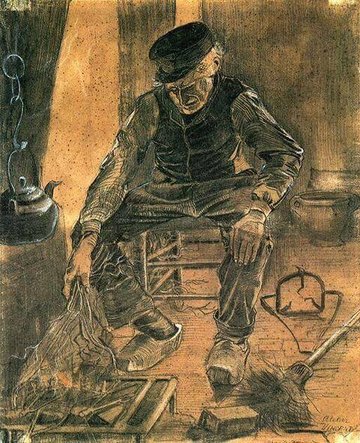
It was the design of Angelo Ricci and Joe Czanek and Manuel Silva to call on the Terrible Old Man. This old man dwells all alone in a very ancient house on Water Street near the sea, and is reputed to be both exceedingly rich and exceedingly feeble; which forms a situation very attractive to men of the profession of Messrs. Ricci, Czanek, and Silva, for that profession was nothing less dignified than robbery.
The inhabitants of Kingsport say and think many things about the Terrible Old Man which generally keep him safe from the attention of gentlemen like Mr. Ricci and his colleagues, despite the almost certain fact that he hides a fortune of indefinite magnitude somewhere about his musty and venerable abode. He is, in truth, a very strange person, believed to have been a captain of East India clipper ships in his day; so old that no one can remember when he was young, and so taciturn that few know his real name. Among the gnarled trees in the front yard of his aged and neglected place he maintains a strange collection of large stones, oddly grouped and painted so that they resemble the idols in some obscure Eastern temple. This collection frightens away most of the small boys who love to taunt the Terrible Old Man about his long white hair and beard, or to break the small-paned windows of his dwelling with wicked missiles; but there are other things which frighten the older and more curious folk who sometimes steal up to the house to peer in through the dusty panes. These folk say that on a table in a bare room on the ground floor are many peculiar bottles, in each a small piece of lead suspended pendulum-wise from a string. And they say that the Terrible Old Man talks to these bottles, addressing them by such names as Jack, Scar-Face, Long Tom, Spanish Joe, Peters, and Mate Ellis, and that whenever he speaks to a bottle the little lead pendulum within makes certain definite vibrations as if in answer.
Those who have watched the tall, lean, Terrible Old Man in these peculiar conversations, do not watch him again. But Angelo Ricci and Joe Czanek and Manuel Silva were not of Kingsport blood; they were of that new and heterogeneous alien stock which lies outside the charmed circle of New England life and traditions, and they saw in the Terrible Old Man merely a tottering, almost helpless grey-beard, who could not walk without the aid of his knotted cane, and whose thin, weak hands shook pitifully. They were really quite sorry in their way for the lonely, unpopular old fellow, whom everybody shunned, and at whom all the dogs barked singularly. But business is business, and to a robber whose soul is in his profession, there is a lure and a challenge about a very old and very feeble man who has no account at the bank, and who pays for his few necessities at the village store with Spanish gold and silver minted two centuries ago.
Messrs. Ricci, Czanek, and Silva selected the night of April 11th for their call. Mr. Ricci and Mr. Silva were to interview the poor old gentleman, whilst Mr. Czanek waited for them and their presumable metallic burden with a covered motor-car in Ship Street, by the gate in the tall rear wall of their hosts grounds. Desire to avoid needless explanations in case of unexpected police intrusions prompted these plans for a quiet and unostentatious departure.
As prearranged, the three adventurers started out separately in order to prevent any evil-minded suspicions afterward. Messrs. Ricci and Silva met in Water Street by the old man's front gate, and although they did not like the way the moon shone down upon the painted stones through the budding branches of the gnarled trees, they had more important things to think about than mere idle superstition. They feared it might be unpleasant work making the Terrible Old Man loquacious concerning his hoarded gold and silver, for aged sea-captains are notably stubborn and perverse. Still, he was very old and very feeble, and there were two visitors. Messrs. Ricci and Silva were experienced in the art of making unwilling persons voluble, and the screams of a weak and exceptionally venerable man can be easily muffled. So they moved up to the one lighted window and heard the Terrible Old Man talking childishly to his bottles with pendulums. Then they donned masks and knocked politely at the weather-stained oaken door.
Waiting seemed very long to Mr. Czanek as he fidgeted restlessly in the covered motor-car by the Terrible Old Man's back gate in Ship Street. He was more than ordinarily tender-hearted, and he did not like the hideous screams he had heard in the ancient house just after the hour appointed for the deed. Had he not told his colleagues to be as gentle as possible with the pathetic old sea-captain? Very nervously he watched that narrow oaken gate in the high and ivy-clad stone wall. Frequently he consulted his watch, and wondered at the delay. Had the old man died before revealing where his treasure was hidden, and had a thorough search become necessary? Mr. Czanek did not like to wait so long in the dark in such a place. Then he sensed a soft tread or tapping on the walk inside the gate, heard a gentle fumbling at the rusty latch, and saw the narrow, heavy door swing inward. And in the pallid glow of the single dim street-lamp he strained his eyes to see what his colleagues had brought out of that sinister house which loomed so close behind. But when he looked, he did not see what he had expected; for his colleagues were not there at all, but only the Terrible Old Man leaning quietly on his knotted cane and smiling hideously. Mr. Czanek had never before noticed the colour of that mans eyes; now he saw that they were yellow.
Little things make considerable excitement in little towns, which is the reason that Kingsport people talked all that spring and summer about the three unidentifiable bodies, horribly slashed as with many cutlasses, and horribly mangled as by the tread of many cruel boot-heels, which the tide washed in. And some people even spoke of things as trivial as the deserted motor-car found in Ship Street, or certain especially inhuman cries, probably of a stray animal or migratory bird, heard in the night by wakeful citizens. But in this idle village gossip the Terrible Old Man took no interest at all. He was by nature reserved, and when one is aged and feeble, one's reserve is doubly strong. Besides, so ancient a sea-captain must have witnessed scores of things much more stirring in the far-off days of his unremembered youth.
The Terrible Old Man also makes an appearance in Lovecraft's story The Strange High House in the Mist. This story is featured in Gothic Literature Study Guide and our collection of Short-Short Stories to read when you have five minutes to spare.
Frequently Asked Questions about The Terrible Old Man
What is "The Terrible Old Man" about?
The Terrible Old Man is a short story by about three robbers—Angelo Ricci, Joe Czanek, and Manuel Silva—who plan to steal a fortune from a mysterious, elderly former sea captain living alone in the fictional town of Kingsport. The old man is reputed to be fabulously wealthy, paying for goods with centuries-old Spanish gold, yet appears frail and helpless. When two of the robbers enter his house while the third waits in a getaway car, they discover too late that the old man is far more dangerous than he appears. Their mutilated bodies are later found washed ashore, “horribly slashed as with many cutlasses, and horribly mangled as by the tread of many cruel boot-heels.”
What are the mysterious bottles in "The Terrible Old Man"?
The Terrible Old Man keeps a collection of peculiar bottles on a table in a bare ground-floor room. Each bottle contains a small piece of lead suspended pendulum-wise from a string. He addresses these bottles by names such as Jack, Scar-Face, Long Tom, Spanish Joe, Peters, and Mate Ellis—names suggestive of former crewmates from his days as a sea captain. When he speaks to a bottle, the lead pendulum vibrates “as if in answer.” Scholar Carol S. Matthews has noted that these bottles are a reference to spirit bottles, a method of divination popular among spiritualists in ’s era, suggesting the old man has trapped the souls of his former crew.
What are the main themes of "The Terrible Old Man"?
The central themes of The Terrible Old Man include appearance versus reality, as the robbers fatally misjudge the frail-looking old man; supernatural justice, in which criminals who prey on the seemingly weak meet a gruesome comeuppance; and the dangers of underestimating the unknown. also explores the idea of the uncanny lurking within the mundane—the old man’s quiet life on Water Street conceals occult powers and a violent past. The story serves as an ironic parable: those who see only surface appearances pay the ultimate price for their arrogance.
Who is the Terrible Old Man and what are his supernatural powers?
The Terrible Old Man is an ancient, unnamed resident of Kingsport who is believed to have been a captain of East India clipper ships. He is so old that no one can remember when he was young, and so taciturn that few know his real name. His front yard contains large painted stones resembling Eastern temple idols, and he communicates with spirit bottles containing his former crewmates’ souls. His supernatural nature is confirmed at the story’s climax when the getaway driver sees the old man emerge with yellow eyes—a detail suggesting demonic or inhuman qualities. Critics have described him as a kind of necromancer who can reconstitute his dead crew into deadly physical form when threatened.
What literary devices does Lovecraft use in "The Terrible Old Man"?
employs several key literary devices in The Terrible Old Man. Dramatic irony pervades the narrative, as the reader understands the old man’s danger long before the robbers do. Foreshadowing appears in details like the spirit bottles, the idol-like stones, and the fact that townspeople who watch the old man’s conversations “do not watch him again.” The story uses an oblique narrative technique where all violence occurs offstage—we hear screams and see mutilated bodies but never witness the act itself. also uses understatement and a detached, ironic narrator in the style of Lord Dunsany and Ambrose Bierce, creating horror through implication rather than graphic description.
What happens to the three robbers in "The Terrible Old Man"?
The three robbers meet a grisly end. Angelo Ricci and Manuel Silva enter the old man’s house to force him to reveal his treasure, while Joe Czanek waits outside in a getaway car. Czanek hears hideous screams from inside the house. When the back gate finally opens, it is not his colleagues who emerge but the Terrible Old Man himself, leaning on his knotted cane and “smiling hideously” with yellow eyes. The townspeople of Kingsport later discover three unidentifiable bodies washed in by the tide, “horribly slashed as with many cutlasses, and horribly mangled as by the tread of many cruel boot-heels”—suggesting the old man’s spectral crew carried out the killings.
What is the significance of Kingsport in "The Terrible Old Man"?
The Terrible Old Man holds a special place in ’s fiction as the first story set in Kingsport, one of the fictional New England towns that would become central to the Cthulhu Mythos. Kingsport is loosely based on Marblehead, Massachusetts, a real coastal town whose colonial architecture and maritime history deeply impressed Lovecraft. In the story, Kingsport functions as an insular community with deep traditions and unspoken knowledge—the locals instinctively avoid the old man while outsiders, ignorant of local lore, walk into danger. Kingsport would later appear in stories such as The Festival and The Strange High House in the Mist.
When was "The Terrible Old Man" written and published?
wrote The Terrible Old Man on January 28, 1920, and it was first published in July 1921 in The Tryout, an amateur press publication. At only 1,142 words, it is one of Lovecraft’s shortest significant stories. Despite its brevity, critics consider it a pivotal work in his development because it marks his first use of a fictional New England setting and shows the influence of writers like Lord Dunsany and Ambrose Bierce in its restrained, ironic narrative style. The story would later be reprinted in the landmark 1939 collection The Outsider and Others published by Arkham House.
What is the role of the painted stones in "The Terrible Old Man"?
In the front yard of the Terrible Old Man’s house stand large stones, oddly grouped and painted so that they resemble “the idols in some obscure Eastern temple.” These stones serve multiple narrative functions. They foreshadow the old man’s connection to exotic and occult forces from his seafaring days in the East Indies. They also function as a protective barrier, frightening away the neighborhood boys who might otherwise torment him. Symbolically, the stones suggest the old man has brought back not just gold and silver from his voyages but also forbidden knowledge and dark rituals from distant lands. Along with the spirit bottles, they mark the house as a site where the boundary between the natural and supernatural has been erased.
How does "The Terrible Old Man" use irony?
The Terrible Old Man is saturated with dramatic irony. The robbers view the old man as “a tottering, almost helpless grey-beard” and feel “quite sorry” for him, while the reader already suspects he is far more dangerous than he appears. The narrator’s mock-polite language—referring to the robbers as “Messrs. Ricci, Czanek, and Silva” and calling robbery their “profession”—creates a tone of sardonic humor that undercuts any sympathy for them. The ultimate irony is that the robbers, who planned to make the old man “loquacious” through torture, become the victims themselves. ’s detached, wry narration ensures the reader understands the reversal long before it occurs, making the climax feel inevitable rather than shocking.
Save stories, build your reading list, and access all study tools — completely free.
Save The Terrible Old Man to your library — it's free!Need help with The Terrible Old Man?
Study tools to help with homework, prepare for quizzes, and deepen your understanding.
Flashcards →