The Brave Tin Soldier
by Hans Christian Andersen
This lesser-known Hans Christian Andersen story is also known as The Steadfast Tin Soldier.
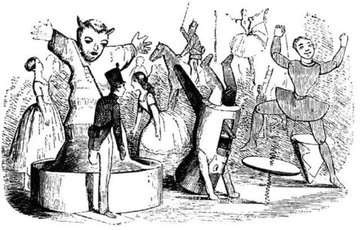
THERE were once five-and-twenty tin soldiers, who were all brothers, for they had been made out of the same old tin spoon. They shouldered arms and looked straight before them, and wore a splendid uniform, red and blue. The first thing in the world they ever heard were the words, "Tin soldiers!" uttered by a little boy, who clapped his hands with delight when the lid of the box, in which they lay, was taken off. They were given him for a birthday present, and he stood at the table to set them up. The soldiers were all exactly alike, excepting one, who had only one leg; he had been left to the last, and then there was not enough of the melted tin to finish him, so they made him to stand firmly on one leg, and this caused him to be very remarkable.
The table on which the tin soldiers stood, was covered with other playthings, but the most attractive to the eye was a pretty little paper castle. Through the small windows the rooms could be seen. In front of the castle a number of little trees surrounded a piece of looking-glass, which was intended to represent a transparent lake. Swans, made of wax, swam on the lake, and were reflected in it. All this was very pretty, but the prettiest of all was a tiny little lady, who stood at the open door of the castle; she, also, was made of paper, and she wore a dress of clear muslin, with a narrow blue ribbon over her shoulders just like a scarf. In front of these was fixed a glittering tinsel rose, as large as her whole face. The little lady was a dancer, and she stretched out both her arms, and raised one of her legs so high, that the tin soldier could not see it at all, and he thought that she, like himself, had only one leg. "That is the wife for me," he thought; "but she is too grand, and lives in a castle, while I have only a box to live in, five-and-twenty of us altogether, that is no place for her. Still I must try and make her acquaintance." Then he laid himself at full length on the table behind a snuff-box that stood upon it, so that he could peep at the little delicate lady, who continued to stand on one leg without losing her balance. When evening came, the other tin soldiers were all placed in the box, and the people of the house went to bed. Then the playthings began to have their own games together, to pay visits, to have sham fights, and to give balls. The tin soldiers rattled in their box; they wanted to get out and join the amusements, but they could not open the lid. The nut-crackers played at leap-frog, and the pencil jumped about the table. There was such a noise that the canary woke up and began to talk, and in poetry too. Only the tin soldier and the dancer remained in their places. She stood on tiptoe, with her legs stretched out, as firmly as he did on his one leg. He never took his eyes from her for even a moment. The clock struck twelve, and, with a bounce, up sprang the lid of the snuff-box; but, instead of snuff, there jumped up a little black goblin; for the snuff-box was a toy puzzle.
"Tin soldier," said the goblin, "don't wish for what does not belong to you."
But the tin soldier pretended not to hear.
"Very well; wait till to-morrow, then," said the goblin.
When the children came in the next morning, they placed the tin soldier in the window. Now, whether it was the goblin who did it, or the draught, is not known, but the window flew open, and out fell the tin soldier, heels over head, from the third story, into the street beneath. It was a terrible fall; for he came head downwards, his helmet and his bayonet stuck in between the flagstones, and his one leg up in the air. The servant maid and the little boy went down stairs directly to look for him; but he was nowhere to be seen, although once they nearly trod upon him. If he had called out, "Here I am," it would have been all right, but he was too proud to cry out for help while he wore a uniform.
Presently it began to rain, and the drops fell faster and faster, till there was a heavy shower. When it was over, two boys happened to pass by, and one of them said, "Look, there is a tin soldier. He ought to have a boat to sail in."
So they made a boat out of a newspaper, and placed the tin soldier in it, and sent him sailing down the gutter, while the two boys ran by the side of it, and clapped their hands. Good gracious, what large waves arose in that gutter! and how fast the stream rolled on! for the rain had been very heavy. The paper boat rocked up and down, and turned itself round sometimes so quickly that the tin soldier trembled; yet he remained firm; his countenance did not change; he looked straight before him, and shouldered his musket. Suddenly the boat shot under a bridge which formed a part of a drain, and then it was as dark as the tin soldier's box.
"Where am I going now?" thought he. "This is the black goblin's fault, I am sure. Ah, well, if the little lady were only here with me in the boat, I should not care for any darkness."
Suddenly there appeared a great water-rat, who lived in the drain.
"Have you a passport?" asked the rat, "give it to me at once." But the tin soldier remained silent and held his musket tighter than ever. The boat sailed on and the rat followed it. How he did gnash his teeth and cry out to the bits of wood and straw, "Stop him, stop him; he has not paid toll, and has not shown his pass." But the stream rushed on stronger and stronger. The tin soldier could already see daylight shining where the arch ended. Then he heard a roaring sound quite terrible enough to frighten the bravest man. At the end of the tunnel the drain fell into a large canal over a steep place, which made it as dangerous for him as a waterfall would be to us. He was too close to it to stop, so the boat rushed on, and the poor tin soldier could only hold himself as stiffly as possible, without moving an eyelid, to show that he was not afraid. The boat whirled round three or four times, and then filled with water to the very edge; nothing could save it from sinking. He now stood up to his neck in water, while deeper and deeper sank the boat, and the paper became soft and loose with the wet, till at last the water closed over the soldier's head. He thought of the elegant little dancer whom he should never see again, and the words of the song sounded in his ears- -
"Farewell, warrior! ever brave,
Drifting onward to thy grave." -
Then the paper boat fell to pieces, and the soldier sank into the water and immediately afterwards was swallowed up by a great fish. Oh how dark it was inside the fish! A great deal darker than in the tunnel, and narrower too, but the tin soldier continued firm, and lay at full length shouldering his musket. The fish swam to and fro, making the most wonderful movements, but at last he became quite still. After a while, a flash of lightning seemed to pass through him, and then the daylight approached, and a voice cried out, "I declare here is the tin soldier." The fish had been caught, taken to the market and sold to the cook, who took him into the kitchen and cut him open with a large knife. She picked up the soldier and held him by the waist between her finger and thumb, and carried him into the room. They were all anxious to see this wonderful soldier who had travelled about inside a fish; but he was not at all proud. They placed him on the table, and- how many curious things do happen in the world!- there he was in the very same room from the window of which he had fallen, there were the same children, the same playthings, standing on the table, and the pretty castle with the elegant little dancer at the door; she still balanced herself on one leg, and held up the other, so she was as firm as himself. It touched the tin soldier so much to see her that he almost wept tin tears, but he kept them back. He only looked at her and they both remained silent. Presently one of the little boys took up the tin soldier, and threw him into the stove. He had no reason for doing so, therefore it must have been the fault of the black goblin who lived in the snuff-box. The flames lighted up the tin soldier, as he stood, the heat was very terrible, but whether it proceeded from the real fire or from the fire of love he could not tell. Then he could see that the bright colors were faded from his uniform, but whether they had been washed off during his journey or from the effects of his sorrow, no one could say. He looked at the little lady, and she looked at him. He felt himself melting away, but he still remained firm with his gun on his shoulder. Suddenly the door of the room flew open and the draught of air caught up the little dancer, she fluttered like a sylph right into the stove by the side of the tin soldier, and was instantly in flames and was gone. The tin soldier melted down into a lump, and the next morning, when the maid servant took the ashes out of the stove, she found him in the shape of a little tin heart. But of the little dancer nothing remained but the tinsel rose, which was burnt black as a cinder. - -
THE END
Frequently Asked Questions about The Brave Tin Soldier
What is "The Brave Tin Soldier" about?
The Brave Tin Soldier (also known as "The Steadfast Tin Soldier") is a fairy tale by , first published in 1838. It tells the story of a one-legged tin soldier who falls in love with a paper ballerina he believes also has one leg (she is simply posed with one leg raised). A malicious goblin from a snuff-box warns the soldier away, and the next day the soldier falls from a window into the street. Two boys place him in a paper boat that sails down the gutter into a storm drain, where a rat demands his passport. The boat washes into a canal and the soldier is swallowed by a fish, which is caught and brought to the very same house. Reunited with the ballerina, he is inexplicably thrown into the stove by a child. A gust of wind blows the ballerina in after him. The next morning, the maid finds the soldier melted into the shape of a little tin heart, and all that remains of the dancer is her burnt tinsel rose.
What is the moral of "The Brave Tin Soldier"?
The primary moral is about steadfast devotion and loyalty in the face of adversity. No matter what befalls him — falling from a window, sailing through sewers, being swallowed by a fish, or being thrown into a fire — the tin soldier never wavers in his love for the paper ballerina or his dignity as a soldier. He stands firm, shoulders his musket, and faces each ordeal without complaint. However, the story also carries a more bittersweet lesson: that love and devotion do not guarantee a happy ending. The soldier and the ballerina are united only in death, making this one of 's most poignant explorations of the gap between love felt and love fulfilled. The tin heart that survives the fire is all that remains — devotion persists even when everything else is destroyed.
What are the main themes of "The Brave Tin Soldier"?
The central themes include steadfastness and resilience, unrequited or unfulfilled love, fate and the unpredictability of life, and the dignity of endurance. The soldier represents unwavering constancy — he faces every trial with silent courage and never abandons his love. The story also explores the cruelty of chance: the soldier's misfortunes are caused by random events (a goblin, a gust of wind, a child's whim) rather than any fault of his own. weaves in a theme of class and inadequacy — the soldier believes the ballerina is "too grand" for him, living in a castle while he shares a box with twenty-four brothers. This sense of social distance mirrors Andersen's own feelings about the women he admired but could never reach.
What does the tin heart symbolize at the end of the story?
The tin heart found in the ashes of the stove is the story's most powerful symbol. It represents the endurance of love beyond physical destruction. Everything else about the soldier — his uniform, his musket, his one-legged stance — has melted away, but his heart remains, suggesting that the essence of who he was is defined by his love. The heart is also a poignant contrast to the ballerina's remains: only her burnt tinsel rose survives, a decorative ornament rather than something vital. Some scholars read this as Andersen's comment that the capacity for deep feeling is the most indestructible part of a person, outlasting even death. The image has become one of the most iconic moments in Andersen's entire body of work.
How does "The Brave Tin Soldier" end?
The ending is both tragic and strangely beautiful. After his incredible journey, the tin soldier finds himself back on the same table, facing the same paper ballerina. But before anything can happen between them, one of the little boys picks up the soldier and throws him into the stove for no apparent reason — the narrator suggests it was "the fault of the black goblin who lived in the snuff-box." As the soldier melts in the flames, the door flies open and a draft catches the paper dancer, sending her fluttering "like a sylph right into the stove by the side of the tin soldier." She is instantly consumed. The next morning, the maid finds the soldier melted into the shape of a little tin heart, and all that remains of the ballerina is her tinsel rose, "burnt black as a cinder." They are united only in destruction.
Is "The Brave Tin Soldier" autobiographical?
Many scholars believe so. had a lifelong pattern of falling in love with women (and men) who did not or could not return his feelings, and the tin soldier's silent, unrequited devotion to the ballerina mirrors this painful personal theme. The soldier's sense that the dancer is "too grand" for him — she lives in a castle while he lives in a box — reflects Andersen's acute awareness of class differences and his feelings of inadequacy despite his growing fame. The story was first published in 1838, during a period when Andersen was experiencing romantic disappointments. Some also read the one-legged soldier as a symbol of Andersen's sense of being fundamentally different or incomplete compared to those around him — a theme that recurs throughout his fairy tales.
What literary devices does Andersen use in "The Brave Tin Soldier"?
employs several distinctive literary devices. Personification is central — the toys come alive at night, with the tin soldier experiencing love, fear, and courage. Irony pervades the story: the soldier believes the ballerina has one leg like him (she does not), and his epic journey ends not in triumph but in the stove. Symbolism enriches the narrative — the one leg represents difference and vulnerability, the goblin represents malice or fate, and the tin heart represents the indestructibility of love. Contrast operates between the soldier's stoic silence and the chaotic events around him. The narrator's tone also employs subtle romantic irony — the story is aware of its own romanticism and gently undercuts it, blending tenderness with a detached, almost fatalistic narrative voice.
Who is the goblin in "The Brave Tin Soldier"?
The goblin (or "black goblin") lives inside a snuff-box on the table and functions as the story's antagonist and agent of fate. He warns the tin soldier, "Don't wish for what does not belong to you," when he sees the soldier gazing at the paper ballerina. The goblin seems to set in motion the soldier's misfortunes — the narrator suggests it was either the goblin or a draft that caused the soldier to fall from the window, and at the end, the child's decision to throw the soldier in the stove is attributed to "the fault of the black goblin." The goblin can be interpreted as a symbol of malicious fate, jealousy, or the forces that prevent happiness. He represents the idea that some suffering has no rational cause — it is simply the cruelty of circumstance, personified as a spiteful little spirit.
When was "The Brave Tin Soldier" published?
The Brave Tin Soldier (originally titled Den standhaftige Tinsoldat) was first published on October 2, 1838, in Copenhagen as part of the first booklet of Fairy Tales Told for Children. It holds a special place in literary history as the first fairy tale Andersen wrote entirely from his own imagination, without any folktale source or literary model. This makes it a landmark in the development of the literary fairy tale as a genre. The story has been continuously in print since its publication and has been adapted into ballets, animated films, and picture books, with its image of the one-legged soldier and his tin heart becoming iconic symbols of devoted, unrequited love.
Save stories, build your reading list, and access all study tools — completely free.
Save The Brave Tin Soldier to your library — it's free!Need help with The Brave Tin Soldier?
Study tools to help with homework, prepare for quizzes, and deepen your understanding.
Flashcards →