The Princess and the Pea


Talk about a rigorous royalty identity test (one that mattress)! Hans Christian Andersen offers his literary tale about a young lady who must prove her worthiness to marry a prince. She could have simply offered, "I'll sleep on it." This classic fairytale was first published by Andersen in 1835.
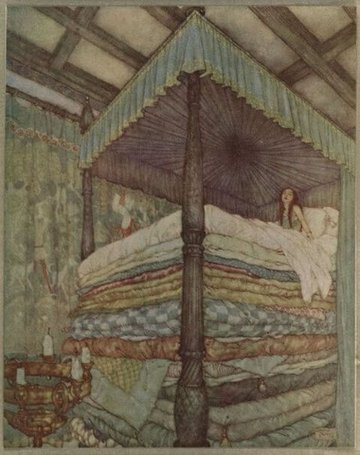
The Princess and the Pea by Hans Christian Andersen

ONCE upon a time there was a prince who wanted to marry a princess; but she would have to be a real princess. He travelled all over the world to find one, but nowhere could he get what he wanted. There were princesses enough, but it was difficult to find out whether they were real ones. There was always something about them that was not as it should be. So he came home again and was sad, for he would have liked very much to have a real princess.

One evening a terrible storm came on; there was thunder and lightning, and the rain poured down in torrents. Suddenly a knocking was heard at the city gate, and the old king went to open it.

It was a princess standing out there in front of the gate. But, good gracious! what a sight the rain and the wind had made her look. The water ran down from her hair and clothes; it ran down into the toes of her shoes and out again at the heels. And yet she said that she was a real princess.

Well, we'll soon find that out, thought the old queen. But she said nothing, went into the bed-room, took all the bedding off the bedstead, and laid a pea on the bottom; then she took twenty mattresses and laid them on the pea, and then twenty eider-down beds on top of the mattresses.

On this the princess had to lie all night. In the morning she was asked how she had slept.

Oh, very badly! said she. I have scarcely closed my eyes all night. Heaven only knows what was in the bed, but I was lying on something hard, so that I am black and blue all over my body. It's horrible!

Now they knew that she was a real princess because she had felt the pea right through the twenty mattresses and the twenty eider-down beds.

Nobody but a real princess could be as sensitive as that.

So the prince took her for his wife, for now he knew that he had a real princess; and the pea was put in the museum, where it may still be seen, if no one has stolen it.

There, that is a true story.


The Princess and the Pea was featured as The Short Story of the Day on Sun, May 08, 2022

Frequently Asked Questions about The Princess and the Pea

What is the summary of "The Princess and the Pea" by Hans Christian Andersen?

A prince searches the world for a real princess to marry but cannot verify that any candidate is genuine. One stormy night, a drenched young woman arrives at the city gate claiming to be a princess. The old queen secretly places a single pea beneath twenty mattresses and twenty eider-down beds. After a sleepless night, the young woman complains of lying on something hard, proving her extraordinary sensitivity and confirming she is a real princess. The prince marries her and the pea is placed in a museum.

What is the moral of "The Princess and the Pea"?

The most common interpretation is that true worth cannot be judged by outward appearances alone. The princess arrives looking bedraggled from the storm, yet her inner sensitivity reveals her authentic nobility. Andersen himself suggested that the sensitivity in the story represents emotional compassion rather than mere physical delicacy, implying that a true leader must be attuned to the feelings and needs of others. Some scholars also read the tale as a gentle satire of aristocratic pretensions.

What does the pea symbolize in "The Princess and the Pea"?

The pea is a multifaceted symbol in the story. On a literal level it is a test of physical sensitivity, but symbolically it represents a hidden truth that cannot be concealed no matter how many layers of comfort are piled on top of it. The twenty mattresses and twenty eider-down beds can be read as the material trappings that society uses to mask or soften uncomfortable realities. Only someone with genuine depth of feeling can perceive what lies beneath the surface.

Why does the queen test the princess and not the king or prince?

The old queen devises and conducts the pea test entirely on her own initiative, reflecting a common fairy tale motif in which the older female figure serves as gatekeeper of domestic and dynastic matters. The queen says nothing about her plan to anyone, suggesting that she possesses the shrewdness and practical wisdom the prince lacks. Her role highlights the theme that recognizing true character requires experience and discernment rather than romantic longing.

When was "The Princess and the Pea" written and why is it so famous?

Hans Christian Andersen first published the tale on May 8, 1835, in Copenhagen as part of his debut collection of fairy tales. Despite being one of the shortest fairy tales ever written, it became one of the most widely recognized stories in Western literature. Its fame stems from its memorable central image, its adaptability to different interpretations, and the 1959 Broadway musical "Once Upon a Mattress," which brought the story to an even larger audience.

Where can I read more fairy tales by Hans Christian Andersen?

You can read many more Hans Christian Andersen fairy tales here on American Literature, including "The Ugly Duckling," about a misfit bird who discovers he is a beautiful swan; "The Little Match Girl," a poignant winter tale about a poor child's final visions; and "The Emperor's New Clothes," a timeless satire about vanity and the fear of speaking truth to power. All of these stories are available to read for free in our Hans Christian Andersen collection.

Save stories, build your reading list, and access all study tools โ€” completely free.

Save The Princess and the Pea to your library โ€” it's free!

Need help with The Princess and the Pea?

Study tools to help with homework, prepare for quizzes, and deepen your understanding.

Flashcards โ†’