A Requiem
by Herman Melville
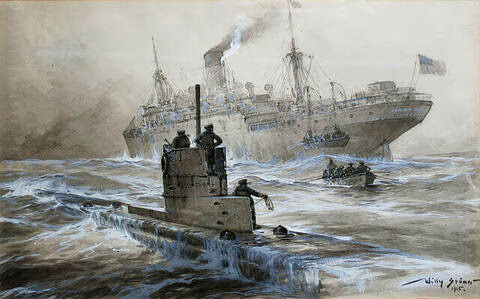
For Soldiers Lost in Ocean Transports!

When, after storms that woodlands rue,
  To valleys comes atoning dawn,
The robins blithe their orchard-sports renew;
  And meadow-larks, no more withdrawn
Caroling fly in the languid blue;
The while, from many a hid recess,
Alert to partake the blessedness,
The pouring mites their airy dance pursue.
  So, after ocean's ghastly gales,
When laughing light of hoyden morning
    breaks,
      Every finny hider wakes—
  From vaults profound swims up with
    glittering scales;
  Through the delightsome sea he sails,
With shoals of shining tiny things
Frolic on every wave that flings
  Against the prow its showery spray;
All creatures joying in the morn,
Save them forever from joyance torn,
  Whose bark was lost where now the
    dolphins play;
Save them that by the fabled shore,
  Down the pale stream are washed away,
Far to the reef of bones are borne;
  And never revisits them the light,
Nor sight of long-sought land and pilot more;
  Nor heed they now the lone bird's flight
Round the lone spar where mid-sea surges
    pour.
Frequently Asked Questions
What is "A Requiem" by Herman Melville about?
A Requiem, subtitled For Soldiers Lost in Ocean Transports, is a Civil War elegy mourning Union soldiers who drowned when their transport ships were lost at sea. The poem builds an extended contrast between nature's joyful renewal after storms—robins singing, meadow-larks caroling, fish leaping through sunlit waves—and the permanent silence of the dead, who are "forever from joyance torn." While every creature in the sea and sky celebrates the return of calm weather, the drowned soldiers are carried "far to the reef of bones" where light never reaches them and they will never see land or a guiding pilot again. The poem closes with the haunting image of a lone bird circling a lone spar—the only remnant of a sunken ship—amid mid-ocean surges.
What collection is "A Requiem" from?
A Requiem was published in 's Battle-Pieces and Aspects of the War (1866), his first collection of poetry. The book contains 72 poems addressing the battles, personalities, and moral complexities of the American Civil War, and is dedicated "To the Memory of the Three Hundred Thousand Who in the War for the Maintenance of the Union Fell Devotedly Under the Flag of Their Country." Battle-Pieces was published by Harper & Brothers in New York one year after the war ended. While Melville is far better known for his prose—particularly Moby-Dick—his Civil War poetry is highly regarded for its refusal to glorify battle and its unflinching attention to the human cost of war.
What literary devices does Melville use in "A Requiem"?
The poem's most powerful device is contrast (or antithesis): the entire structure pivots on the difference between nature's exuberant recovery after storms and the permanent loss of the drowned soldiers. Imagery is vivid and sensory—robins in orchards, meadow-larks in "languid blue" sky, fish swimming up "with glittering scales"—creating a world of light and motion that makes the soldiers' absence more devastating. employs personification in describing waves that fling "showery spray" against the prow and creatures "joying in the morn." The repeated word "Save" (meaning "except for") creates an anaphoric pivot, turning from celebration to elegy. Classical allusion appears in "the fabled shore" and "the pale stream," evoking the River Styx of Greek mythology. The final image—a lone bird circling a "lone spar"—functions as a powerful symbol of solitary mourning over an unmarked grave.
What is the historical context of "A Requiem" by Melville?
During the American Civil War, thousands of Union soldiers were transported by ship along the Atlantic coast and on rivers. Several transport vessels were lost to storms, Confederate attacks, and other disasters. Notable incidents include the sinking of the Governor off Cape Hatteras in 1861 and the loss of the Maple Leaf to a mine in 1864. These maritime casualties were often overshadowed by the massive land battles, and the soldiers who drowned left no battlefield graves or monuments. , who had extensive maritime experience from his years as a sailor and whaler, was particularly attuned to the horror of death at sea. A Requiem serves as a memorial for these forgotten dead—soldiers whose bodies were never recovered and whose loss went largely unrecognized. The poem is part of Melville's broader effort in Battle-Pieces to honor all dimensions of the war's human cost.
What are the themes of "A Requiem" by Melville?
The poem explores several interconnected themes. Nature's indifference to human suffering is the most prominent: after the storm that sinks the soldiers' ship, the natural world resumes its joyful cycles without any acknowledgment of the dead. The anonymity of war's victims is central—unlike soldiers who fall on named battlefields, these drowned men have no graves, no monuments, and no one to witness their fate. The poem also meditates on the sea as both giver and taker of life: the same ocean that teems with "shining tiny things" and frolicking dolphins holds the soldiers' bones on a deep reef. The impossibility of proper mourning haunts the poem—a requiem is a mass for the dead, but these soldiers have no church, no congregation, only a lone bird circling a solitary spar. This absence of ritual makes the poem itself the only memorial they receive.
What does "the reef of bones" mean in "A Requiem"?
The phrase "the reef of bones" is one of the poem's most striking images, referring to the ocean floor where the drowned soldiers' remains have come to rest. It evokes a coral reef composed not of living organisms but of human skeletons—a grim underwater graveyard far beneath the sunlit surface where dolphins play. The image carries multiple resonances: it suggests the accumulation of maritime deaths over centuries, as if the ocean floor is paved with the bones of the lost. It also echoes classical and biblical traditions of the sea as a place of the dead—the preceding line references "the fabled shore" and "the pale stream," alluding to the River Styx and the underworld of Greek mythology. By placing the soldiers' bones on a reef—a permanent, geological formation— suggests that their deaths are woven into the very structure of the natural world, permanent yet invisible.
Want to save this story?
Create a free account to build your personal library of favorite stories
Sign Up - It's Free!Already have an account? Log in